Longines Lindbergh Hour Angle Watch: Celestial Navigation on the Wrist
The Longines Lindbergh Hour Angle Watch is one of the few watches in history that was genuinely designed to solve a navigation problem — not inspired by aviation aesthetics, but engineered as an instrument for a specific computational task. The task was determining the Greenwich Hour Angle of the sun or a celestial body during flight, enabling a pilot to establish longitude without ground-based radio. The watch was the result of a direct collaboration between Charles Lindbergh and Longines, developed with the navigation system of Philip Van Horn Weems. It appeared in 1931, four years after Lindbergh's transatlantic flight, and remains in production as a heritage reissue today.
Photo: Eric Long / NASM, Smithsonian — CC0 1.0 — Wikimedia Commons
The 1927 Transatlantic Flight
Photo: Missouri Historical Society — Public Domain — Wikimedia Commons
On 20–21 May 1927 , Charles Lindbergh completed the first solo nonstop transatlantic flight from New York to Paris in the Spirit of St. Louis — a journey of approximately 33.5 hours. Longines served as the official FAI (Fédération Aéronautique Internationale) timekeeper for the flight.
The timing of the flight established Longines' association with Lindbergh personally and with aviation achievement broadly. The brand had been producing precision instruments for competitive timekeeping, science, and exploration since the 1870s; the Lindbergh flight was the most celebrated precision achievement of the era, and the timing relationship was not incidental. Longines instruments were used because they were trusted for accuracy in conditions where error had consequences.
The relationship forged in 1927 led, four years later, to the watch collaboration.
The Hour Angle Watch — 1931
Photo: KRaikkonen01 — CC BY-SA 4.0 — Wikimedia Commons
In 1931 , Charles Lindbergh and Philip Van Horn Weems — a US Navy navigator who had developed the Weems system of aerial navigation — collaborated with Longines to produce the Hour Angle Watch .
The navigation problem it solved: in the era before GPS and reliable long-range radio, an aviator at sea over the Atlantic could establish latitude using a sextant to measure the altitude of the sun or a star above the horizon. But establishing longitude required knowing the Greenwich Hour Angle — the angle between the Greenwich meridian and the celestial body's position at the moment of observation. This required knowing exact Greenwich Mean Time.
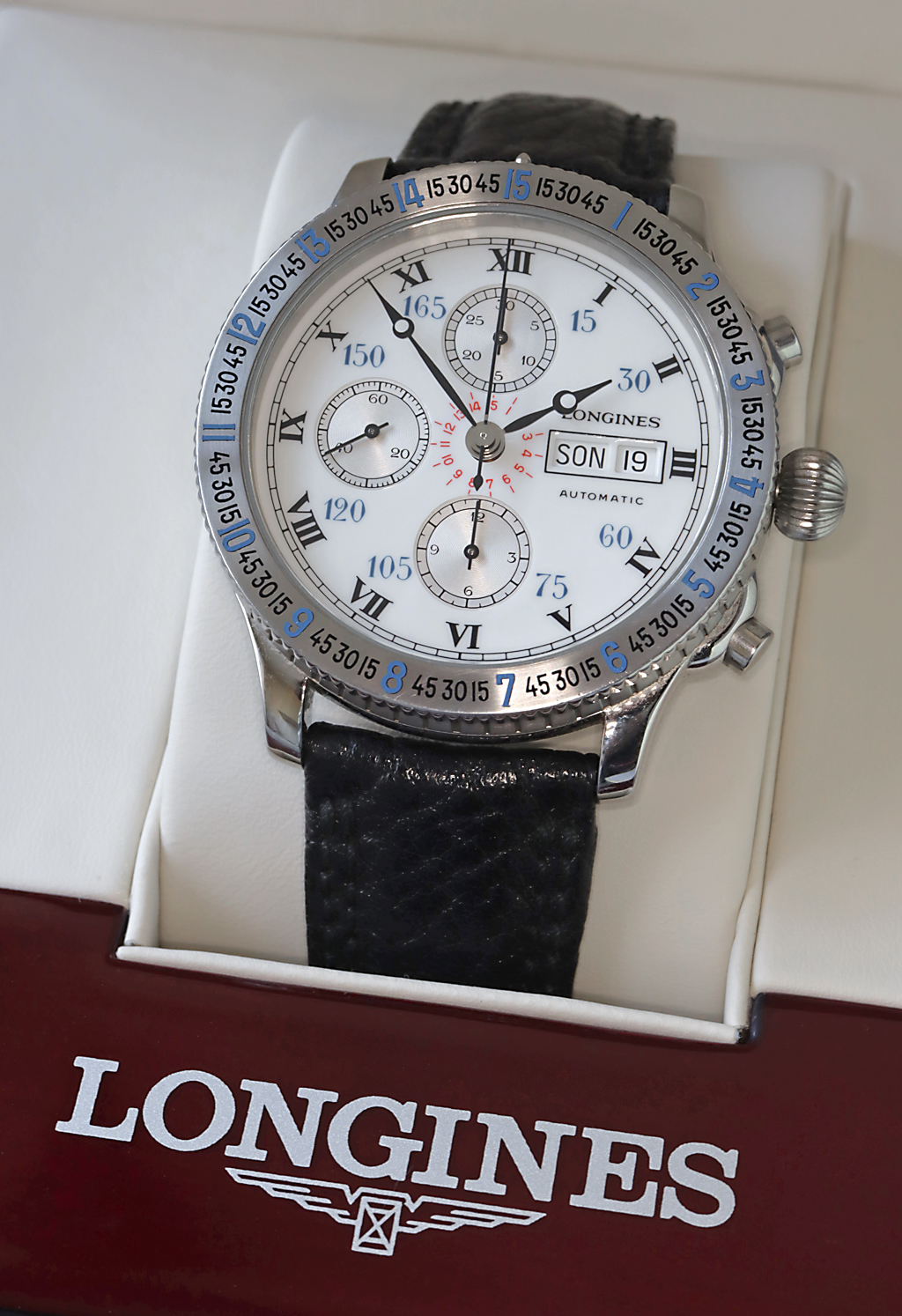
The Hour Angle Watch addressed this with a distinctive dial architecture:
- A rotating central dial marked in seconds (0–60) that could be synchronised to a radio time signal
- An outer bezel graduated in degrees, minutes, and seconds of arc, representing the hour angle scale
- The combination allowed the pilot to read Greenwich Hour Angle directly from the watch dial after celestial observation
The original 1931 Hour Angle Watch was produced in a case of 47.5mm sterling silver — large by any measure, sized for cockpit visibility in gloves and flight conditions. The movement was the Calibre 18.69 N.S.C. Production was approximately 2,000 pieces .
The watch was genuinely used as a navigation instrument, not merely worn as a badge of aviation association. Lindbergh tested and refined the design; Weems contributed the computational logic; Longines produced the movement and case to specification.
Photo: Minzoblate — CC BY-SA 4.0 — Wikimedia Commons
Modern Reissues
Photo: Minzoblate — CC BY-SA 4.0 — Wikimedia Commons
Longines has produced several Lindbergh Hour Angle reissues:
| Year | Description |
|---|---|
| 1987 | 38mm reissue — 60th anniversary of the 1927 flight; Calibre L989.2 |
| 1988 | 47.5mm reissue — limited to 1,000 pieces; reproduction of the original proportions |
| 2012 | Contemporary reissue — Reference L2.678.4.11.0 |
| 2017 | 47.5mm titanium — limited to 90 pieces; 90th anniversary of the transatlantic flight |
The 1987 38mm reissue adapted the original's dial logic to a more wearable proportion, powered by the Calibre L989.2. The 1988 47.5mm reissue reproduced the original's proportions for collectors who wanted the authentic scale. The 2017 titanium edition — 90 pieces for the 90th anniversary — used lightweight titanium to make the original 47.5mm diameter more practically wearable.
All reissues maintain the core functional elements: the rotating central seconds dial and the graduated outer bezel. Whether the navigation function remains practically useful in the GPS era is secondary; the reissues exist as historical and horological objects, not as working navigation tools for contemporary aviators.
Significance
Photo: Longines183 — CC BY-SA 4.0 — Wikimedia Commons
The Lindbergh Hour Angle Watch occupies a category that few watches can claim: it was designed for a real task, by a real person who needed it, in collaboration with watchmakers who could build it. The brief was not "make a watch that looks like aviation." The brief was "make a watch that solves this specific navigation problem."
That specificity is what distinguishes it from the broader category of aviation-inspired watches. The Lindbergh Hour Angle Watch is, in the most literal sense, an instrument.
Frequently Asked Questions
What was Longines' role in Lindbergh's 1927 flight?
Longines served as official FAI timekeeper for the New York–Paris transatlantic flight on 20–21 May 1927.
What does the Hour Angle Watch actually do?
It allows a pilot to determine the Greenwich Hour Angle of a celestial body — enabling longitude calculation by celestial navigation. A rotating central seconds dial can be synchronised to a radio time signal; an outer bezel graduated in degrees of arc provides the hour angle reading.
When was the original Hour Angle Watch produced?
1931. It was 47.5mm sterling silver, powered by Calibre 18.69 N.S.C., in an edition of approximately 2,000 pieces.
Are modern Lindbergh watches still functional navigation instruments?
The functional elements — rotating seconds dial, graduated bezel — are present in all reissues, but the watches are produced today as heritage objects. GPS has made the celestial navigation system they support effectively obsolete for practical aviation.