Doxa SUB 200 T.Graph: History of the 1969 Dive Chronograph
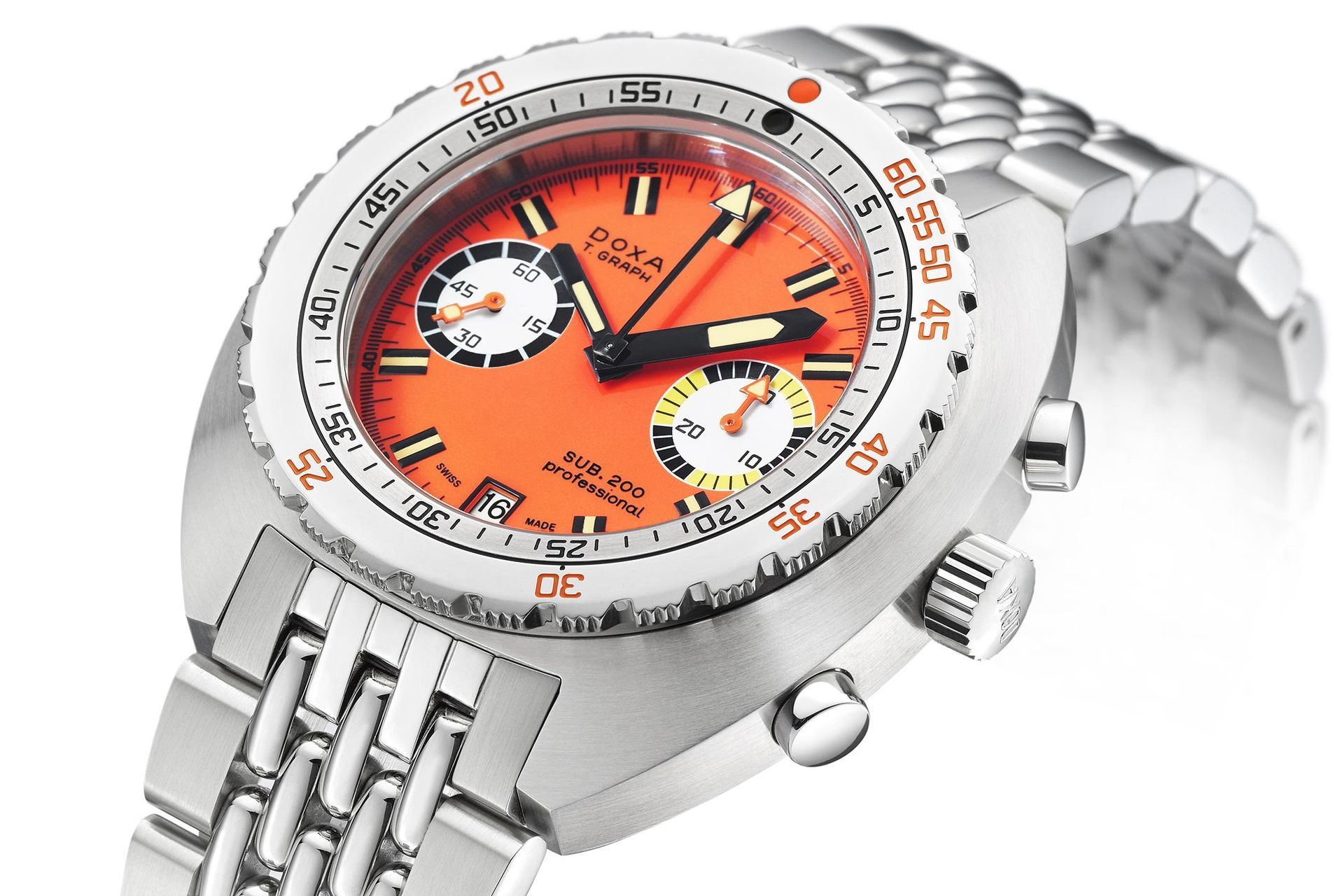
The Doxa SUB 200 T.Graph of 1969 is one of the rarest dive chronographs ever produced and one of the most misunderstood. It is not, strictly speaking, a dive watch with a chronograph added as a complication in the luxury tradition. It is a professional dive instrument that extended its timing capability beyond the rotating bezel — a watch that allowed a diver to time a surface interval with the pusher-activated chronograph without disturbing the no-decompression bezel setting from the preceding dive. That specific functional logic, combined with a hand-wound column-wheel chronograph movement sealed to 200 metres of water resistance, makes the T.Graph historically important in a way its rarity alone does not fully explain.
Fewer than 1,000 examples survive across all colorways. The originals are among the most actively collected vintage dive watches of the 1960s–70s era. The model returned in limited form for its 50th anniversary in 2019, sold out immediately, and was revived again in 2026 as a permanent collection member — the T.Graph II. That three-generation arc, spanning 57 years, is a measure of how much the design means to the people who care about Doxa.
The Engineering Problem: Sealing a Chronograph to 200 Metres
A standard dive watch of the 1960s had one crown: the winding and setting crown, sealed against the case by a gasket and secured by a screw-down system. Every penetration of the case — every hole drilled through the case wall for a stem or pusher — is a potential point of water ingress. Sealing one crown to 200 metres was achievable with proven gasket technology. Sealing a crown plus two chronograph pushers to 200 metres — three penetrations through the case instead of one — required substantially more engineering and substantially more commitment to quality control.
Most watch manufacturers of the period did not bother. The few who produced chronographs with dive credentials generally settled for 50 or 100 metres, enough for casual water contact but not professional diving. Doxa sealed the T.Graph's case to a full 200 metres — the same depth rating as the base SUB 200 — while maintaining a functional chronograph. This is why the original T.Graph commands the prices it does.
The Eberhard Column-Wheel Movement
The original T.Graph ran on a hand-wound Eberhard Calibre 310-82 , rebadged internally as the Doxa Calibre 287. The movement was supplied to Doxa through the Synchron Group, which then owned Eberhard and maintained relationships with select partner brands. The 310-82 used a column-wheel chronograph mechanism — a construction in which a ratchet wheel with vertical columns controls the start, stop, and reset functions of the chronograph train. Column-wheel chronographs are generally considered superior to the simpler cam-and-lever (coulisse) systems that dominated later Swiss chronograph production: the column wheel provides smoother actuation, more precise timing, and a more positive feel at the pushers.
Some research into the period identifies the Eberhard 310-82 as the last original wristwatch chronograph design of the 1960s–70s era to use a column-wheel mechanism in a new calibre — making it not just a good movement but a historically notable one. The hand-wound architecture kept the overall movement profile slim enough to fit within the T.Graph's sealed case, a packaging constraint that an automatic calibre of the period would have made significantly more difficult.
Production Numbers and Rarity
The Doxa SUB 200 T.Graph was produced in the four standard Doxa colorways — Professional (orange), Sharkhunter (black), and Searambler (silver), with estimates of approximately 300 pieces per colorway. Total production across the 1969–1983 period before Doxa's dormancy is estimated at under 1,000 units across all variants. The production figures have never been officially confirmed by the brand; the 300-per-color estimate comes from dealer and collector research rather than factory records.
Original T.Graphs are rare in absolute terms and rarer still in good condition. The watches were designed for professional use — diving, sailing, commercial water work — and examples that have seen genuine service show it. A T.Graph in unmolested condition, with original pushers, crown, and crystal, commands significant premiums. Prices for documented examples have reached and exceeded USD 8,000–15,000, depending on colorway and condition. The orange Professional variants attract the highest prices, partly for their historical resonance with the Cousteau era.
The 2019 50th Anniversary Reissue
In 2019, Doxa marked the 50th anniversary of the original T.Graph with a limited reissue: 300 pieces in stainless steel and 13 pieces in solid gold . The reissue used vintage-specification Valjoux 7734 movements — hand-wound column-wheel chronograph calibres that the Jenny family had carefully preserved in new-old-stock condition for over three decades since the brand's 1983 dormancy. The result was an anniversary watch built with the same type of movement as the original, at a modern price of EUR 4,900 for the steel version.
The reissue sold out rapidly and immediately entered the secondary market above retail. It demonstrated, conclusively, that collector demand for the T.Graph concept was not nostalgic sentiment but active purchasing power. The Valjoux 7734 stocks were finite, which meant the 2019 edition could not be continued — but the demand it proved existed created the commercial case for the 2026 T.Graph II.
The 2026 T.Graph II: Permanent Production
The Doxa SUB 200 T.Graph II, launched in June 2026, is the permanent-collection answer to the 2019 limited edition. It uses the Sellita SW510 automatic chronograph — a cam-and-lever mechanism rather than the column-wheel of the originals, a practical concession to what is achievable at the EUR 3,950 / USD 4,250 price point in permanent production. The case shrinks modestly from 43mm to 42mm and refines from 15.15mm to 14.6mm thickness. The colorway system expands from three to four with the addition of Caribbean navy blue.
The T.Graph II is the most accessible route into the T.Graph story, and its permanent collection status means it will build its own collector cohort over time. Whether it eventually commands the same resonance as the 1969 original depends on what collectors in 2050 decide the 2026 model means — a question no one can answer now, but one that the original T.Graph's trajectory suggests is worth asking.
| Version | Year | Movement | Pieces | Price (at launch) |
|---|---|---|---|---|
| Original | 1969–1983 | Eberhard 310-82, column-wheel, hand-wound | ~300/color | Retail price of the era |
| 50th Anniversary | 2019 | Valjoux 7734, column-wheel, hand-wound | 300 steel + 13 gold | EUR 4,900 (steel) |
| T.Graph II | 2026–present | Sellita SW510, cam-lever, automatic | Unlimited (permanent) | EUR 3,950 / USD 4,250 |
Original (1969): ~43mm case, hand-wound Eberhard 310-82, 200m WR, three colorways, ~300/color produced
2019 Reissue: Valjoux 7734, 300 steel + 13 gold pieces, EUR 4,900 steel, sold out
T.Graph II (2026): 42mm, Sellita SW510 automatic, 28,800 vph, 56-hour PR, EUR 3,950 / USD 4,250, four colorways, permanent
Frequently Asked Questions
How rare is the original Doxa SUB 200 T.Graph?
Approximately 300 pieces per colorway were produced between 1969 and Doxa's 1983 dormancy — roughly 900 total across all three original colorways (Professional orange, Sharkhunter black, Searambler silver). Original examples in good condition are actively sought by collectors and trade at significant premiums, with documented examples reaching USD 8,000–15,000+.
What movement does the original T.Graph use?
The Eberhard Calibre 310-82, rebadged as Doxa Calibre 287 — a hand-wound column-wheel chronograph supplied through Eberhard's relationship with the Synchron Group. The column-wheel mechanism is considered superior to the cam-and-lever systems that dominated later production, and the 310-82 is identified by some researchers as the last original wristwatch column-wheel chronograph design of the 1960s–70s era.
What is the difference between the 2019 reissue and the 2026 T.Graph II?
The 2019 reissue used new-old-stock Valjoux 7734 hand-wound column-wheel movements preserved from the original era, was limited to 313 pieces total, and sold for EUR 4,900 in steel. The 2026 T.Graph II uses a Sellita SW510 automatic cam-lever chronograph, is a permanent collection member with no production limit, and costs EUR 3,950 / USD 4,250. The 2019 is the more historically authentic; the 2026 is more wearable and accessible.
Sources: Doxa Watches (doxawatches.com), Monochrome Watches, Fratello Watches, aBlogtoWatch, Analog:Shift, The Hour Markers.