Doxa SUB 300T: The First Commercial Dive Watch with a Helium Escape Valve
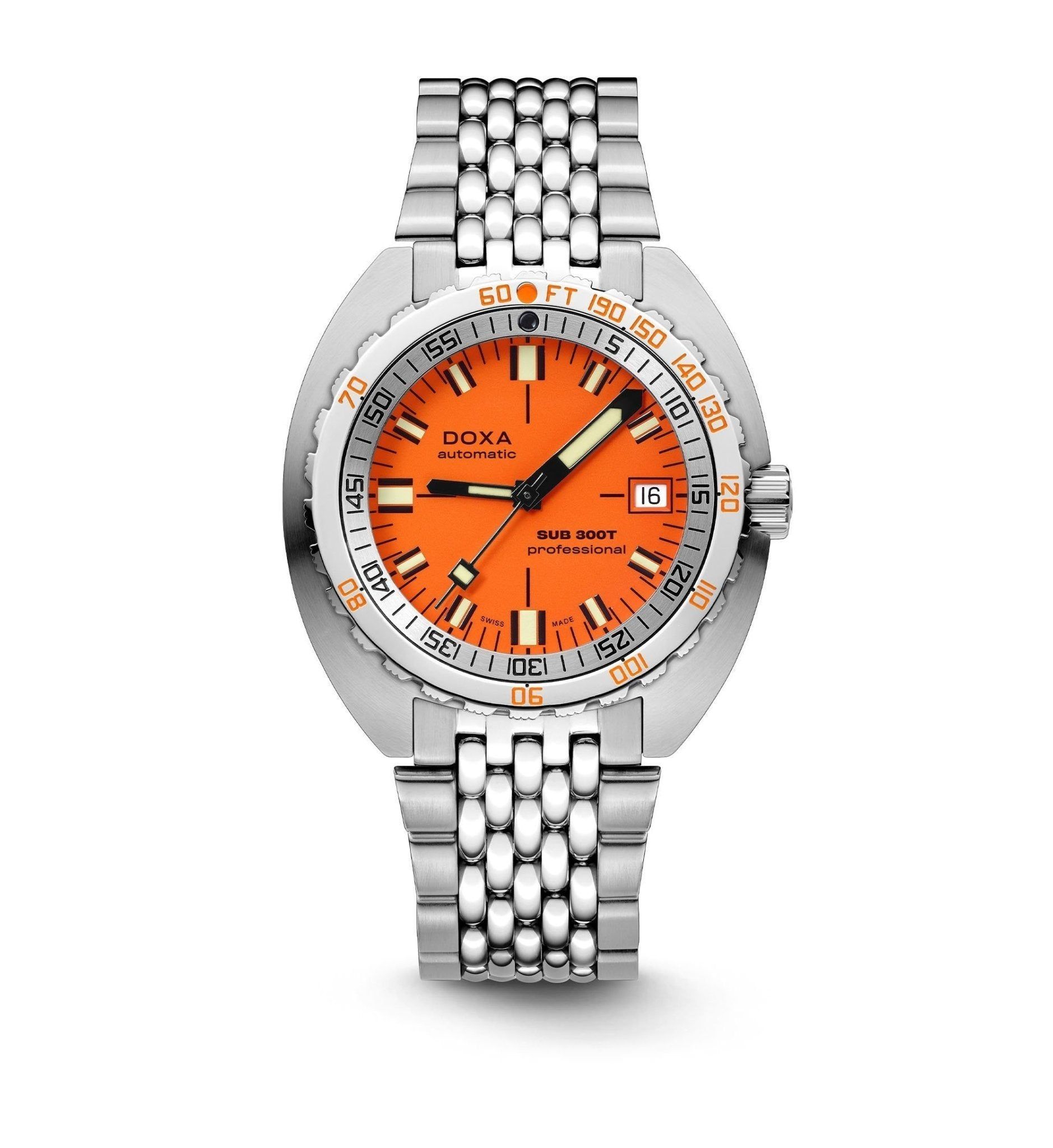
The Doxa SUB 300T — the "T" standing for Taucher , the German word for diver — holds a specific and documented place in dive watch history: it was the first commercially available dive watch equipped with a helium release valve . The original SUB 300T Conquistador , released in 1968–1969, solved a problem that had been quietly killing watches — and potentially endangering divers — during saturation diving operations: the catastrophic crystal failure caused by trapped helium expanding during decompression. Doxa engineered and integrated a one-way helium escape valve before Rolex brought its version of the technology to the consumer market with the Sea-Dweller in 1971–1972.
That historical priority is not a footnote. The helium release valve addresses a genuine engineering challenge specific to saturation diving — the most extreme form of commercial diving, where workers spend days or weeks living in a pressurized environment at depth, breathing a helium-oxygen gas mixture. The molecular size of helium allows it to penetrate even water-tight watch seals over extended exposure periods. When the diver's habitat is depressurized, the helium trapped inside the watch expands rapidly — and if it cannot escape, it can blow the crystal off the case with enough force to injure. Doxa's solution, the Helium Release Valve (HRV), vents the helium safely during ascent. The modern SUB 300T, revived in September 2019, carries this valve and its history into current production.
The SUB 300T Conquistador: 1968–1969
The original Conquistador name marked Doxa's intent clearly — this was not a recreational diver's watch but a professional tool for the underwater frontier. When the SUB 300T launched commercially in 1968, professional diving was a growth industry: offshore oil and gas exploration, military diving programs, and scientific research were all driving demand for equipment that could function at depths and durations beyond recreational diving.
The SUB 300T addressed the specific requirements of saturation diving — also called "sat diving" — where a team of commercial divers lives for extended periods in a pressurized habitat (a diving bell or underwater habitat) at the pressure of the target working depth. The watches those divers wore needed to withstand not just pressure at depth but the cumulative effect of a helium-rich breathing environment over days or weeks. The Conquistador was built to those requirements.
The helium valve co-development between Doxa and Rolex during this period is documented in horological research. Both companies recognized the problem simultaneously and developed valve solutions; Doxa brought theirs to market first through the Conquistador, and Rolex followed with the Sea-Dweller. The precise terms of any co-development arrangement have not been fully disclosed by either company, but the chronology gives Doxa clear first-to-market status.
The 2019 Revival: September Relaunch
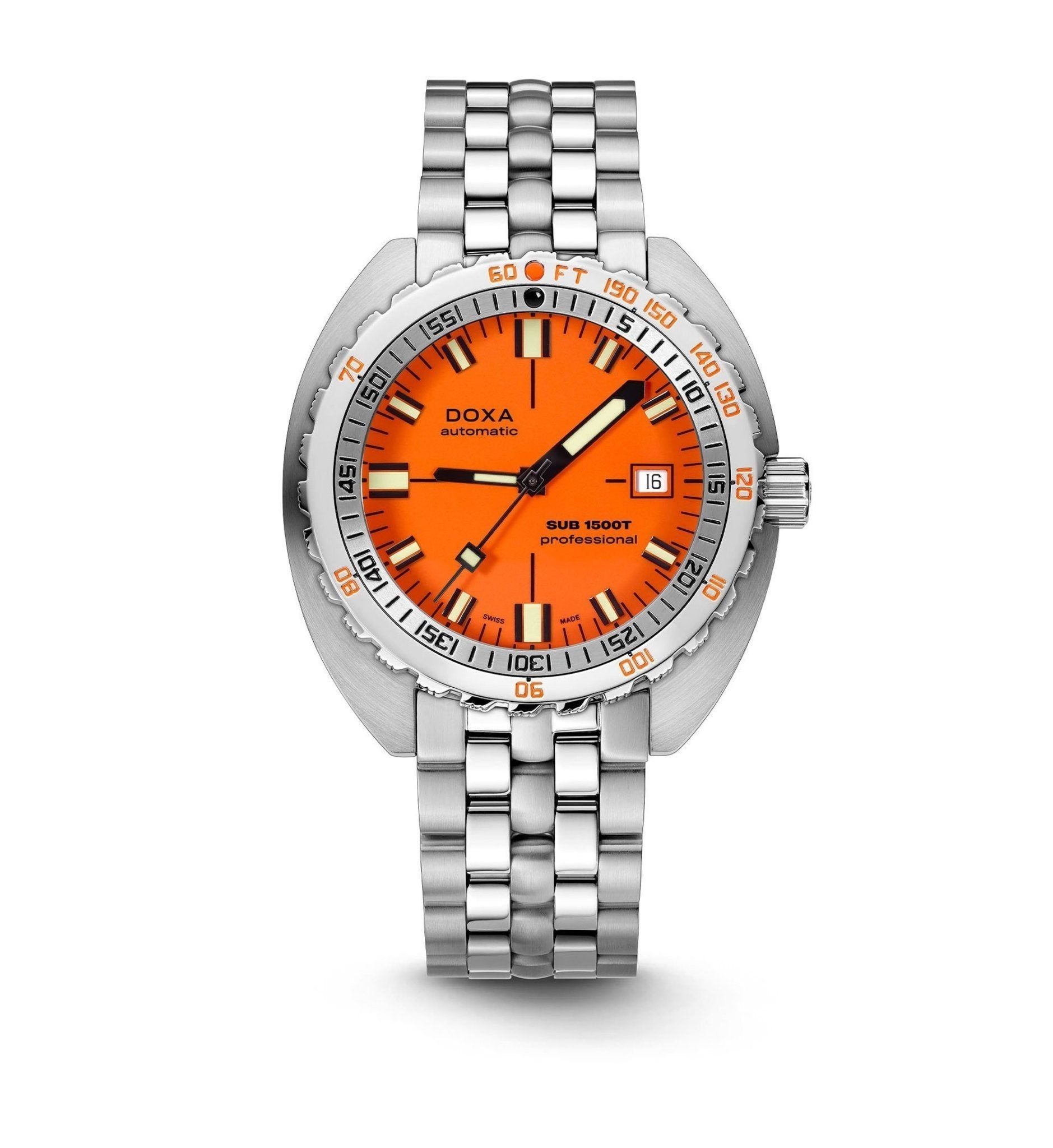
Doxa's modern SUB 300T arrived in September 2019, marking the Conquistador's 50th anniversary. The revival retained the essential design language of the original — the cushion-inflected SUB case, the no-decompression bezel, the four-colorway system — while updating the specifications to contemporary standards. The stainless steel case measures 42.5mm in diameter (45mm lug-to-lug), runs to 1,200 metres of water resistance (120 ATM), and retains the signature helium release valve that makes this model historically significant.
The movement is the Sellita SW200-1 automatic, beating at 28,800 vph with a 38-hour power reserve. Unlike the SUB 300 Professional, the SUB 300T is not COSC chronometer-certified — a pragmatic choice for a professional tool watch where robust serviceability matters more than COSC paperwork. The crystal is flat rather than the domed sapphire of the SUB 200 and SUB 300, providing a more rugged profile for working use.
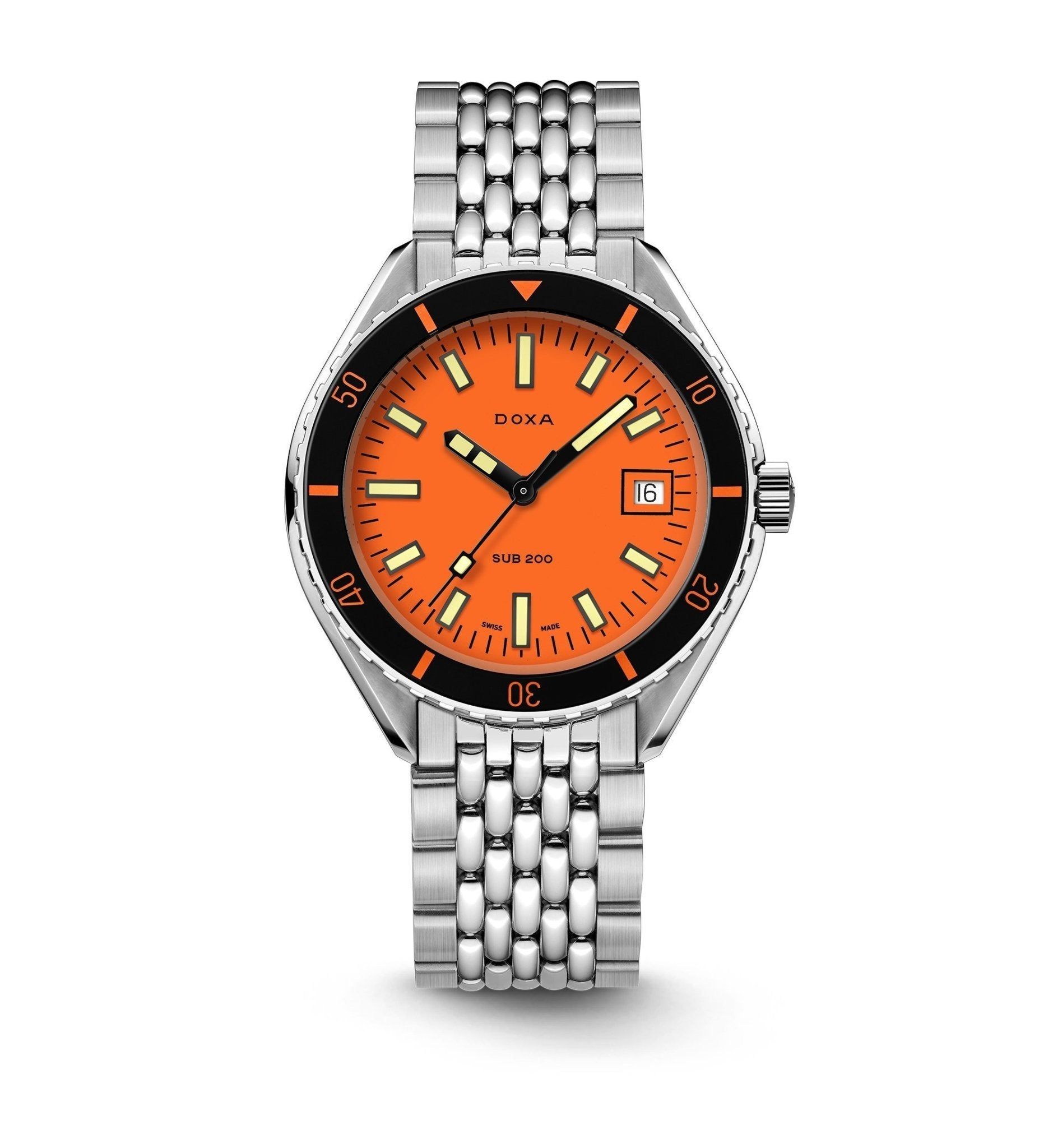
The SUB 300T is offered in eight colorways — an expanded palette compared to the four-colorway base models — reflecting the evolution of the SUB family's commercial approach over the decades. The core four remain: Professional (orange), Sharkhunter (black), Searambler (silver), and Caribbean (navy blue). Additional colors — Divingstar (yellow), Aquamarine (turquoise), Whitepearl (white), and Sea Emerald (green) — extend the range for contemporary buyers who want the technical credentials of the 300T without necessarily the signature orange.
Special Editions: Aristera and Clive Cussler
The 2019 revival was accompanied by two notable special editions. The Aristera (Greek for "left") repositioned the crown to 9 o'clock for left-handed wearers — a specification that makes genuine ergonomic sense on a dive watch, where a right-wrist wearer would prefer the crown on the opposite side from their watch hand. The Aristera was limited to 300 pieces in the Professional colorway, priced at EUR 2,490.
The Clive Cussler Limited Edition — produced in collaboration with the estate of the thriller novelist and avid watch collector — carried the Sharkhunter black dial with an aged steel finish that references vintage patina without compromising the functional specifications. Limited to just 93 pieces (Cussler's age at death), it priced at USD 3,250 / CHF 3,050 / EUR 3,350.
SUB 300T vs. SUB 300: What Actually Differs
The two models share the same 42.5mm case diameter, the same Sellita SW200-1 movement, and the same four-colorway foundation. The differences are substantive where they exist:
| Specification | SUB 300 | SUB 300T |
|---|---|---|
| Water resistance | 300m | 1,200m (120 ATM) |
| Helium escape valve | No | Yes |
| Crystal | Domed sapphire | Flat sapphire |
| COSC certification | Yes (Professional) | No |
| Colorways available | 4 | 8 |
| Price (Professional) | ~USD 1,690 | USD 2,190 |
For recreational divers, the SUB 300 is the more refined daily wearer — the domed crystal adds visual elegance and COSC certification adds accuracy assurance. For professional divers, saturation diving workers, or collectors who want the historically significant HEV specification, the SUB 300T is the correct choice and worth the USD 500 premium.
Original: SUB 300T Conquistador, 1968–1969 | Revival: September 2019
Case: 42.5mm | 13.65mm thick | 44.5mm L2L | 316L stainless steel
Water resistance: 1,200m (120 ATM) | Helium escape valve: Yes
Movement: Sellita SW200-1 automatic | 28,800 vph | 38-hour power reserve
Crystal: Flat sapphire | Colorways: 8 standard options
Price: USD 2,190 (Professional) | EUR 2,490 (Aristera limited)
Why the Helium Escape Valve Matters: The Engineering Context
Helium (He) has an atomic radius of approximately 31 picometres — significantly smaller than water molecules. This allows helium gas to migrate through materials and past gaskets that are perfectly water-tight under normal conditions. A diver in a saturation diving habitat breathing a HeO2 (helium-oxygen) gas mixture at, say, 300 metres of equivalent pressure will be surrounded by helium under enormous pressure for their entire working period — sometimes 28 days or more.
During that time, helium migrates into any sealed space: watch cases, diving bells, dry habitats. The concentration builds slowly. When the team decompresses — a process that can take multiple days at controlled ascent rates — the ambient pressure drops. The helium inside the watch cannot escape through the same routes by which it entered, because the pressure differential now runs the other direction. As the external pressure decreases, the internal helium pressure remains, creating a growing differential across the crystal and bezel seals. Without a relief valve, the weakest seal fails — typically the crystal, which can exit the case with explosive force.
The Helium Release Valve is a spring-loaded one-way valve: it opens to release internal helium when internal pressure exceeds external by approximately 2–3 bar, then reseals. Water cannot enter during decompression because water pressure is dropping alongside the helium pressure differential. The valve is invisible during normal use and irrelevant to recreational diving, but for the professionals who need it, it is the difference between a functioning instrument and a destroyed one.
Frequently Asked Questions
What does the "T" stand for in Doxa SUB 300T?
Taucher — the German word for "diver." The designation marks the model's professional diving orientation and heritage.
Was the Doxa SUB 300T really the first watch with a helium escape valve?
Yes. The Doxa SUB 300T Conquistador, released commercially in 1968–1969, was the first commercially available dive watch with an integrated helium release valve. Rolex released its helium escape valve variant — the Sea-Dweller — in 1971–1972. Multiple horological sources and Doxa's own documented history support this chronology.
How much does the Doxa SUB 300T cost?
The current production SUB 300T Professional (orange dial) retails at USD 2,190. The limited Aristera (left-handed) edition prices at EUR 2,490. The Clive Cussler limited edition was USD 3,250 and has sold through.
Is the Doxa SUB 300T made of titanium?
No. The current Doxa SUB 300T is built in 316L stainless steel. The "T" stands for Taucher (diver), not titanium. Some Doxa models are offered in titanium, but the standard SUB 300T production models use stainless steel.
How deep can the Doxa SUB 300T go?
The SUB 300T is rated to 1,200 metres (120 ATM / 3,937 feet) of water resistance — four times the depth rating of the standard SUB 300. This rating is sufficient for any saturation or commercial diving application.
Sources: Doxa Watches (doxawatches.com), Monochrome Watches, aBlogtoWatch, Fratello Watches, Analog:Shift.