Doxa SUB 300 Carbon: The 1967 Template in Forged Carbon
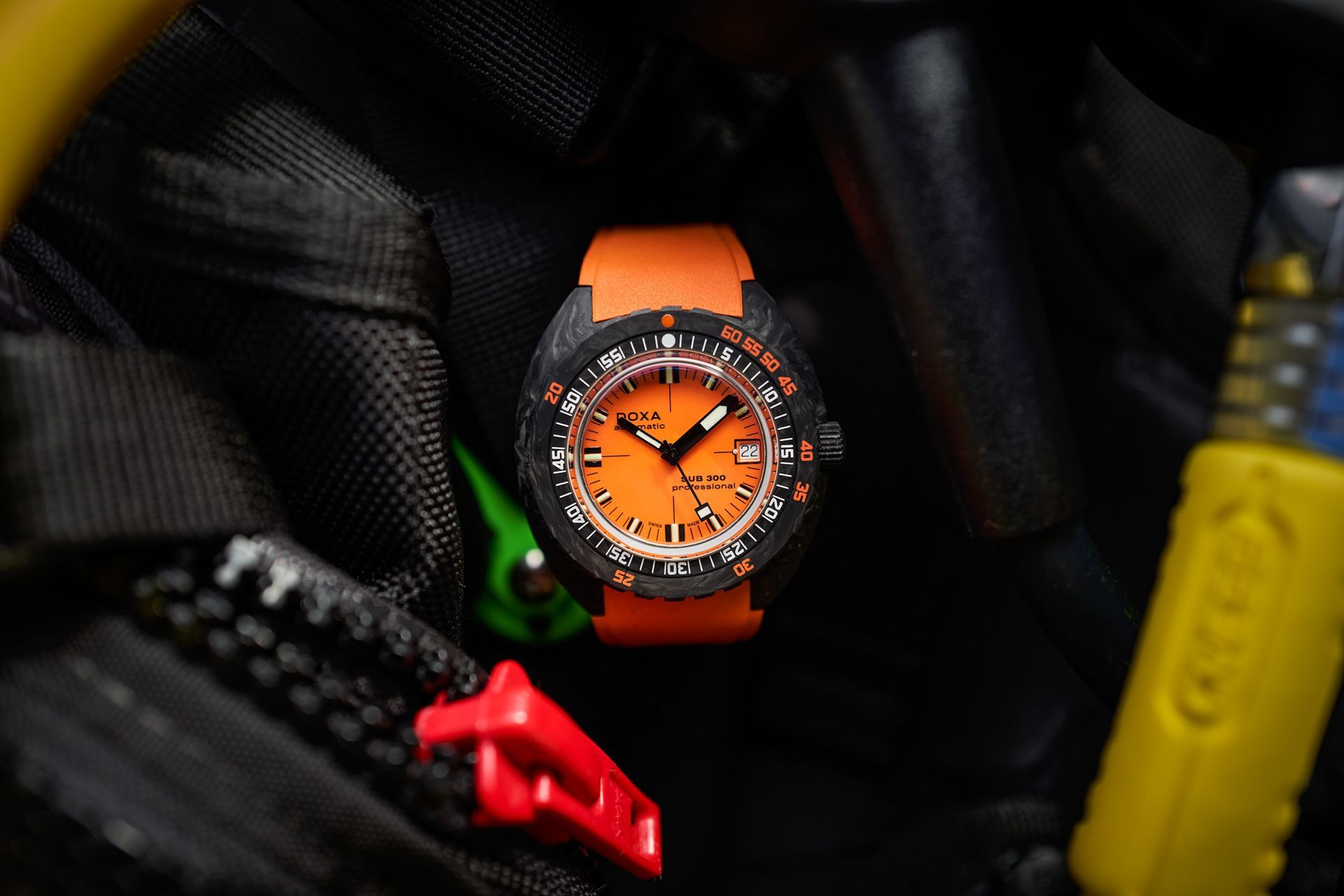
The Doxa SUB 300 Carbon applies 21st-century material science to the exact design template that has defined Doxa since 1967. The case is forged carbon composite with an internal titanium structure — a construction that produces a watch approximately 40% lighter than the equivalent stainless steel SUB 300 while retaining the same 42.5mm dimensions, the same 300-metre water resistance, the same no-decompression bezel, and the same colorway system. At 45 grams without strap versus the steel SUB 300's approximately 75 grams, the weight difference is immediately perceptible on the wrist — less so in photographs, which is why this model is best understood in person.
The Carbon launched in its current form in 2021, preceded by a limited 2020 collaboration with Aqua Lung (the successor company to Jacques Cousteau's US Divers) that tested the concept with 300 numbered pieces. The 2021 production release established the Carbon as a permanent catalog member at USD 4,390 — a significant premium over the steel SUB 300's USD 1,690 starting price, reflecting both the material cost and the COSC chronometer certification that the Carbon carries and the steel model does not. Current production remains active, and the model has attracted its own dedicated collector following separate from the steel SUB family.
The Forged Carbon Case: Construction and Material Properties
The SUB 300 Carbon is not carbon fiber in the conventional sense — it is forged carbon composite , a material produced by compressing carbon fiber strands and a binding resin under high heat and pressure in a mold. The forging process creates a random, non-directional pattern of carbon fibers throughout the case (unlike the woven grid pattern of sheet carbon fiber), which distributes structural stress more evenly across the material and allows the case to be machined to precise tolerances in three dimensions. The result is a material that is visually distinctive — the random carbon pattern gives each case a slightly different visual texture — and structurally capable of handling the compressive and tensile stresses of a 300-metre dive watch.
The internal titanium structure provides the threaded attachment points for the screw-down caseback and crown tube, and contributes structural reinforcement at the case's stress points. Carbon composite does not machine thread well enough for screw-down components — the titanium insert solves this without adding the weight of a full titanium case. The result is a hybrid construction that uses each material for what it does best: carbon for weight reduction and visual character, titanium for structural precision at the case's functional interfaces.
The quoted strength advantage for forged carbon — sometimes cited as "up to 10 times stronger than steel" — refers to specific loading conditions in the carbon's directional axis and should not be read as a blanket comparison. What matters practically is that the case is fully capable of the claimed 300-metre depth rating, that it is significantly lighter than steel, and that it does not corrode in saltwater environments. These properties, combined, make it genuinely useful for divers and not just a luxury material exercise.
COSC Certification: The Carbon's Unique Specification
A notable difference between the SUB 300 Carbon and the steel SUB 300 is that the Carbon carries COSC chronometer certification . Both use calibres in the ETA 2824-2 / Sellita SW200-1 family, but the Carbon's movement is individually tested by the Official Swiss Chronometer Testing Institute to the COSC standard: -4/+6 seconds per day across five positions and three temperatures. The steel SUB 300 Professional is COSC-certified; standard steel variants are not. The Carbon's certification applies across all colorways.
In practical terms, a COSC-certified movement will run close to the centre of its specified accuracy range under typical wearing conditions. This is meaningful for a watch used as a dive instrument — knowing that your timing reference is running accurately matters more in a dive context than in casual wear. The Carbon's COSC specification is thus consistent with its positioning as the premium material variant of the SUB 300 family.
The 2020 Aqua Lung Collaboration: The Carbon's Origin
Before the 2021 production launch, the SUB 300 Carbon concept was tested as a 2020 limited edition in partnership with Aqua Lung — the company that is the direct commercial successor to Jacques Cousteau's US Divers, the partnership that had put orange Doxas on the wrists of the Calypso team in 1968. The Aqua Lung SUB 300 Carbon was limited to 300 numbered pieces in a carbon-dialed variant with a yellow minute hand and Aqua Lung logo at 7 o'clock, priced at USD 4,790. It sold through promptly and established the commercial case for the permanent production Carbon that followed in 2021.
The Cousteau connection running through the Aqua Lung collaboration is not incidental. Doxa's origin story is inseparable from the Cousteau partnership — the 1968 US Divers deal that placed orange-dial SUBs on the Calypso and in front of tens of millions of television viewers. Building the Carbon launch around an Aqua Lung collaboration was a deliberate historical callback, linking the brand's highest-specification modern material to its most important historical association.
Special Editions and the Seafoam
In September 2025, Doxa produced the SUB 300 Carbon Seafoam as an exclusive for Watches of Switzerland — a seafoam green colorway on the carbon case, limited to 100 individually numbered pieces at USD 3,990, available only through Watches of Switzerland UK and US. The edition demonstrates the Carbon's viability as a platform for exclusive retail collaborations, a strategy consistent with how the broader watch industry uses material variants to create collector-focused limited editions without requiring new tooling.
Eight Colorways: The Full Palette
The Carbon is offered in the expanded eight-colorway system, consistent with the SUB 300T:
| Name | Dial Color |
|---|---|
| Professional | Orange |
| Sharkhunter | Black |
| Divingstar | Yellow |
| Caribbean | Navy blue with orange accents |
| Searambler | Silver |
| Aquamarine | Turquoise |
| Whitepearl | White |
| Sea Emerald | Green |
Introduced: 2021 (full production) | Preceded by: 2020 Aqua Lung limited edition (300 pieces)
Case: 42.5mm | 13.4mm thick | 45mm L2L | Forged carbon composite + internal titanium
Weight: 45g (without strap) — approx. 40% lighter than steel SUB 300
Water resistance: 300m | Bezel: Unidirectional, no-decompression table
Movement: ETA 2824-2 / Sellita SW200-1 equivalent | COSC chronometer-certified
Crystal: Domed sapphire, AR coating | Caseback: Screw-down titanium
Price: USD 4,390 (standard colorways) | 8 colorways available
Carbon vs. Steel SUB 300: Is the Premium Justified?
The USD 2,700 price gap between the Carbon (USD 4,390) and the steel SUB 300 (USD 1,690) buys three things: a 40% weight reduction, COSC certification, and a visual material that produces a unique case finish on each individual watch. Whether those justify the cost depends entirely on the buyer's priorities.
For a working diver, the weight reduction is the most functional advantage — a lighter watch is simply more comfortable over a long day's work. COSC matters if timing accuracy is operationally relevant. For a collector, the visual character of the forged carbon pattern — no two cases are identical — adds a level of individuality that standard production watches cannot offer. For a casual buyer choosing between the two, the steel SUB 300 is the better value proposition at two-thirds the price with no meaningful functional deficit for recreational use.
The Carbon is the SUB 300 for buyers who specifically want modern materials, and it delivers on that proposition. It is not a better dive watch than the steel — it is a different watch made from different materials, for buyers to whom those materials matter.
Frequently Asked Questions
What is the case material of the Doxa SUB 300 Carbon?
Forged carbon composite with an internal titanium structure. The carbon provides the case's outer form and weight advantage; the titanium provides structural reinforcement and threaded interfaces for the screw-down crown and caseback. The combination produces a case approximately 40% lighter than the equivalent stainless steel construction.
How much does the Doxa SUB 300 Carbon cost?
The SUB 300 Carbon retails at USD 4,390 in all eight standard colorways. The 2025 Seafoam limited edition (100 pieces, Watches of Switzerland exclusive) was USD 3,990. The 2020 Aqua Lung limited edition was USD 4,790 and has sold through.
Is the Doxa SUB 300 Carbon COSC certified?
Yes. Unlike some steel SUB 300 variants, the Carbon carries COSC chronometer certification across all colorways — the movement is individually tested to -4/+6 seconds per day. This certification is included in the purchase price and is part of the watch's specification sheet.
What is the difference between the Doxa SUB 300 and SUB 300 Carbon?
The Carbon has a forged carbon composite case (versus stainless steel), is approximately 40% lighter (45g vs. ~75g without strap), carries COSC chronometer certification, and costs USD 4,390 versus the steel SUB 300's USD 1,690. Both share 42.5mm dimensions, 300m water resistance, and the no-decompression bezel. The Steel does not have a helium escape valve, and neither does the Carbon.
Sources: Doxa Watches (doxawatches.com), Monochrome Watches, Fratello Watches, Watches of Switzerland, aBlogtoWatch.