Doxa SUB 300: The 1967 Orange Dive Watch That Redefined a Brand
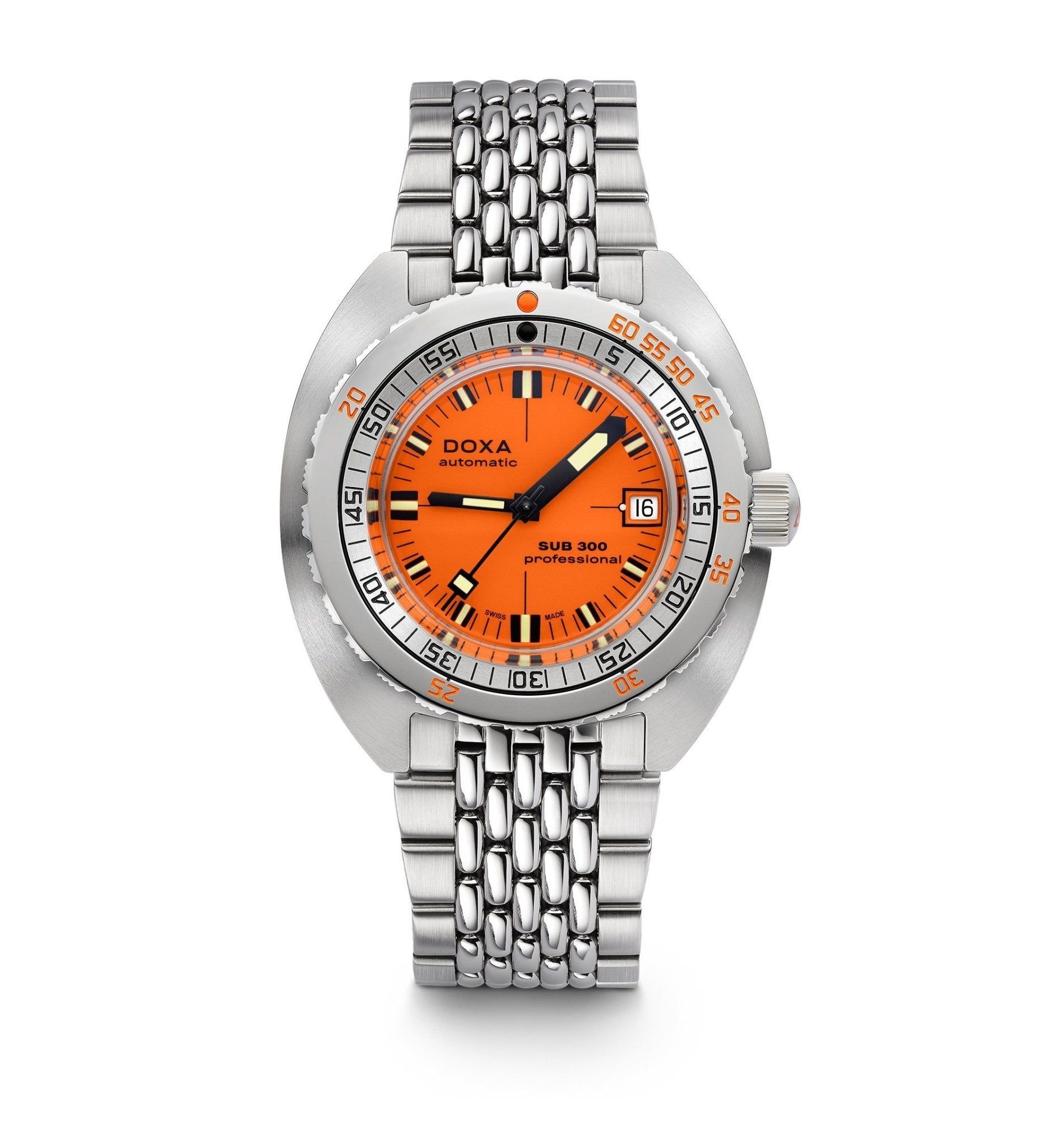
The Doxa SUB 300 , introduced in 1967, is one of the most historically significant dive watches ever produced — not because of its movement specifications or case finishing, but because of two design decisions that had never appeared together on a single watch before: a bright orange dial chosen for underwater visibility, and a rotating bezel marked with a no-decompression table that allowed a diver to calculate safe ascent times without carrying separate reference cards. Those two features, combined with a genuine 300-metre water resistance rating, created the professional diver's tool watch of the late 1960s. They also created Doxa's entire identity.
Before 1967, Doxa was a competent but unremarkable movement manufacturer and dress watch maker, known primarily for automotive dashboard clocks and the Bauhaus-influenced Grafic line. The SUB 300 transformed the brand in a single model and connected it — through the partnership with Jacques Cousteau's US Divers — to the most visible professional dive operation in the world. Fifty-seven years later, the SUB 300 remains in production, still wearing the orange dial, still carrying the no-deco bezel, still made in Le Locle.
The No-Decompression Bezel: A Genuine Innovation
Most rotating bezels on dive watches of the 1960s served one purpose: marking elapsed time. A diver would align the triangle marker with the minute hand at descent and read off how long they had been underwater. Useful, but incomplete. Safe scuba diving at most recreational depths requires the diver to know not just how long they have been down but how long they can safely remain before ascending without a decompression stop.
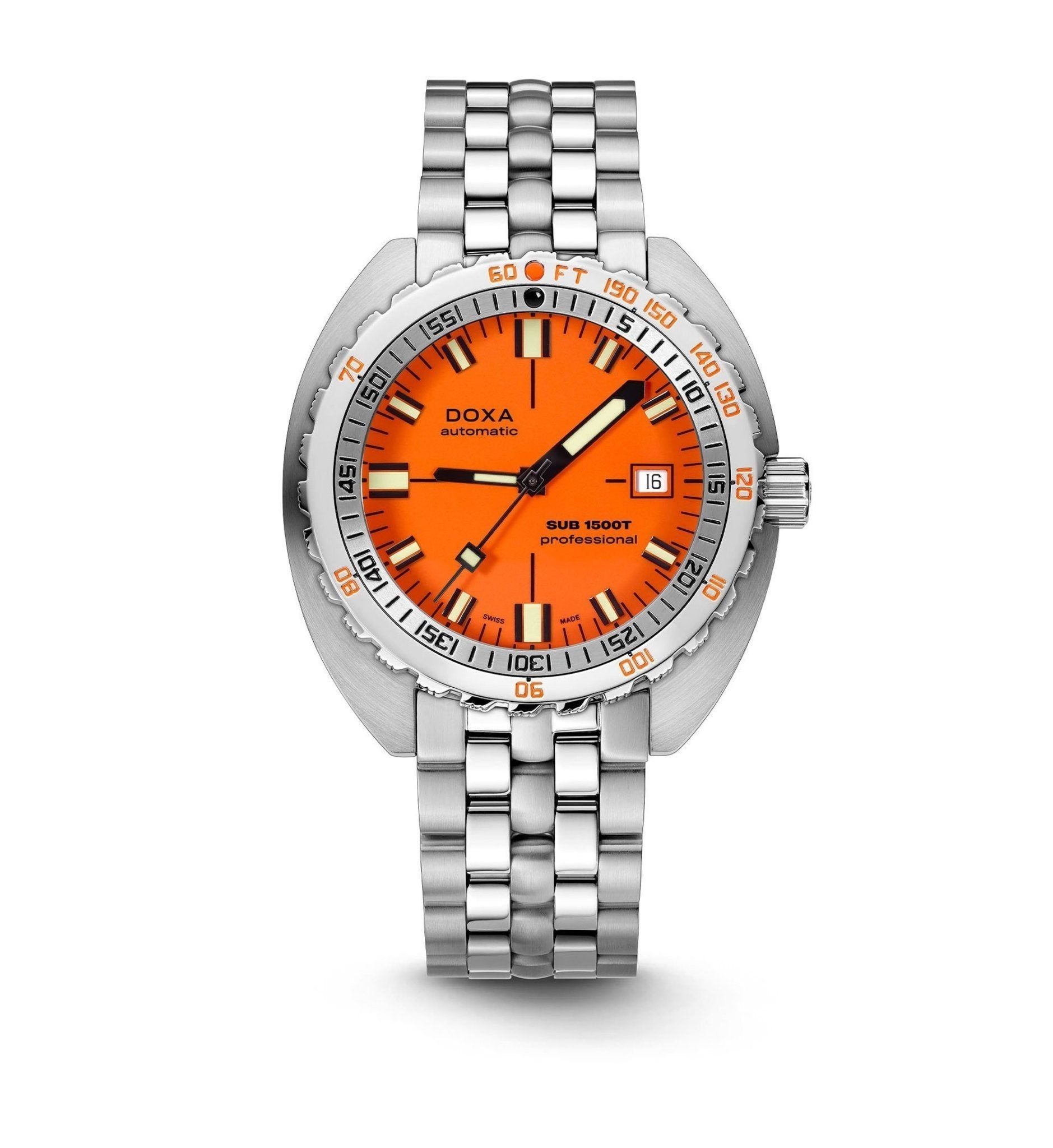
The Doxa no-decompression bezel — patented and unique to the brand — integrated this calculation directly into the watch. The bezel carried a table of depth-to-time limits: at a given depth marking, the diver could read the maximum safe bottom time without needing decompression. The watch became a dive computer in mechanical form, decades before electronic dive computers existed. No other watch maker had done this in a production timepiece, and no other watch maker had committed to the engineering required to make it work reliably underwater.
The SUB 300's 300-metre depth rating supported the bezel's professional claims. At 300m, the watch was rated beyond any recreational diving depth — it was built for the serious diver, not the weekend snorkeler, and the bezel made that explicit at a glance.
The Orange Dial: Function Before Fashion
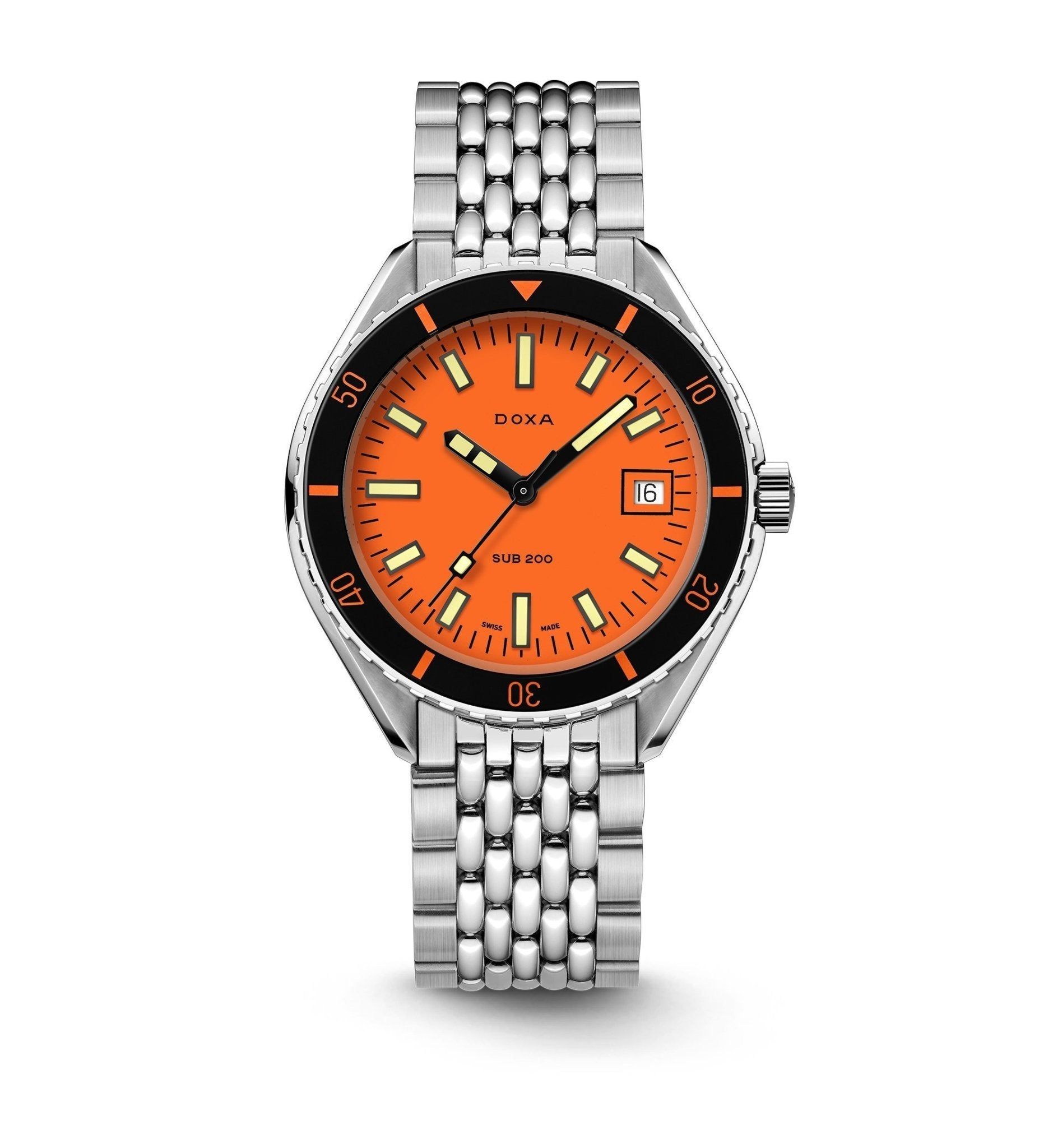
The choice of orange for the primary dial color in 1967 was made on the same functional grounds as the no-deco bezel. Orange sits at approximately 600 nanometres on the visible spectrum — close to the warm end — and absorbs depth-scattered blue light more slowly than cooler colors. At moderate diving depths, where blue wavelengths dominate and red tones fade first, orange persists longer than virtually any other color. A diver glancing at a wrist in low visibility water can read an orange dial at distances where a black, white, or blue face has become unreadable.
That is the practical reason. The cultural reason is what Jacques Cousteau's television program did with it. Beginning in 1968, when Cousteau's company US Divers obtained exclusive North American distribution rights for the Doxa SUB, orange Doxas appeared weekly on the wrists of Cousteau's team aboard the Calypso in The Undersea World of Jacques Cousteau — a series broadcast to tens of millions of viewers. The functional choice became the iconic choice by association with the most famous diver of the 20th century.
The Cousteau Partnership and US Divers Distribution
Jacques-Yves Cousteau did not simply endorse the Doxa SUB 300 — he integrated it into the operational toolkit of his expeditions. The watch appeared not as product placement but as genuine equipment. US Divers, the American company Cousteau co-founded to market Aqua-Lung diving equipment, took the Doxa distribution deal and brought it to the most active recreational diving market in the world during the boom years of scuba diving.
The partnership ran through the late 1960s and into the 1970s, giving Doxa a level of professional endorsement that no watch manufacturer could buy at any price today. The orange SUB 300 with US Divers branding on the dial became — for a specific generation — the definitive professional dive watch, sitting alongside the Rolex Submariner and Blancpain Fifty Fathoms as the reference-point dive instruments of the era.
The SUB 300 Today: Current Production
The modern Doxa SUB 300 retains the essential design DNA of the 1967 original. The case diameter is 42.5mm in stainless steel, with 300 metres of water resistance, a unidirectional rotating no-deco bezel, and the four colorways established during the vintage era: Professional (orange), Sharkhunter (black), Searambler (silver/white), and Caribbean (blue). A screw-down crown and solid caseback seal the case; a domed sapphire crystal sits above the dial.
Current production uses a Sellita SW200-1 automatic movement, running at 28,800 vph with a 38-hour power reserve — a Swiss-made workhorse movement appropriate to a tool watch that people are expected to actually use. The price for the current SUB 300 in steel starts at approximately CHF 1,490 / USD 1,690 on rubber strap, making it among the most accessible serious dive watches with a genuine 1960s heritage pedigree.
| Colorway | Name | Dial |
|---|---|---|
| Orange | Professional | Orange with orange no-deco markers |
| Black | Sharkhunter | Black with white markers |
| Silver/White | Searambler | Silver/white dial |
| Blue | Caribbean | Navy blue dial |
Introduced: 1967 | Current case diameter: 42.5mm | Water resistance: 300m
Movement: Sellita SW200-1 automatic | Frequency: 28,800 vph | Power reserve: 38 hours
Bezel: Unidirectional rotating, no-decompression table | Crystal: Domed sapphire
Price from: CHF 1,490 / USD ~1,690 (rubber strap)
Reference Evolution: Vintage to Modern
The original 1967 SUB 300 used a 45mm case — large for the era but proportional for a professional tool watch. Vintage examples are identified by their particular dial typography, hand shapes, and the specific no-deco bezel markings of different production runs. Early "Searambler" variants had a distinctive dial layout that has become one of the most collected vintage Doxa configurations.
The brand went dormant in 1983, and vintage SUBs from the 1967–1983 production period are now actively collected. Originals with confirmed US Divers dial markings carry a significant premium — they are the physical evidence of the Cousteau partnership, worn by the people who made professional diving what it is.
The 1997 revival by the Jenny family restored the SUB 300 to production with updated movements and refined tolerances, while maintaining the original colorway system. Subsequent production has refined the case to 42.5mm and updated the movement to the Sellita SW200-1, but the design language — the bold indices, the distinctive no-deco bezel, the orange Professional dial — remains continuous with 1967.
Frequently Asked Questions
What is the no-decompression bezel on the Doxa SUB 300?
The no-decompression (no-deco) bezel is a Doxa patent that integrates a depth-to-time decompression table directly into the rotating bezel. Instead of simply marking elapsed time, the bezel shows the maximum safe bottom time at various depths — allowing a diver to read ascent requirements from the watch without carrying separate reference cards. No other manufacturer had done this in a production dive watch before 1967.
What is the history of the Doxa SUB 300?
The Doxa SUB 300 was introduced in 1967 in Le Locle, Switzerland, with an orange dial and patented no-decompression bezel. In 1968, Jacques Cousteau's US Divers company obtained exclusive North American distribution rights, and the watch appeared on the wrists of Cousteau's team in The Undersea World of Jacques Cousteau. Production continued until 1983, when Doxa went dormant. The Jenny family revived the brand and the SUB 300 in 1997, and it remains in production today.
How much does the Doxa SUB 300 cost?
The current production Doxa SUB 300 in stainless steel starts at approximately CHF 1,490 / USD 1,690 on rubber strap. Prices vary by colorway and strap option.
What movement does the Doxa SUB 300 use?
Current production uses the Sellita SW200-1 automatic, running at 28,800 vph with a 38-hour power reserve. Vintage examples used various movements depending on the production era.
Sources: Doxa Watches (doxawatches.com), Analog:Shift, Fratello Watches, Monochrome Watches, aBlogtoWatch, Wikipedia.