Zenith Chronomaster: The El Primero Chronograph Collection, 1969 to Present
Zenith Chronomaster: The El Primero Collection
The Chronomaster is the El Primero collection — the watches built to show what the movement can do in its canonical context. When collectors and enthusiasts think of Zenith, they typically think of the Chronomaster: the tri-colour subdials, the pump-style pushers, the 36,000 vph sweep of the seconds hand. The design has a 1969 lineage and the movement has been produced continuously since 1987. Nothing in the current catalogue has a deeper root.
The 1969 Originals — A384, A385, A386
Photo: Rama — CC BY-SA 2.0 FR — Wikimedia Commons
Three references launched the El Primero in 1969 and established the design vocabulary of what would become the Chronomaster.
A384
- Case: 37mm tonneau
- Dial: Panda — silver chapter ring with black subdials
- Pushers: Pump-style at 2 and 4 o'clock
- The most restrained of the three originals; the dial layout that most clearly anticipates the modern Chronomaster Original
A385
- Case: 37mm tonneau
- Dial: Smoked brown gradient — a deeply unusual choice for 1969 that now reads as ahead of its time
- The rarest of the original trio; the most sought-after by collectors of the vintage references
A386
- Case: Round, 37mm
- Dial: Tri-colour subdials — silver chapter ring, blue 30-minute counter, black running seconds register
- The canonical El Primero reference; the one most reproduced in modern revival editions; the design that the majority of Chronomaster successors reference
Beyond these three, the launch programme included gold-cased variants (G381, G582, G7810) and the A7817 "Espada" — an El Primero base fitted with a full triple-calendar module showing date, day, and month, the complication approach anticipating the Chronomaster's later calendar variants.
Chronomaster Revival (from 2019)
Photo: Zenith El Primero (user) — CC BY-SA 3.0 — Wikimedia Commons
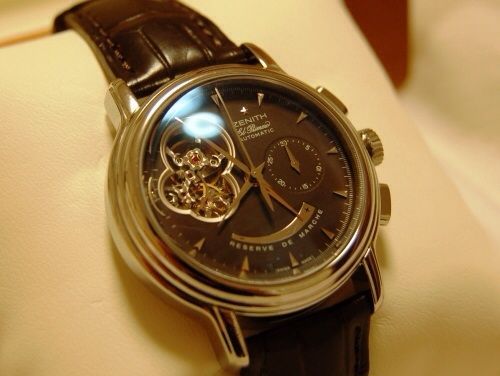
The Chronomaster Revival series reproduces the A384, A385, and A386 as faithful modern re-editions — same 37mm tonneau or round cases, same proportions, same dial layouts, powered by the Calibre 400 (the period-designation for the El Primero after the 1987 return from the quartz crisis).
The use of Cal. 400 rather than the newer Cal. 3600 is deliberate: Revival editions are positioned as period-correct, and the 400 designation connects directly to the movement's production history. The specifications are essentially El Primero architecture, with improvements from the intervening decades, but the designator anchors them historically.
Chronomaster Original (from 2021)
Photo: Hiroaki Kikuchi (Torajiro) — CC BY-SA 3.0 — Wikimedia Commons
The Chronomaster Original is the modern interpretation of the 1969 A386 — the round case, tri-colour subdials — updated to current size expectations and fitted with the El Primero Calibre 3600.
Specifications:
- Case diameter: 38mm
- Movement: El Primero Calibre 3600
- Frequency: 36,000 vph
- Power reserve: 60 hours
- Jewels: 35
- Components: 311
- Water resistance: 50m
- Crystal: Domed sapphire — a deliberate heritage reference to the original's mineral crystal profile
- Pushers: Pump-style, as in 1969
The 38mm case is fractionally larger than the 37mm original but maintains the same proportional relationship between the round case and the subdial layout. The domed sapphire crystal — unusual in current production, where flat anti-reflective sapphire is the norm — is the single most visually distinguishing element from a distance, and the most direct reference to the 1969 watch's character.
Key reference numbers:
- 03.3200.3600/69.C902
— steel, silver dial
- 03.3200.3600/21.M3200
— steel, metal bracelet
- Rose gold and bicolour variants also available
Chronomaster Sport (from 2021)
Photo: Zenith El Primero (user) — CC BY-SA 3.0 — Wikimedia Commons
The Chronomaster Sport applies the El Primero to a more robust proposition — a larger case, black ceramic bezel with 1/10th-second graduation, and 100m water resistance — while retaining the same Calibre 3600 movement.
Specifications:
- Case diameter: 41mm
- Case thickness: 13.6mm
- Lug-to-lug: 46.2mm
- Movement: El Primero Calibre 3600
(identical to Original)
- Frequency: 36,000 vph
- Power reserve: 60 hours
- Bezel: Black ceramic with 1/10th-second graduation
- Water resistance: 100m
(double the Original's 50m)
- Available on integrated metal bracelet or rubber/fabric strap
The ceramic bezel's 1/10th-second graduation is a functional reference to the El Primero's 36,000 vph frequency: at that oscillation rate, the chronograph hand completes a full revolution in 60 seconds with 600 discrete positions, making 1/10th-second measurement meaningful at a glance.
Key reference numbers:
- 03.3100.3600/69.M3100
— white dial, metal bracelet
- 03.3100.3600/69.C822
— white dial, blue Cordura strap
- 03.3100.3600/21.M3100
— black dial, metal bracelet
- 18.3100.3600/69.C920
— 18k rose gold
Chronomaster Open
The Chronomaster Open uses the Calibre 3604 — the skeletonised configuration of the 3600 — exposing the movement architecture through openwork on the dial side. The El Primero column wheel, the three-gear chronograph train, and the oscillating mass are visible from the front.
The open-worked movement in a traditional Chronomaster case creates a visual contrast with the Original's clean dial — same movement DNA, entirely different reading experience.
The Chronomaster in Collector Context
The Chronomaster's collector position is established and stable. The 1969 references — particularly the A386 with its tri-colour subdials — are genuinely scarce and trade at multiples of original price. The modern Chronomaster Original and Sport occupy a price point (approximately CHF 7,900–9,000 retail for steel references) that places them below most Swiss chronograph competitors at comparable movement quality, which has historically supported strong secondary market demand.
The Chronomaster Revival editions occupy a middle ground — modern watches in period-correct specifications — and attract collectors who want the 1969 proportions and the Cal. 400 designation without the condition risk of a genuine vintage piece.
The Chronomaster in 2026
Zenith continued to expand the Chronomaster line in 2026. At Watches and Wonders 2026 the brand unveiled the Chronomaster Sport Skeleton , a 41mm rose-gold limited edition of 50 pieces that strips away the dial to expose the high-frequency El Primero 3600, retaining the tenth-of-a-second chronograph and 60-hour power reserve. Then, at Geneva Watch Days 2026, Zenith did something the Chronomaster had never done: it dropped the chronograph entirely. The Chronomaster Solo Sport places a time-only, high-frequency El Primero — calibre 3620, running at 5Hz with a 60-hour reserve — into a 40mm steel sports case with a unidirectional rotating ceramic bezel and 200 metres of water resistance. It is the most overtly tool-oriented watch the collection has worn, and the first three-hander to carry the Chronomaster name.
Latest News
Frequently Asked Questions
What are the original 1969 Chronomaster references?
A384 (37mm tonneau, panda dial), A385 (37mm tonneau, smoked gradient dial), and A386 (round case, tri-colour subdials). The A386 is the most iconic and most reproduced in modern revival editions.
What is the difference between the Chronomaster Original and Sport?
The Original is 38mm with a domed sapphire crystal and 50m water resistance. The Sport is 41mm with a black ceramic 1/10th-second bezel and 100m water resistance. Both use the El Primero Calibre 3600 (36,000 vph, 60-hour power reserve).
What is the Chronomaster Revival?
Modern re-editions of the A384, A385, and A386 in period-correct 37mm cases, powered by the El Primero Calibre 400 — the period designator connecting them to the movement's post-quartz-crisis production history.
What movement powers the Chronomaster?
El Primero Calibre 3600 (current production): 30mm diameter, 35 jewels, 36,000 vph, 60-hour power reserve, 311 components, COSC chronometer certified. Revival editions use Calibre 400.
Why does the Chronomaster Sport bezel have 1/10th-second markings?
Because the El Primero runs at 36,000 vph — the chronograph hand completes one revolution in 60 seconds with 10 advances per second, making 1/10th-second the native precision of the movement. The bezel graduation is calibrated to this mechanical specification.