King Seiko: Suwa vs Daini, the KSK Chronometer, and the 2022 Revival
King Seiko: The Rival from Daini Seikosha
One of the stranger facts in watch history is that the same company produced two competing luxury watch lines that were rivals in the market. Grand Seiko and King Seiko did not occupy different price points or different categories — they competed directly for the same Japanese consumer. The competition was built in: Grand Seiko came from Suwa Seikosha in Nagano; King Seiko came from Daini Seikosha in Tokyo. Seiko encouraged the factories to compete, believing that rivalry between its own divisions would drive technical excellence in ways that corporate direction could not. The result was a decade of accelerating standards, two lines of watches that pushed Japanese finishing to levels that challenged anything produced in Switzerland, and eventually the kind of internal logic that produces corporate rationalisation: King Seiko was discontinued in the early 1980s. It returned in 2022 — and the watch it returned with is still correct.
Photo: Roland Fischer (Dnalor 01) — CC BY-SA 3.0 AT — Wikimedia Commons
The Internal Competition — Suwa vs Daini
Photo: Ash Crow (Sylvain Boissel) — CC BY-SA 3.0 — Wikimedia Commons
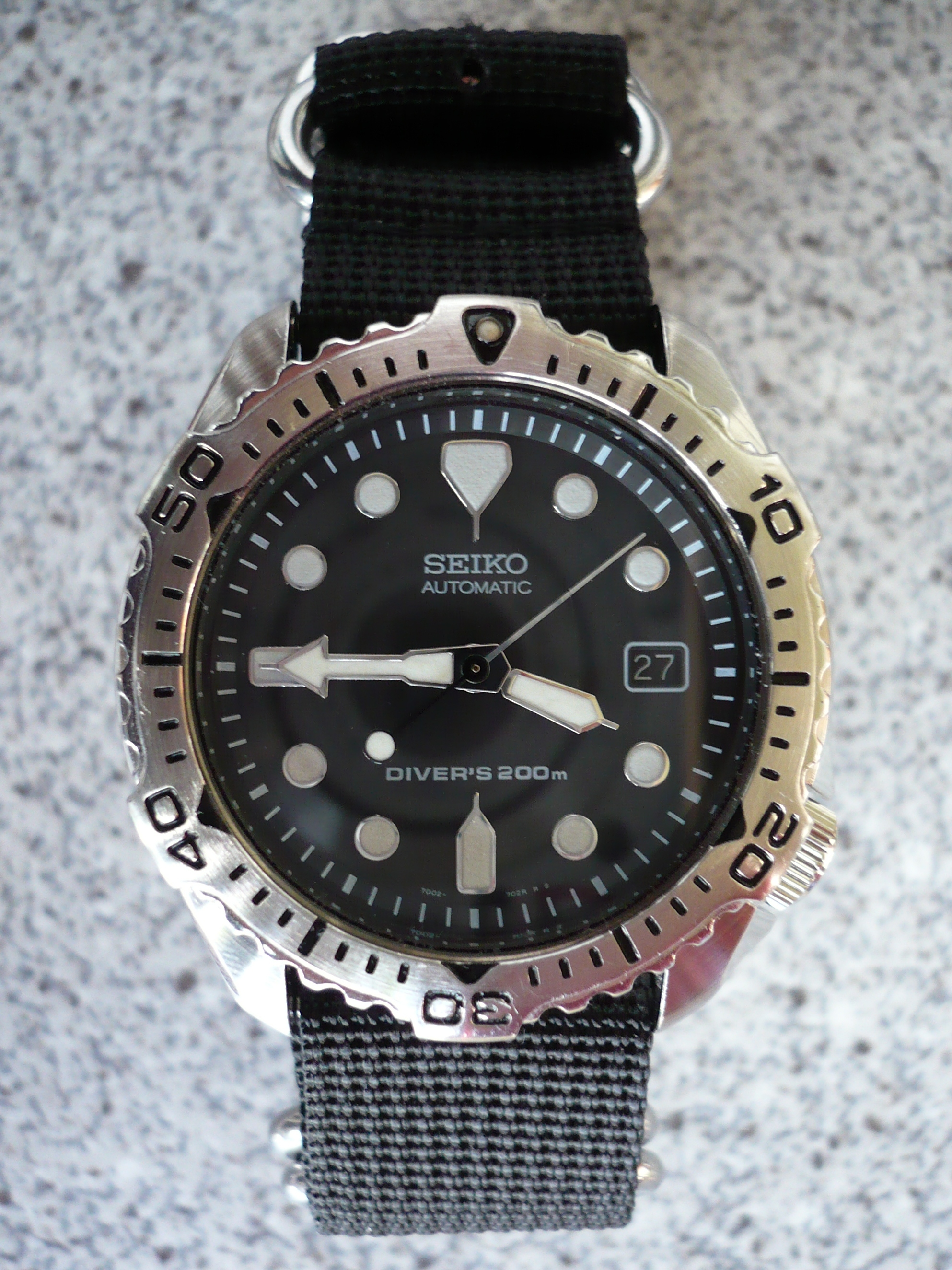
To understand King Seiko, you need to understand Seiko's factory structure. By the 1960s, Seiko operated two distinct manufacturing facilities:
- Suwa Seikosha (Suwa, Nagano Prefecture): The Nagano facility, eventually the home of Seiko Epson. Technically innovative, with a focus on precision instrumentation and miniaturised movements.
- Daini Seikosha (Kameido, Tokyo): The Tokyo facility, eventually the home of Seiko Instruments. Focused on high-precision mechanical production.
When Suwa Seikosha launched Grand Seiko in 1960 — a response to the Swiss high-end watch market, with an ambition to produce watches of equivalent quality at lower cost — Daini Seikosha responded by launching King Seiko in 1961 . The two lines were explicit rivals: not different segments, but two different watches from two different factories, competing for the same buyer, under the same Seiko brand.
Seiko management knew about this competition. They encouraged it. The belief — confirmed by subsequent history — was that the internal rivalry would drive each facility to exceed what either could achieve without competition.
First King Seiko — 1961
Photo: Francis Flinch — Public Domain — Wikimedia Commons
The first King Seiko references appeared in June 1961 :
- Reference : J14102 (first generation, June 1961 – September 1963)
- Case : Gold-plated, with solid gold hands and dial markers
- Movement : Derived from Daini's 54A calibre; 25 jewels; tadpole fine regulator; 18,000 vph
- Price : Approximately ¥12,000–¥15,000
The first King Seiko was not a "junior" product to Grand Seiko. It was conceived as an equal rival — a different expression of the same ambition from a different manufacturing tradition.
The KSK — 1965
Photo: Les Zetlein — Public Domain — Wikimedia Commons
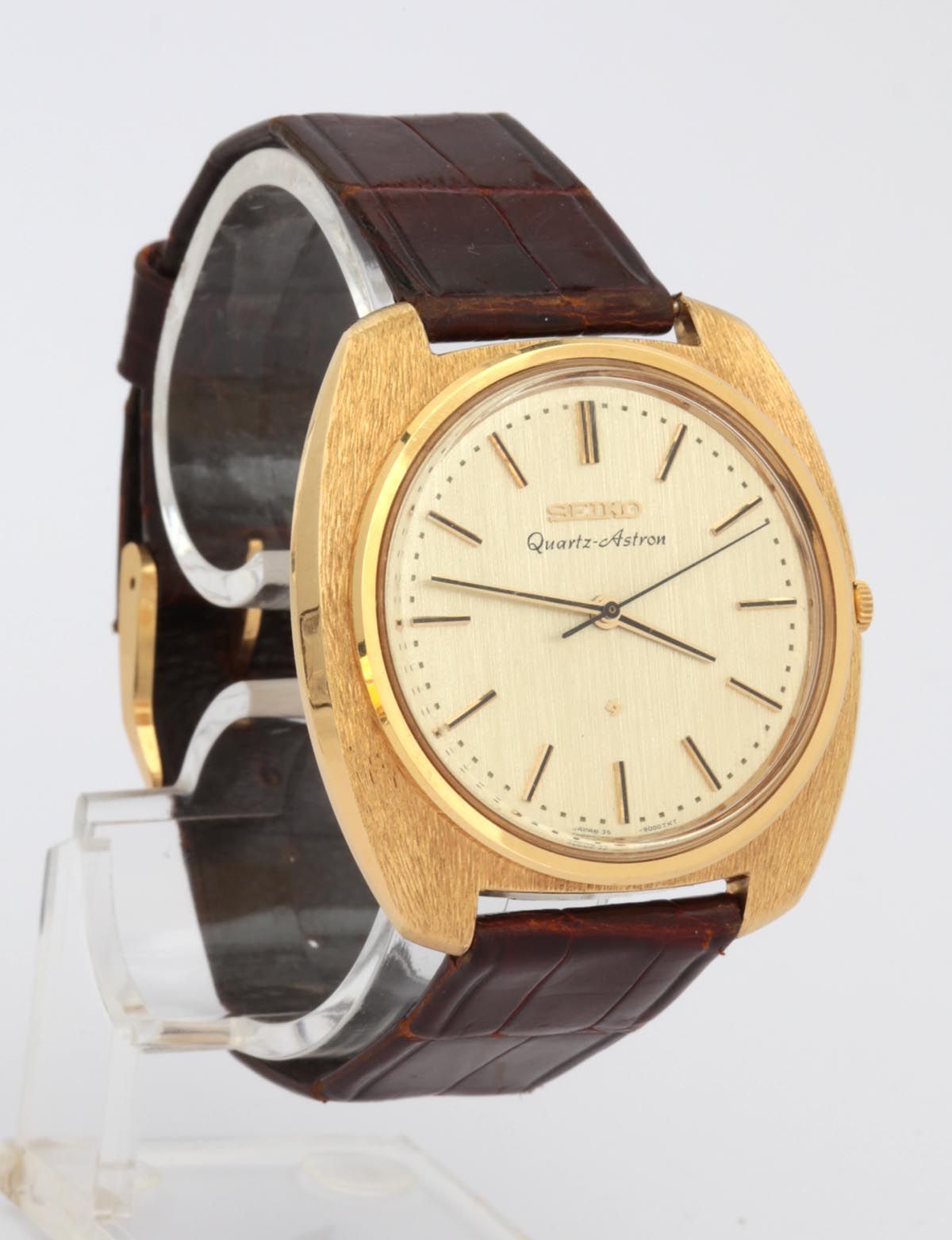
The second generation King Seiko — the KSK (King Seiko Kisei-Tsuki, indicating the hacking/stop-seconds function) — is the design that defines the modern revival:
| Specification | Value |
|---|---|
| Reference | 44-9990 |
| Movement | Hand-wound Calibre 44A |
| Features | Hacking seconds (Kisei-Tsuki) |
| Case design | Angular, sharp-edged — a significant departure from the rounded first generation |
The KSK's case geometry is immediately recognisable: angular facets, sharply defined surfaces, and a dial architecture that owes nothing to the rounded Swiss dress watch conventions of the era. It is a specifically Japanese expression of what a precision dress watch should look like — not a response to European aesthetics but an alternative to them.
This is the watch that the 2022 permanent revival most closely references. When Seiko's design team returned to King Seiko, they returned to the KSK.
Discontinuation and the Early 1980s
King Seiko production declined through the late 1970s and was discontinued in the early 1980s — a period in which Seiko's internal priorities were dominated by the quartz crisis, the development of kinetic technology, and the rationalisation of product lines that had proliferated during the mechanical watch era. The dual-factory luxury watch competition no longer served the same purpose when both facilities were redirected toward electronic timekeeping.
The 2021 Limited Return
King Seiko re-emerged briefly in 2021 as a limited edition — a controlled re-creation of the KSK design rather than a permanent product launch. The SJE083 and related references tested collector response without committing to ongoing production.
The 2022 Permanent Revival
Photo: Deutsches Uhrenmuseum — CC BY-SA 4.0 — Wikimedia Commons
In 2022 , Seiko made King Seiko a permanent part of its catalogue — a significant commitment rather than a nostalgic one-off.
SPB279 — The Flagship Reference
| Specification | Value |
|---|---|
| Movement | Calibre 6R31 |
| Power reserve | 70 hours |
| Display | No date |
| Frequency | 21,600 vph |
| Case diameter | 37mm |
| Crystal | Sapphire |
| Finishing | Multi-surface case with sharp-edged brushing faithful to KSK |
The Calibre 6R31 is the no-date version of the 6R35 used in the Sumo and Alpinist — 70-hour power reserve, hacking and manual winding. The choice of a no-date movement is deliberate: the KSK original carried no date, and the clean dial architecture of the King Seiko revival is designed around the uninterrupted dial space that a date window would compromise.
At 37mm , the revival is true to the original's proportions — the KSK was a dress watch in the dimensions that dress watches occupied in 1965, not inflated to the sizes that the 2010s watch market had trained buyers to expect. This is an unusual choice for a revival: most brands enlarge historical references when returning them to production. King Seiko went the other direction.
SPB279 Series References
| Reference | Dial |
|---|---|
| SPB279 | Silver sunray — most faithful to the original 44-9990 |
| SPB281 | White |
| SPB283 | Black |
| SPB285 | Blue |
| SPB287 | Additional variant |
The silver sunray SPB279 is regarded as the primary reference: the one that most directly traces the KSK's design language and the one most frequently compared to the original.
King Seiko in the Broader Seiko Range
Photo: Ferengi — CC BY-SA 3.0 — Wikimedia Commons
King Seiko occupies an unusual position in the current Seiko portfolio. It is not a budget alternative to Grand Seiko — it is differently positioned, drawing on a different historical tradition and using a different movement family (6R31 vs Grand Seiko's 9S family). Its price point is substantially below Grand Seiko while above the main Presage line.
For collectors who find Grand Seiko's pricing inaccessible but want a watch that carries genuine Seiko heritage — specifically the Daini Seikosha heritage that Grand Seiko does not represent — King Seiko provides an answer. It is not a substitute for Grand Seiko. It is the other thing.
Frequently Asked Questions
What was King Seiko?
A luxury automatic wristwatch line launched by Daini Seikosha in 1961 as a direct rival to Suwa Seikosha's Grand Seiko (1960). The internal competition between the two Seiko factories was deliberately encouraged by Seiko management to drive technical excellence.
What is the KSK?
The second-generation King Seiko, reference 44-9990, introduced 1965. "KSK" stands for King Seiko Kisei-Tsuki (hacking/stop-seconds). Features angular case geometry and hand-wound Calibre 44A. The design that the 2022 revival directly references.
When did King Seiko return?
A limited revival appeared in 2021 (SJE083). The permanent return occurred in 2022 with the SPB279 series — Calibre 6R31 (70hr PR, no date), 37mm case, sapphire crystal, price positioning above Presage and below Grand Seiko.
What movement does the modern King Seiko use?
Calibre 6R31: 70-hour power reserve, no date, hacking and manual winding, 21,600 vph. The no-date variant of the 6R35 used in the Sumo and Alpinist.