
Christopher Ward C60 Trident: The British Dive Watch
Originally published June 18, 2026. Updated November 4, 2026. Prices are US retail in USD with the source and date named in the text; figures marked REPORTED rest on a single source or on sources that conflict, and UNCERTAIN marks an unresolved conflict.
The C60 Trident is the watch most associated with Christopher Ward's value proposition: it offers ISO 6425-compliant 300-metre dive watch specifications, a Swiss-made automatic movement, and a case design developed by the brand itself — at a price point that undercuts Swiss dive watches of comparable specification by a substantial margin. The Trident has been the brand's flagship since its early iterations and the reference against which its positioning is most frequently tested.
The Trident Name
Photo: Daniel Zimmermann — CC BY 2.0 — Wikimedia Commons
"Trident" references the three-pronged spear of Poseidon/Neptune, the god of the sea — an appropriate mythological reference for a dive watch. The name also connects to the British naval tradition (the Royal Navy's trident insignia) and Christopher Ward's British identity.
The C60 designation places the Trident in the brand's 60-series — historically the designation for sport and diving references. The numbering system has evolved over the brand's history, but the C60 prefix has remained consistent for the primary dive watch.
C60 Trident Pro — The 600m Reference
Photo: Daniel Zimmermann — CC BY 2.0 — Wikimedia Commons
Status note (4 November 2026): Christopher Ward's international dive-watch page now leads with the Trident Pro 300, the Trident GMT 300 and the Trident Biscay, and we could not find the Pro 600 on the pages we read (UNCERTAIN: it may be retired or listed elsewhere, and the specification table below has not been re-checked).
At the apex of the older Trident range was the C60 Trident Pro 600 — a professional-grade dive watch with 600-metre water resistance:
| Specification | Detail |
|---|---|
| Water resistance | 600 metres (60 bar) |
| Case diameter | 43mm |
| Case material | Stainless steel |
| Bezel | Unidirectional ceramic |
| Movement | ETA 2824-2 automatic |
| Power reserve | 38 hours |
| Crystal | Domed sapphire, AR-coated both sides |
600-metre water resistance exceeds the requirements of ISO 6425 (the international dive watch standard, which requires only 200m) and most recreational and professional diving applications. At 600 metres, the watch would function at depths accessible only by saturation diving systems. The specification is primarily a safety margin statement: a watch rated to 600m worn in 40m recreational diving conditions has a 15× safety factor.
Current Trident line-up and US prices (4 November 2026)
Christopher Ward's international site, which prices in USD, listed these C60 dive watches on 4 November 2026:
| Model | Size and strap | US price |
|---|---|---|
| C60 Trident Pro 300 | 40mm, Bader bracelet | $1,320 |
| C60 Atoll 300 | 40mm, Bader bracelet | $1,320 |
| C60 Trident GMT 300 | 40mm, Consort bracelet | $1,730 |
| C60 Sapphire Edge | 42mm, Bader bracelet | $1,640 |
| Trident 30x30 (limited edition) | 41mm, Bader bracelet | $1,475 |
| Trident Biscay Automatic / Bronze | 42mm / 39mm | $2,095 |
| Trident Biscay GMT | 42mm to 39mm | $1,995 to $2,275 |
| C60 Trident Lumière | 41mm, Bader bracelet | $2,570 |
The Trident Pro 300 is made in four sizes (38, 40, 42 and 44mm), has a Sellita SW200-1 automatic with a 38-hour reserve, an exhibition caseback and 300m water resistance, and is described by Christopher Ward as up to 1.9mm slimmer than the Pro 600. Our research notes give the 40mm as 11.3mm thick and 47.45mm lug to lug, with a rubber-strap price of $1,095 (REPORTED: a single product-page reading, and the 4 November page we re-read showed only the $1,320 bracelet price). Only the first page of the site's 93 dive-watch listings was read, so other references exist.
C60 Trident Concept
The C60 Trident Concept represents Christopher Ward's most technically ambitious dive watch — developed in conjunction with the Calibre SH21:
| Specification | Detail |
|---|---|
| Movement | Calibre SH21 (bidirectional jumping hours) |
| Hours display | Jumping digital display |
| Minutes display | Analogue sweeping hand |
| Power reserve | 5 days (120 hours) |
| Water resistance | 300 metres |
The Trident Concept pairs the SH21's jumping hours display with a dive watch case — an unusual combination that demonstrates Christopher Ward's willingness to experiment with watch functions outside the traditional centre-hands layout. Jumping hours in a dive context is unusual; most divers prefer the continuous sweep of a conventional minutes hand for underwater timing. The Concept is more a design and movement showcase than a functional diving tool.
C60 Trident GMT
Photo: Daniel Zimmermann — CC BY 2.0 — Wikimedia Commons
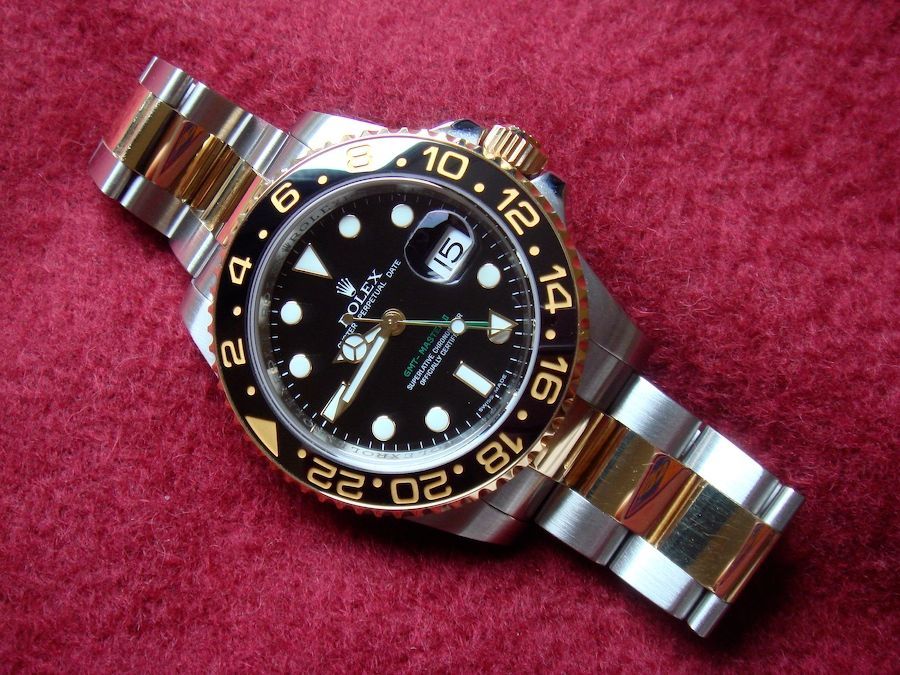
The C60 Trident GMT adds a second time zone to the dive watch proposition:
- GMT hand in a contrasting colour indicating a second time zone
- 24-hour bezel graduated scale
- 300-metre water resistance
- Helium escape valve for saturation diving use
The GMT dive watch serves the international maritime professional — crew on trans-ocean vessels who need both diving capability and home-time reference. For most buyers, it serves as a travel watch in a robust case.
C60 Bronze Trident
The C60 Bronze Trident uses a silicon bronze alloy case — a material choice that differentiates it from the standard stainless steel Trident:
Silicon bronze develops a patina with wear and exposure to salt water — an irregular oxidation pattern that gives each watch a unique appearance over time. The patina is considered desirable by many watch enthusiasts, as it makes the watch visually unique to its owner's wearing history.
Bronze watch cases appeared prominently in the enthusiast market from the mid-2010s — Panerai's bronze Luminor being an early and influential example. Christopher Ward's bronze Trident brings the material to a more accessible price point.
Trident Competition and Positioning
The Trident competes directly with:
- Seiko Prospex range (Japanese dive watches, similar prices)
- Oris Aquis (Swiss, 300m, significantly higher price)
- Tissot Seastar 1000 (Swatch Group, Swiss made, similar specification)
- Longines HydroConquest (Swiss, higher price)
Against these competitors, the Trident's argument is consistent: more specification for less money than Swiss alternatives, better build quality than Japanese alternatives at the same price. The argument has resonance in the enthusiast community, where the Trident regularly appears in "value dive watch" discussions alongside much more expensive competitors.
Retail prices: the older £600–1,400 range is a historical GBP figure that has not been re-verified. In USD, the Trident Pro 300 lists at $1,095 on rubber (REPORTED) and $1,320 on the Bader bracelet, and the GMT 300 at $1,730 (Christopher Ward international site, 4 November 2026). The Oris Aquis it is compared with below now lists from $2,600 (Oris US, November 2026).