Blancpain Tourbillon: Forty Years of Rotating Escapement Watchmaking
The tourbillon is the complication most associated with prestige watchmaking: technically demanding, visually captivating, and mechanically arguable (its benefits in a wristwatch, which moves constantly, are disputed). Blancpain has produced tourbillon wristwatches continuously since the 1983 revival — longer than almost any other brand's unbroken production run. The variety of tourbillon implementations across the Blancpain collection demonstrates that the complication is genuinely mastered, not merely contracted.
The Tourbillon — Mechanism and History
Photo: EMore98 — CC BY-SA 4.0 — Wikimedia Commons
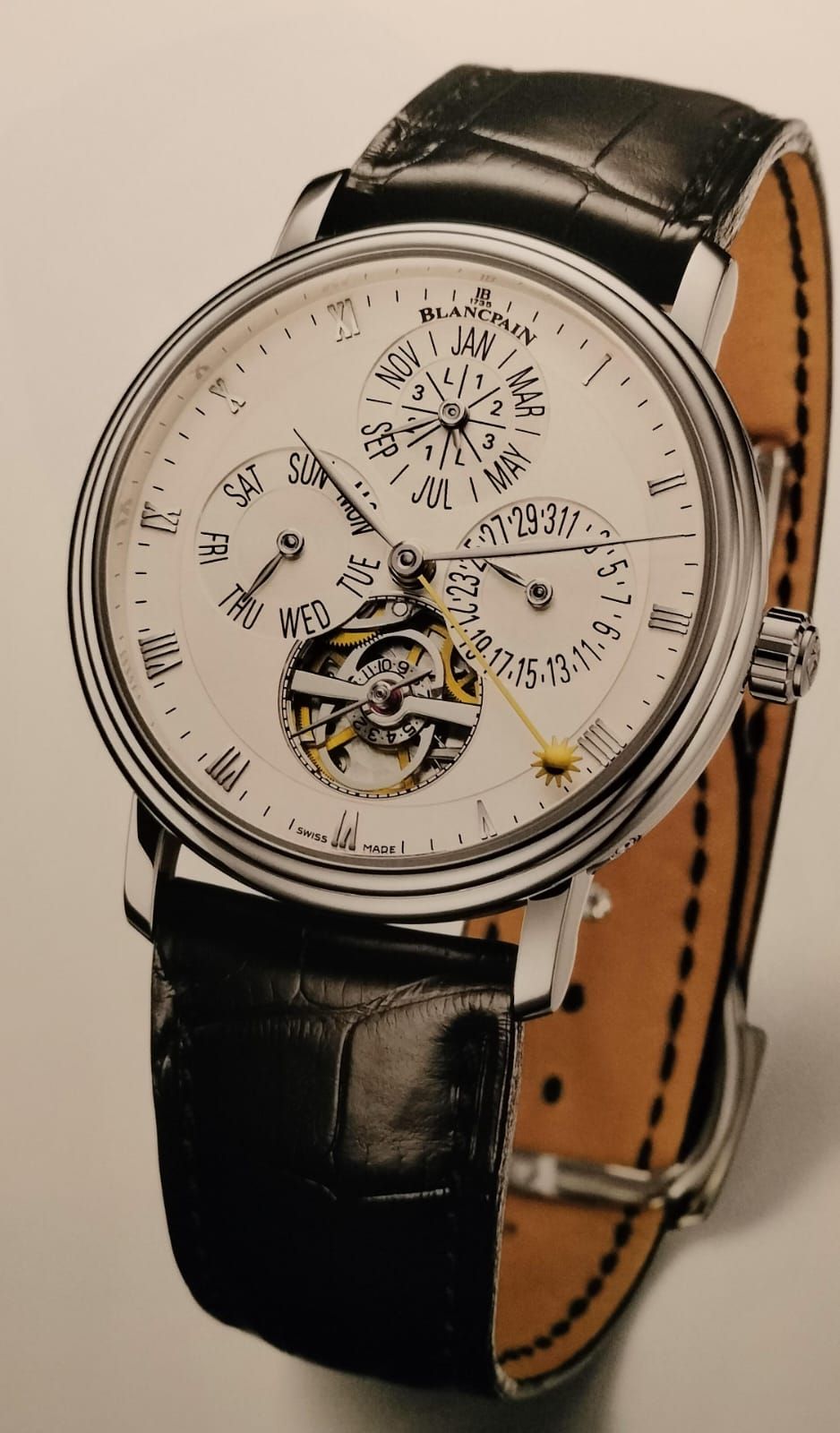
The tourbillon was invented by Abraham-Louis Breguet and patented in France on June 26, 1801 (Patent No. 157). Breguet's insight: the primary source of error in a pocket watch was gravity acting on the escapement components when the watch was carried vertically in the waistcoat pocket. If the escapement were placed in a rotating cage that completed one revolution per minute, the gravity error would be averaged across all orientations — zero net error in theory.
The tourbillon cage typically contains:
- Escape wheel
(typically 15–20 teeth in miniature wristwatch implementations)
- Pallet fork
(the anchor, regulating the escape wheel release)
- Balance wheel and hairspring
(the oscillator)
All three rotate together within the cage. The cage itself is the fourth wheel in the gear train — driven by the third wheel and driving the seconds display. One cage revolution per minute provides the running seconds display (the rotating cage itself serves as the seconds indicator).
The patent expired after ten years. The tourbillon became theoretically available to all watchmakers in 1811, but the extreme precision required for cage construction meant that very few could actually produce it.
Blancpain's First Tourbillon — 1983
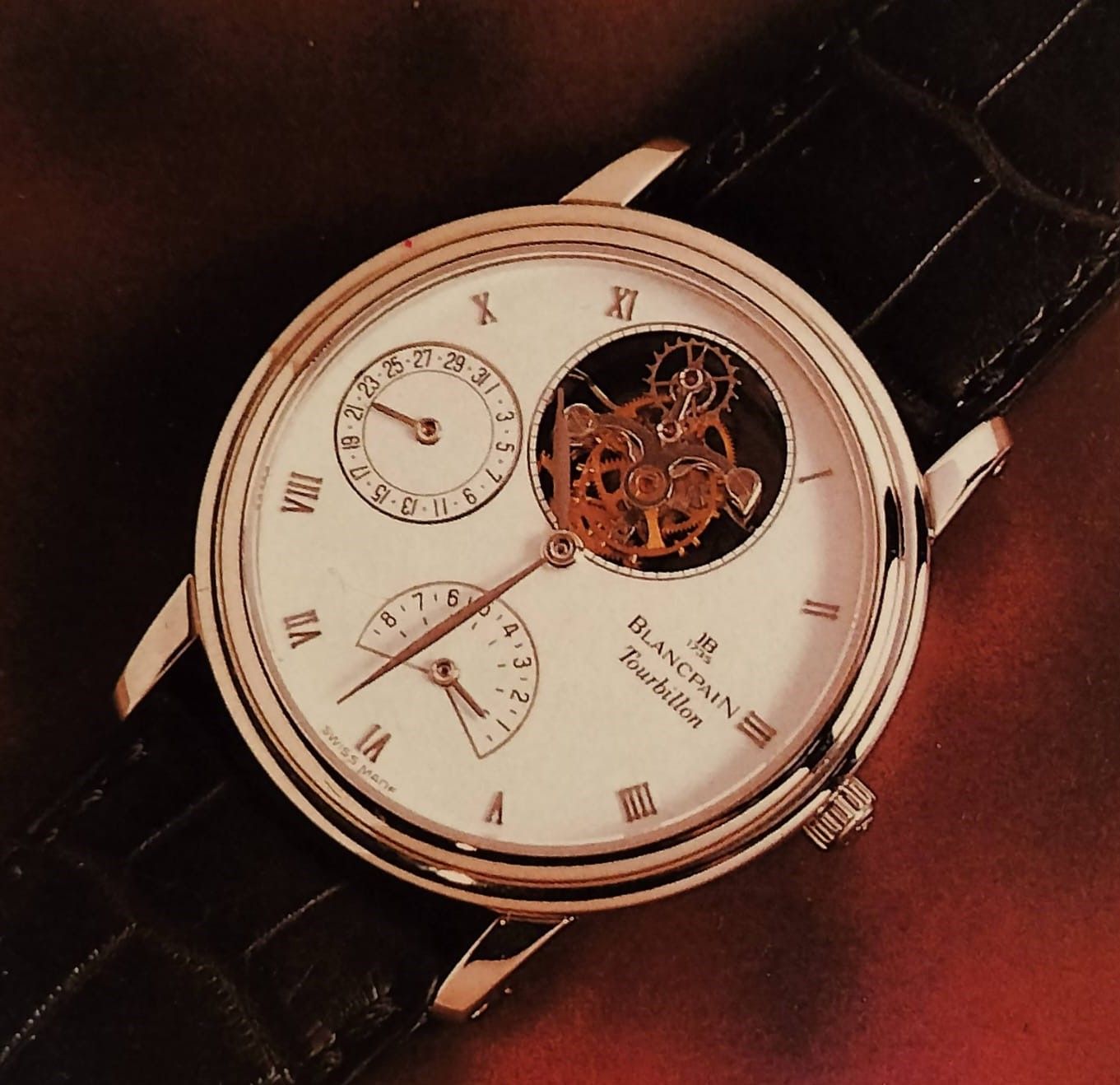
When Jean-Claude Biver revived Blancpain in 1983, his mandate for the first tourbillon was specific: the thinnest tourbillon wristwatch ever produced . The movement maker Frédéric Piguet (specifically, the engineers at what is now Manufacture Blancpain) achieved a tourbillon movement of 3.28mm in height — which became the Calibre 2521 , the thinnest automatic tourbillon wristwatch movement produced to that date.
The 1983 Blancpain tourbillon in a white gold case became one of the most desirable watches of the decade. It established that the new Blancpain was not merely reviving a name but actually competing at the technical frontier of Swiss watchmaking.
Villeret Tourbillon — The Current Reference
Photo: EMore98 — CC BY-SA 4.0 — Wikimedia Commons
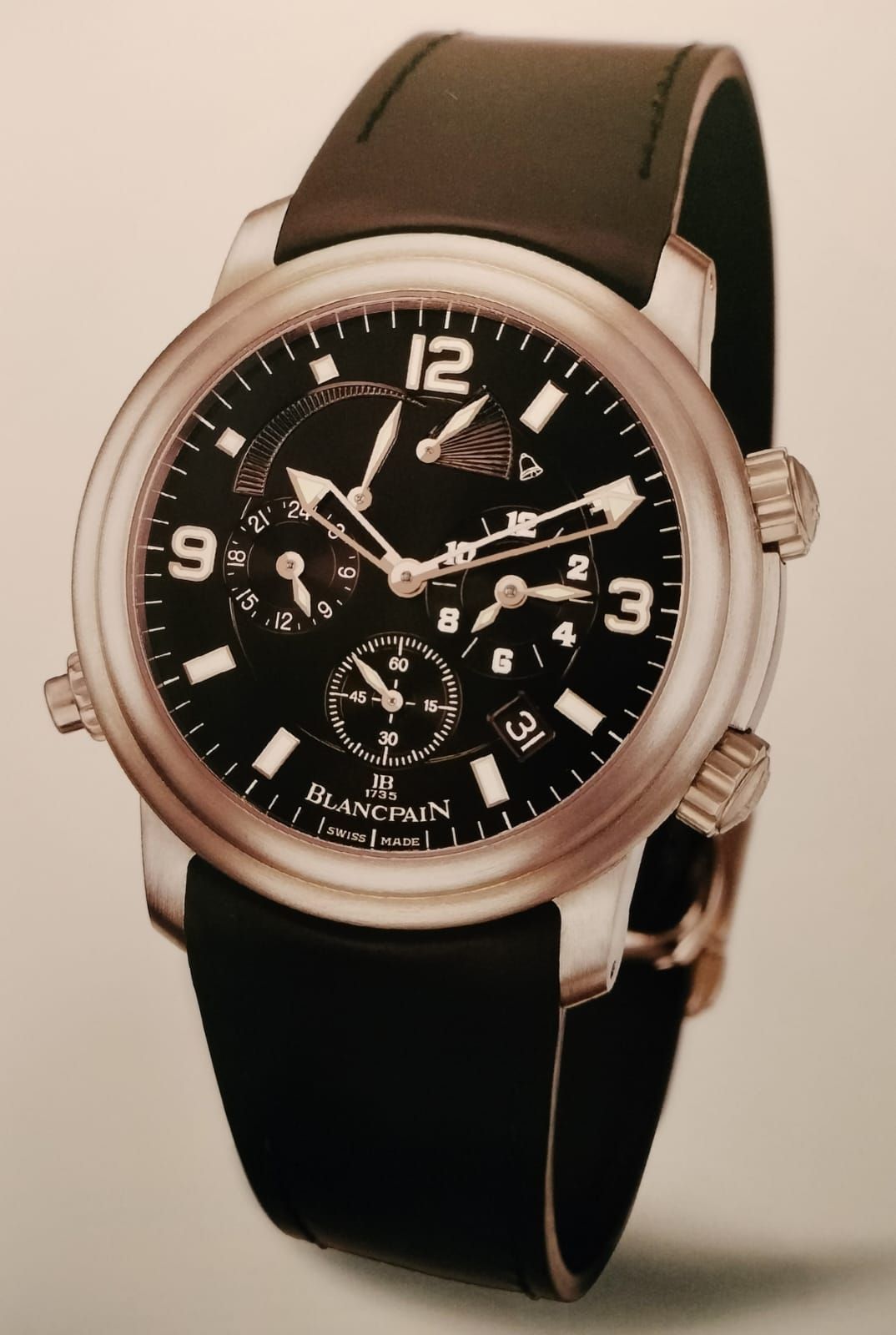
The Villeret Tourbillon (Ref. 6025) is the current expression of the classic Blancpain tourbillon in the brand's dress watch collection:
| Specification | Detail |
|---|---|
| Calibre | 25 (manual-wind) |
| Cage rotation | One revolution per minute |
| Power reserve | 8 days (168 hours) |
| Frequency | 21,600 vph |
| Jewels | 35 |
| Case diameter | 42mm (platinum or gold) |
| Case height | 14.9mm |
The eight-day power reserve is notable: most tourbillon watches have 48–72 hours of reserve. Extending to eight days requires a larger or more efficient energy source. Blancpain achieves this through a single large barrel with a particularly long mainspring — the large barrel occupies significant movement real estate but provides the extended reserve.
The tourbillon cage is visible through a dial aperture at 6 o'clock and through the exhibition caseback simultaneously.
Flying Tourbillon
Photo: EMore98 — CC BY-SA 4.0 — Wikimedia Commons
The flying tourbillon (tourbillon volant) is a variant in which the upper cage bearing is eliminated — the cage appears to float beneath the bridge without visible support from above. The technical challenge: without an upper pivot, the cage must be precisely balanced so that the lower pivot alone can carry the rotation without wobble. The visual effect — the cage apparently suspended in space — is dramatic.
Blancpain has produced flying tourbillon references within the Le Brassus and Villeret collections. The flying tourbillon requires higher manufacturing precision than a conventionally bridged tourbillon (the upper bridge, even when thin, contributes to cage stability) and consequently takes longer to assemble and adjust.
Tourbillon Carrousel — Combined Escapements
Photo: EMore98 — CC BY-SA 4.0 — Wikimedia Commons
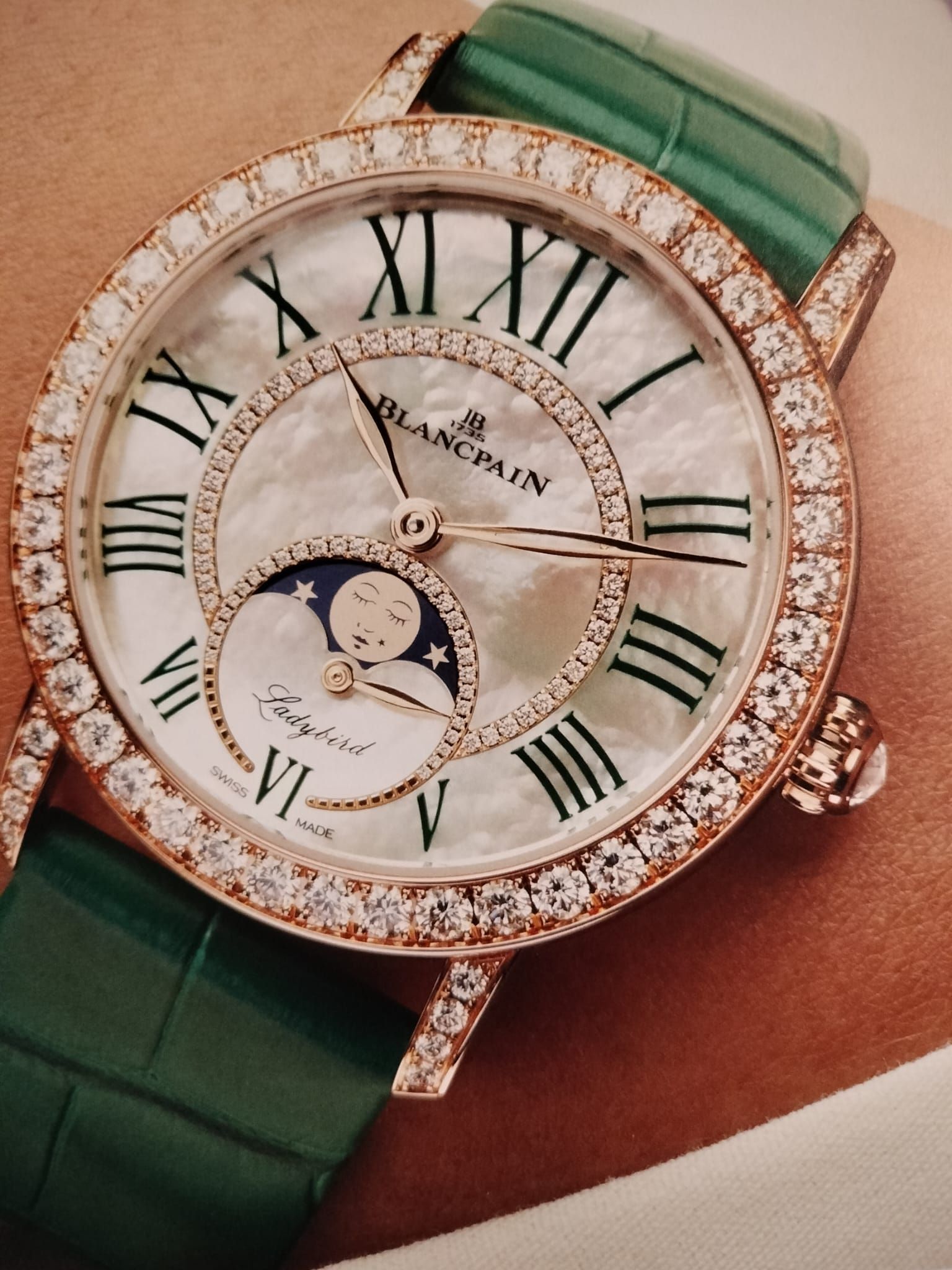
The most technically ambitious Blancpain tourbillon is actually a combination : watches that incorporate both a tourbillon and a carousel in a single movement. These are among the rarest production watches of any manufacturer.
The practical case for combining the two: in a tourbillon, the escapement rotates continuously at the pace of the seconds beat. In a carousel, the rotation is independent of the seconds beat. Combining both provides two independent averaging effects on gravity — theoretically better than either alone.
The more honest case: the combination is mechanically extraordinary, visually extraordinary, and demonstrates manufacturing capability beyond what any single-complication watch can show. The Blancpain Tourbillon Carrousel is produced in quantities of single digits per year.
The Tourbillon as Cultural Object
Photo: EMore98 — CC BY-SA 4.0 — Wikimedia Commons
In the decades since Blancpain's 1983 revival, the tourbillon has moved from technical innovation to cultural symbol. By the mid-2000s, every prestige Swiss brand produced at least one tourbillon; by the 2010s, tourbillons had appeared in watches at CHF 10,000 — prices that could not sustain the movement complexity of genuine cage construction.
Blancpain's continuous tourbillon production since 1983 predates the complication's cultural inflation and gives the brand a historical claim that later entrants cannot. The Calibre 25 of 1983 is the ancestor of the current Calibre 25 — the production lineage is unbroken, the engineers and watchmakers have maintained the tradition, and the movements are genuinely assembled and regulated by individual watchmakers at Le Sentier.