Rolex Perpetual Padellone (2026): A Legendary Name Returns With the New Dynapulse Escapement
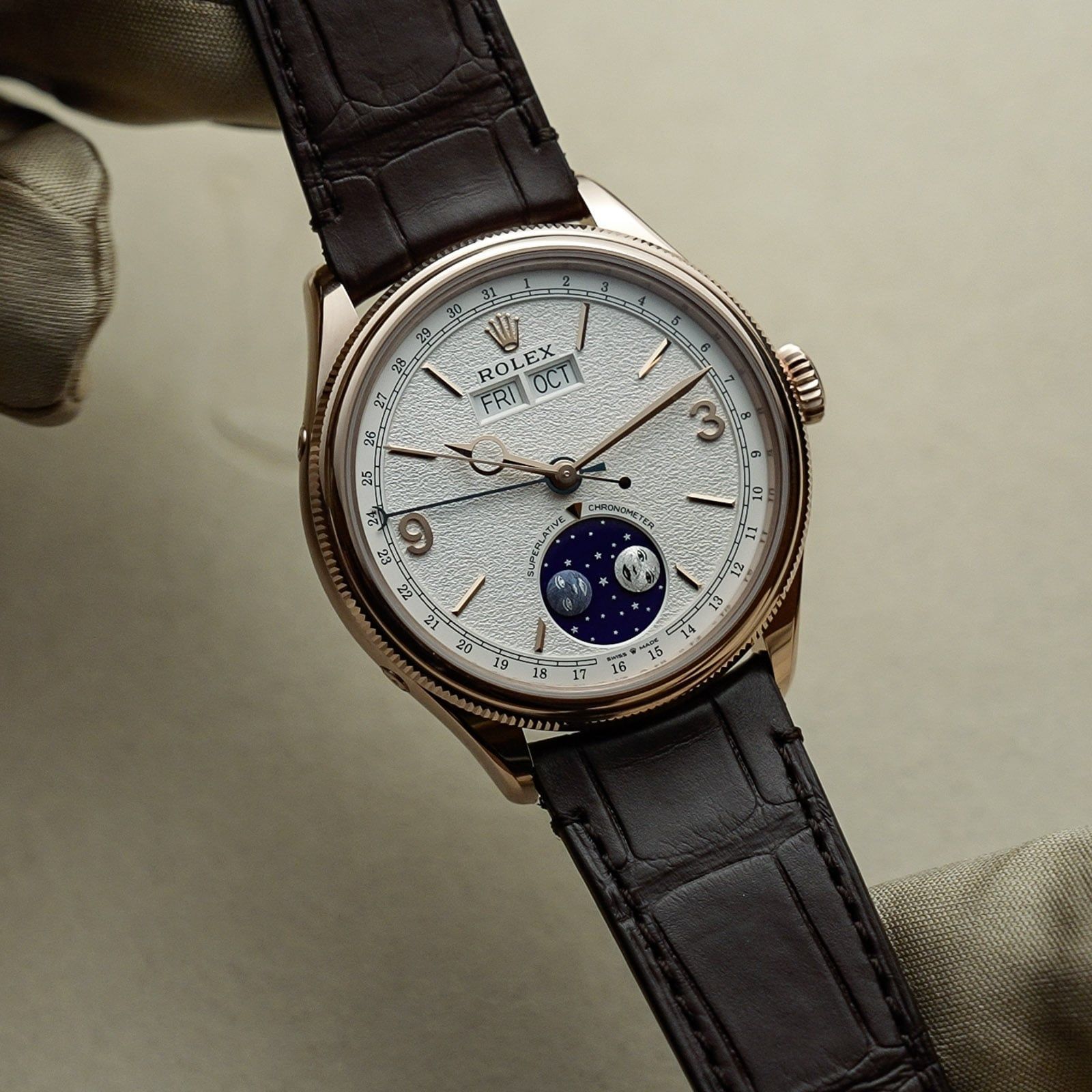
The Rolex Perpetual Padellone is the most significant new watch Rolex has released in years — a 39mm annual-calendar moonphase, offered in Everose gold (reference 53505) and platinum (reference 53506), that revives one of the brand's most storied vintage nicknames and debuts an entirely new regulating organ: the Dynapulse escapement. It is at once a piece of heritage revivalism and Rolex's boldest movement statement of the modern era.
The name matters. "Padellone" — Italian for "big frying pan" — is collector shorthand for the vintage reference 8171, a triple-calendar moonphase produced from roughly 1949 to 1953 in a run of only about 1,000 to 1,200 pieces. Rolex has not merely borrowed the nickname for the 2026 Perpetual Padellone; it has revived and trademarked it, signalling that this is meant to anchor a permanent-collection complication rather than a one-off tribute.
From the 8171 to Today: Why the Padellone Name Carries Weight
The original reference 8171 sat at the top of Rolex's early-1950s catalogue alongside the reference 6062 "Stelline." Both were triple-calendar moonphases, but the 8171 wore its complication on a large — for the period — case of roughly 38mm, giving rise to the affectionate "big frying pan" nickname. Genuine examples are among the most valuable vintage Rolex watches in existence, regularly crossing seven figures at auction. By resurrecting the Padellone name, Rolex is deliberately linking its newest complication to that lineage of calendar watchmaking, a category the brand largely vacated for decades in favour of the Datejust and Day-Date.
The 2026 model is not a slavish reissue. Where the 8171 showed day and month in twin windows with a pointer date and a moon subdial, the Perpetual Padellone streamlines the display into an annual calendar — a modern, mechanically simpler complication that a wearer sets once a year — while keeping the moonphase that gives the family its romance. It arrives during a landmark stretch for the brand, the centenary of the Oyster case reached in 2026, and reads as a statement piece rather than a volume product.
The Dynapulse Escapement: Rolex's Biggest Movement Leap in Years
The headline is not the calendar — it is the Dynapulse , an all-new escapement that replaces the traditional Swiss lever at the heart of the movement. Where the classic lever transmits energy to the balance through a single pallet fork with sliding friction, the Dynapulse is a sequential distribution escapement that uses two silicon escape wheels to deliver an indirect, tangential impulse to the balance. Rolex claims the architecture is roughly 30 percent more energy efficient than the Swiss lever it supersedes.
Why an Escapement Matters
The escapement is the beating gate between the mainspring and the balance — it releases energy in precise increments and keeps the watch ticking evenly. The Swiss lever has dominated for more than 250 years despite wasting energy to friction. A more efficient escapement means more of the mainspring's power reaches the balance, which can translate into better rate stability, longer service intervals, or a longer power reserve. Silicon components, being lightweight, anti-magnetic and friction-reducing, let Rolex rethink the geometry entirely.
This is a genuinely rare event: Rolex almost never changes its escapement. The Dynapulse builds on years of the brand's silicon and Syloxi research, and its debut in a flagship calendar watch — rather than a sports model — underscores how much prestige Rolex is placing on it. Expect the technology to migrate across the catalogue in the years ahead.
Caliber 7190: Annual Calendar and Meteorite Moonphase
Driving the Padellone is the new caliber 7190 , a self-winding movement developed from the caliber 7135. It beats at a high 36,000 vph (5 Hz) , holds a 66-hour power reserve , carries 35 jewels, and — like every current Rolex — is certified a Superlative Chronometer to within −2/+2 seconds per day . The annual calendar runs on what Rolex calls the Haplos system : it automatically accounts for months of 30 and 31 days, requiring a single correction each year at the end of February, with an instantaneous date change at midnight.
The moonphase is a showpiece. The full and new moons are cut from meteorite — a silvered full moon and a blue-PVD new moon — set against a blue enamelled disc, with a 29.53-day synodic cycle. On the dial side, applied numerals sit at 3 and 9 o'clock, the twin month apertures flank the moon at 12, and a blue date hand tipped with a tiny crescent sweeps the periphery. The Everose model wears an Intense White dial; the platinum model wears the brand's signature Ice Blue , the shade Rolex reserves for platinum.
Case, Materials and the Settimo Bracelet
The Padellone measures 39mm across and 12.20mm thick , in either 18k Everose gold or 950 platinum, water resistant to 50 metres. A push-pull crown and a screwed, fluted caseback fitted with a sapphire window — unusual for Rolex, which almost always uses solid casebacks — let owners admire the caliber 7190 and its new escapement. The Everose gold version can be ordered on a leather strap or on the new seven-link Settimo bracelet (Italian for "seventh"), a polished bracelet exclusive to the gold model; the platinum model comes on an alligator strap with a green calfskin lining.
Rolex Perpetual Padellone (2026): Full Specifications
| Specification | Detail |
|---|---|
| References | 53505 (Everose gold), 53506 (platinum) |
| Case size | 39mm diameter × 12.20mm thick |
| Materials | 18k Everose gold or 950 platinum; sapphire display caseback |
| Water resistance | 50m |
| Movement | Caliber 7190, automatic (based on 7135) |
| Escapement | Dynapulse (silicon, sequential distribution) |
| Frequency | 36,000 vph (5 Hz) |
| Power reserve | 66 hours |
| Jewels | 35 |
| Certification | Superlative Chronometer (−2/+2 sec/day) |
| Complications | Annual calendar (Haplos), meteorite moonphase |
| Dials | Intense White (Everose); Ice Blue (platinum) |
| Straps | Settimo bracelet or leather (Everose); alligator (platinum) |
| Prices (CHF) | 52,500 (53505 leather); 64,800 (53505 Settimo); 59,000 (53506 platinum) |
Price, Availability and Positioning
Swiss retail runs from CHF 52,500 for the Everose gold reference 53505-0002 on leather, to CHF 64,800 for the same watch on the Settimo bracelet (ref. 53505-0003), with the platinum reference 53506-0002 at CHF 59,000 on leather. Those figures place the Padellone above the Day-Date but well below Rolex's rarest jewellery pieces — precisely the territory a heritage-laden, technically groundbreaking complication should occupy. Given the new escapement, the trademarked name and the meteorite moonphase, demand will comfortably outstrip the modest production these precious-metal calendar watches command.
Frequently Asked Questions
What is the Rolex Perpetual Padellone?
A 2026 annual-calendar moonphase (refs 53505 in Everose gold, 53506 in platinum) that revives the nickname of the vintage reference 8171 and introduces Rolex's new Dynapulse escapement in a 39mm case.
What is the Dynapulse escapement?
A new silicon sequential distribution escapement that uses two escape wheels to give the balance an indirect, tangential impulse — claimed to be about 30% more efficient than the Swiss lever it replaces.
How much does the Perpetual Padellone cost?
CHF 52,500 (Everose, leather), CHF 64,800 (Everose, Settimo bracelet) and CHF 59,000 (platinum, leather).
Why is it called the Padellone?
"Padellone" means "big frying pan" in Italian — a nickname the vintage reference 8171 (1949–1953) earned for its unusually large dial and case. Rolex has revived and trademarked the name for 2026.
What movement powers it?
The caliber 7190 (based on the 7135): automatic, 36,000 vph, 66-hour reserve, 35 jewels, Dynapulse escapement, Superlative Chronometer certified to −2/+2 sec/day.
Related Reading