Rolex Day-Date: The President's Watch
The Rolex Day-Date is the brand's flagship — the first wristwatch to display the day of the week spelled out in full, launched in 1956 and made only in precious metals. Worn by presidents, prime ministers and cultural figures for nearly seventy years, it earned the nickname "the President" and remains the definitive statement piece in the Rolex catalogue.
1956: The First Day-Date
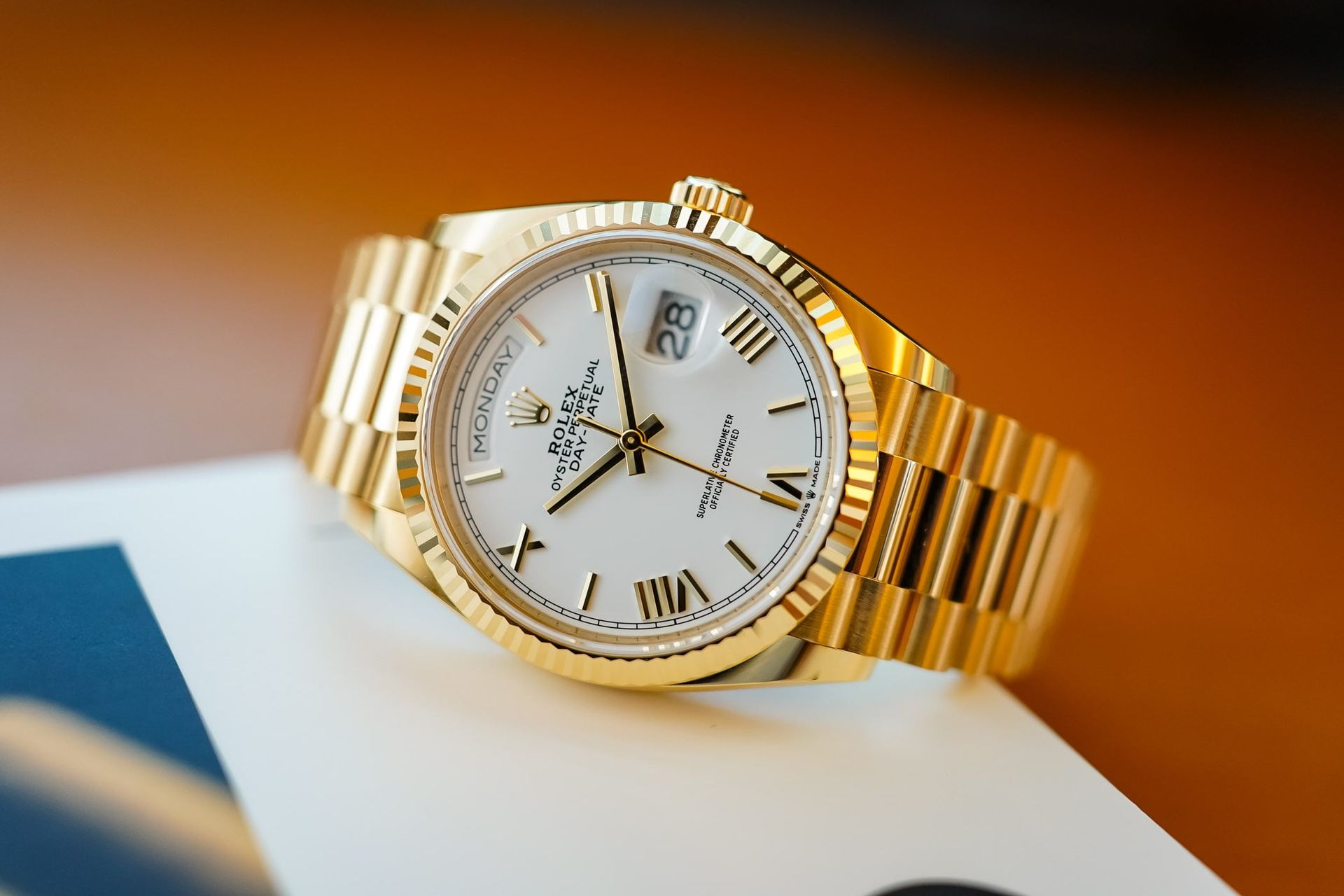
Rolex introduced the Day-Date in 1956 as the crowning expression of the Oyster Perpetual line. It was the first wristwatch to show the date and the day of the week written out in full, the latter in an arched window at 12 o'clock, with the date under a Cyclops lens at 3 o'clock. Crucially, it was offered exclusively in 18-carat gold or platinum — never steel — positioning it from day one as a watch of status rather than utility. The original 36mm references included the smooth-bezel ref. 6510 and the fluted-bezel ref. 6511 .
The earliest examples shipped on a Jubilee bracelet, but Rolex soon developed a bracelet exclusively for the model: the three-piece, semi-circular-link President bracelet . That bracelet — and the association with heads of state that followed — gave the Day-Date its enduring nickname.
Why "The President"?
The "President" nickname is tied both to the bracelet and to the watch's wearers. American presidents Dwight Eisenhower and Lyndon B. Johnson were famously photographed with Day-Dates, and the model became shorthand for achievement at the highest level. Rolex leaned into the association, and today "President" is used colloquially for the Day-Date and its bracelet alike, though Rolex's own name for the watch remains simply Day-Date.
Movement Evolution
The Day-Date has always housed Rolex's most refined automatic movements. Early examples used the caliber 1055; the long-running caliber 3155 (with the Rolex-designed day and date mechanism) powered the 36mm model for decades. In 2015, the Day-Date 40 introduced the modern caliber 3255 — developed largely from scratch with fourteen patents, the high-efficiency Chronergy escapement, a Parachrom hairspring, and an approximately 70-hour (three-day) power reserve. Like all current Rolex movements it carries the Superlative Chronometer certification, rated to −2/+2 seconds per day.
The Current Collection
Today the Day-Date is offered in two case sizes — 36mm and 40mm — across four precious metals: yellow gold, white gold, Everose gold and 950 platinum. The 40mm references (such as the yellow-gold 228238 and Everose 228235 ) use the caliber 3255; the 36mm line (references in the 128 -series, e.g. 128238) uses the closely related caliber 3235. Dial choices range from classic champagne and lacquer colours to hardstone and meteorite, and platinum models carry Rolex's signature ice-blue dial. The fluted bezel and President bracelet remain the defining Day-Date signatures, though smooth bezels and leather straps are also offered.
The Day-Date and the Datejust
The Day-Date is often compared to the Datejust, with which it shares a silhouette. The key differences are material and complication: the Datejust is available in steel and shows only the date, while the Day-Date is precious-metal-only and adds the spelled-out day. In the Rolex hierarchy the Day-Date sits at the top of the classic (non-professional) range, above the Datejust and alongside travel-oriented models such as the Sky-Dweller.
Frequently Asked Questions
What is the Rolex Day-Date?
Introduced in 1956, the Day-Date is Rolex's precious-metal flagship and the first wristwatch to display the day of the week in full at 12 o'clock alongside the date at 3 o'clock. It is nicknamed "the President."
Why is it called the President?
The name comes from the President bracelet developed for the model and from its association with presidents and world leaders who wore it, including Eisenhower and Johnson.
Is the Day-Date available in steel?
No. The Day-Date has only ever been made in 18k gold (yellow, white, Everose) or platinum — never stainless steel. A steel, date-only alternative is the Datejust.
What movement does the current Day-Date use?
The Day-Date 40 uses the caliber 3255 (three-day power reserve, Chronergy escapement, Superlative Chronometer −2/+2 sec/day); the 36mm models use the related caliber 3235.
What sizes does the Day-Date come in?
Two sizes: 36mm and 40mm (the Day-Date 40, launched in 2015).