Ulysse Nardin Marine Chronometer: History of the Navigation Heritage Watch
The Ulysse Nardin Marine Chronometer is the wristwatch expression of the most consequential chapter in the brand's history. For over a century — from its 1846 founding through 1958 — Ulysse Nardin was the world's leading manufacturer of marine chronometers: the precision navigation instruments that naval vessels and merchant fleets used to determine longitude at sea. The brand won 4,324 first prizes in international precision trials at the Geneva, Neuchâtel, Kew, Paris, and Brussels observatories, and supplied chronometers to the navies of 50 nations including the US Navy, the Royal Navy, the French Navy, and the Italian Navy. When Rolf Schnyder revived the brand in 1983, the Marine Chronometer wristwatch was the natural vehicle for restoring that heritage — a dress watch with genuine navigational pedigree, now carrying the in-house UN-118 movement with DIAMonSIL escapement descended from the silicon revolution that began with the 2001 Freak.
The Marine Chronometer Heritage: Navigation Before GPS
Before GPS became available to civilian vessels in the 1980s and 1990s, ships determined their longitude using a marine chronometer. The method, developed in the 18th century by British clockmaker John Harrison, required comparing the time of local solar noon to the time at the Greenwich meridian as kept by a precision clock aboard the ship. An error of four seconds in the chronometer translated to one nautical mile of positional error at the equator. An error of a minute could mean catastrophic navigational failure.
Ulysse Nardin's marine chronometers — housed in specially gimballed wooden boxes mounted in the ship's chart room — were trusted because they maintained accuracy to within 0.1–0.3 seconds per day under shipboard conditions: vibration, temperature extremes, humidity, and the constant motion of a vessel at sea. This precision standard, maintained across hundreds of individual instruments tested at the world's major observatories, gave the brand its unequalled record of 4,324 first prizes from 1846 to 1958. The brand won the Grand Prix at the 1900 Paris World's Fair for chronometer excellence, at the height of its navigational authority.
The Modern Marine Chronometer: From 1996 to Today
When Rolf Schnyder revived Ulysse Nardin in 1983 and launched the Freak in 2001, the brand's mainstream production needed a watchcase that carried the navigation heritage without the avant-garde complexity of the Freak. The Marine Chronometer line — introduced in 1996 as the Marine Chronometer 1846 to mark the brand's 150th anniversary — became that vehicle.
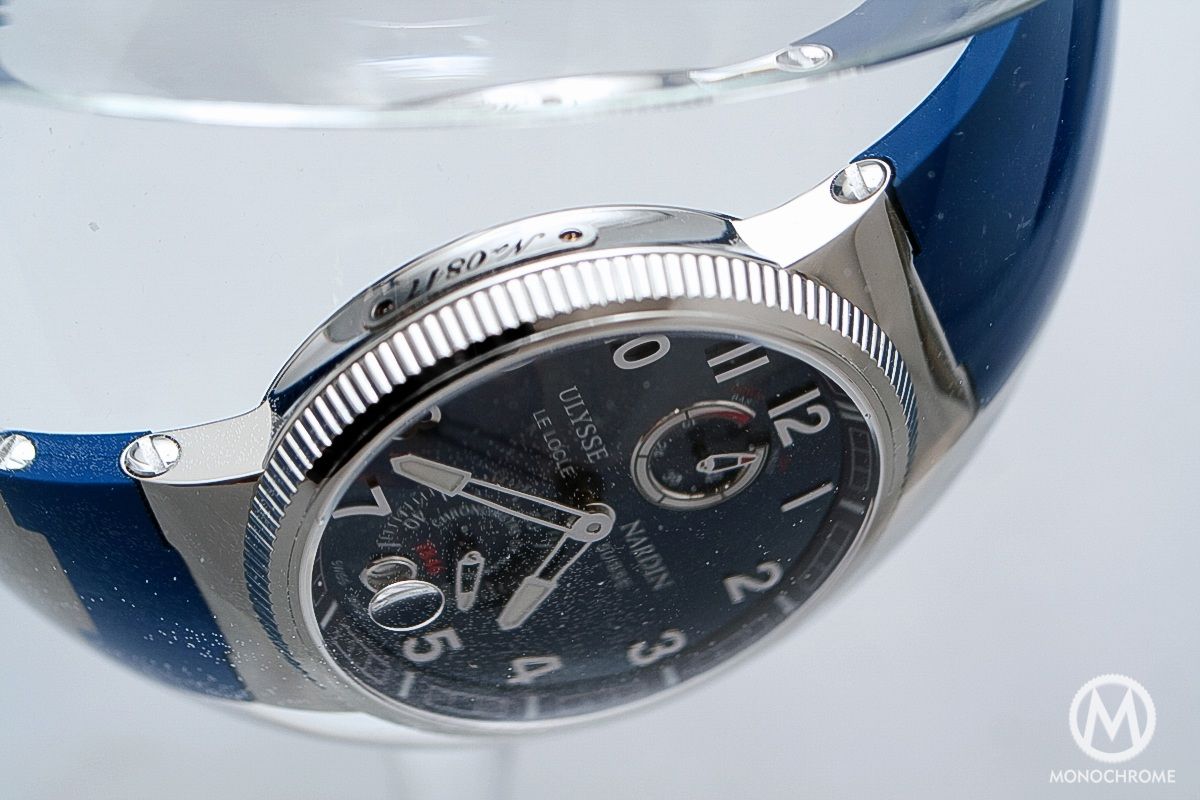
The 150th anniversary edition was limited to 150 pieces in rose gold and established the design language that would define the Marine Chronometer wristwatch: the guilloché dial, the fluted lugs, the power reserve indicator at 6 o'clock, the navy blue colorway referencing maritime context. These design elements deliberately echoed the aesthetic of 19th-century navigational instruments — the same precision objects that had made the brand's reputation — brought into a modern wristwatch format.
The current production Marine Chronometer 1183 series carries this language forward. The 40mm or 43mm stainless steel case — clean, proportional, not aggressive — wears as a serious dress watch with sport watch credentials. The guilloché dial work, still applied by traditional engine-turning in some variants, provides texture that changes under different lighting conditions. Blued steel hands — thermally treated to develop their characteristic oxide color — appear on some references, maintaining a craft element that most comparable watches at the price point have abandoned.
The UN-118 Movement: Silicon Technology in the Heritage Line
The Marine Chronometer's most significant specification is technical rather than aesthetic: the Calibre UN-118 , introduced at Baselworld 2012, brings the silicon technology lineage of the Freak into the mainstream collection. The UN-118 features Ulysse Nardin's proprietary DIAMonSIL escapement — a patented alloy of diamond and silicon applied to the escape wheel and pallet lever — and a silicon balance spring. Together, these components eliminate lubrication requirements at the escapement, dramatically reducing service intervals and improving long-term accuracy stability.
The UN-118 beats at 28,800 vph (4 Hz) and delivers a 60-hour power reserve — the power reserve indicator at 6 o'clock on many Marine Chronometer references is a functional reference to the navigational tradition of monitoring when an instrument needed winding. The movement is COSC-certified as a chronometer, meaning it meets the -4/+6 seconds per day standard of the Official Swiss Chronometer Testing Institute. At the Marine Chronometer's price point, a COSC-certified in-house movement with silicon escapement technology is a substantive specification advantage.
| Reference | Case | Movement | Complication | Price (approx.) |
|---|---|---|---|---|
| 1183-122 | 40mm SS | UN-118 | Date, power reserve | ~$8,500–$10,000 |
| 1186-122 | 43mm SS | UN-118 | Date, power reserve | ~$9,500–$12,000 |
| 1133 (Annual Calendar) | 43mm SS | UN-113 | Annual calendar | ~$12,000–$15,000 |
| Marine Perpetual | 43mm SS/RG | UN-115 | Perpetual calendar | ~$20,000+ |
| 1183 Rose Gold | 40mm RG | UN-118 | Date, power reserve | ~$20,000–$35,000 |
Design Elements: What Makes a Marine Chronometer Authentic
The Marine Chronometer's design literacy is specific and intentional. Guilloché dial decoration — concentric rings, radial sunburst, or "clous de Paris" (hobnail) patterns — is applied via a traditional engine-turning lathe, a craft process that produces a surface texture that catches and reflects light in a way that printed or stamped dials cannot replicate. The pattern depth and consistency in guilloché work is a direct indicator of artisanal investment at the dial-making stage.
The power reserve indicator is not merely decorative. Marine chronometers required daily or weekly winding discipline from navigators — the consequence of letting the instrument run down was potentially catastrophic positional error. A power reserve display on a wristwatch is a historical reference to that operational requirement, even if the modern navigator uses GPS. The Marine Chronometer's use of this complication gives the watch a functional justification its competitors — which also display power reserve — cannot match with equal depth of context.
Navy blue dials are the most common colorway because the maritime reference is direct and legible. Some limited editions carry enamel dials depicting nautical subjects — ships, charts, navigational instruments — produced by specialist enamel houses using grand feu (kiln-fired) cloisonné techniques. These limited editions are among the most technically complex objects in the Marine Chronometer catalog and are collected as much for their artisanal content as their movement specifications.
Primary reference: 1183 series (40mm) and 1186 series (43mm)
Movement: Calibre UN-118 automatic | 28,800 vph | 60-hour power reserve
Escapement: DIAMonSIL (diamond-silicon composite) | Silicon balance spring
Certification: COSC chronometer | Water resistance: 100m
Case materials: Stainless steel (primary); 18K rose gold (premium) | Price from: ~$8,500
Frequently Asked Questions
What is the Ulysse Nardin Marine Chronometer?
The Ulysse Nardin Marine Chronometer is a dress/sport watch line that carries the brand's 180-year marine navigation heritage into current production. It uses the in-house Calibre UN-118 with DIAMonSIL escapement, COSC chronometer certification, and design elements — guilloché dials, power reserve indicator, navy blue colorways — that reference the 19th-century navigation chronometers that made Ulysse Nardin famous.
What movement does the Ulysse Nardin Marine Chronometer use?
The Calibre UN-118 — an in-house automatic movement introduced in 2012, beating at 28,800 vph with a 60-hour power reserve. The UN-118 features Ulysse Nardin's proprietary DIAMonSIL escapement (diamond-silicon composite) and a silicon balance spring, eliminating lubrication requirements at the escapement and improving long-term accuracy.
How much does the Ulysse Nardin Marine Chronometer cost?
The stainless steel Marine Chronometer 1183 starts at approximately $8,500–$10,000. Larger 43mm references (1186 series) run $9,500–$12,000. Annual calendar and perpetual calendar variants command higher prices; rose gold examples start around $20,000.
What is the difference between a COSC chronometer and a standard watch?
COSC (Official Swiss Chronometer Testing Institute) certifies movements that meet -4/+6 seconds per day accuracy across five positions and three temperatures over 16 days of testing. The UN-118's COSC certification means each movement is individually tested and verified, not rated by the manufacturer's own standards.
Sources: Ulysse Nardin (ulysse-nardin.com), Quill & Pad, Fratello Watches, WatchTime, Teddy Baldassarre, SJX Watches.