Ulysse Nardin Freak: History of the 2001 Watch That Rewrote the Rules of Mechanical Timekeeping
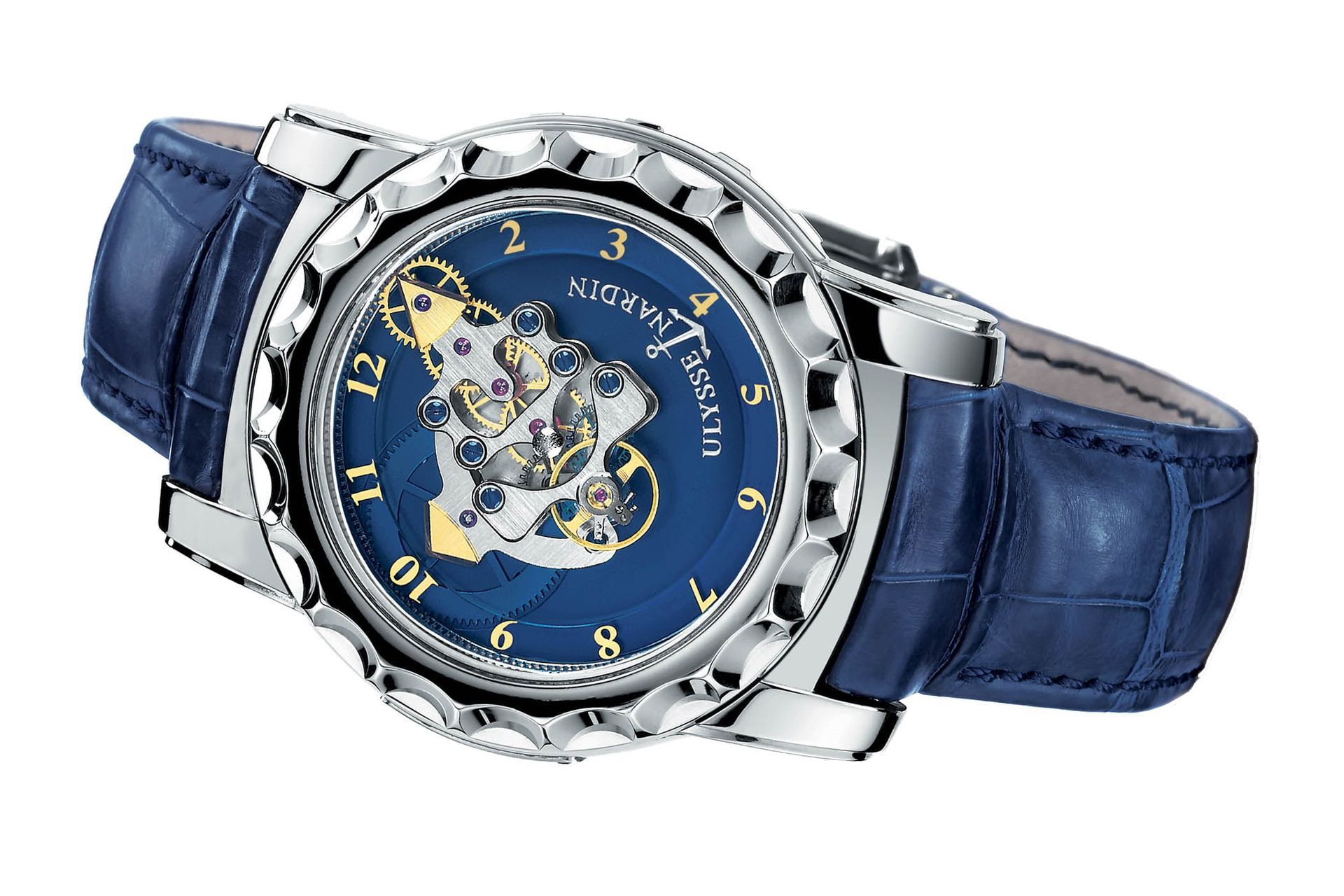
The Ulysse Nardin Freak , debuted at the Basel World Watch Fair in 2001 , is one of the most consequential watches ever made — not because of its price or its rarity but because of what it changed. The Freak was the first wristwatch in the world to use silicon in its escapement , introducing a material that eliminated the need for lubrication at the escapement and proved that centuries-old assumptions about watch movement materials were not inviolable. It was also the first production watch with no crown (wound by rotating the outer bezel), no hands (the movement itself rotates to indicate time), and no dial (the movement is the display). The name acknowledged all of this: Freak was chosen because the watch broke every rule.
The Freak was designed by Ludwig Oechslin , the Swiss watchmaker and director of the International Museum of Horology (MIH) in La Chaux-de-Fonds, working for Ulysse Nardin under owner Rolf Schnyder . Oechslin had already designed the Trilogy of Time — the Astrolabium (1985), Planetarium Copernicus (1988), and Tellurium Johannes Kepler (1992) — which had re-established Ulysse Nardin's credibility in high complication watchmaking. The Freak was his most radical departure. The case architecture was developed with Donzé Baume .
The Silicon Escapement: What Changed and Why
Every mechanical watch requires lubrication at the escapement — the mechanism that regulates the release of energy from the mainspring. Traditional lubricants degrade over time, which is why mechanical watches require periodic servicing. Silicon's properties make it fundamentally different from traditional escapement materials (steel and brass): it is self-lubricating, non-magnetic, extremely low in coefficient of friction, and can be machined to tolerances impossible with metal.
The Freak's silicon components — the escape wheel and pallet lever — were produced via the LIGA process (Lithographie, Galvanoformung, Abformung: photolithography plus electroforming), a microfabrication technique borrowed from the semiconductor industry. This enabled dimensional precision at the micron level, far beyond what conventional watchmaking machining could achieve. The silicon escape wheel teeth meshed with silicon pallet stones that required no lubrication to function correctly. For the first time in the history of the lever escapement, the component requiring the most maintenance attention was self-maintaining.
The Swiss industry's response was immediate. LVMH-owned watch brands began silicon research programs within months of the Freak's Basel debut. Patek Philippe announced a silicon development program. IWC explored silicon components. Rolex developed its Syloxi silicon hairspring, introduced commercially in 2014 — thirteen years after the Freak. Ulysse Nardin's head start gave it a technology leadership position that has never fully closed.
The Mechanism: How the Freak Tells Time
The Freak has no hands. Instead, the entire movement — the barrel, the gear train, the escapement — is mounted on a central axis and rotates once per hour. The movement assembly itself is the minute indicator: the tip of the movement reaches the current minute position on the chapter ring at the case edge. Hours are indicated by a disc at 12 o'clock that rotates once every twelve hours.
This architecture — officially described by Ulysse Nardin as a "carrousel tourbillon" — functions as a gravity-compensation mechanism. Because the entire movement rotates continuously on the same axis, gravity's effect on the balance wheel averages out over the course of each rotation. The mechanism achieves the timing correction of a tourbillon through a fundamentally different architectural approach: not a cage rotating around the balance wheel, but the entire movement rotating around a central axis.
The watch has no crown. The outer bezel winds the mainspring when rotated clockwise. The inner bezel ring (the "lunette") sets the time. These two controls require deliberate engagement rather than casual adjustment — the Freak is a watch that demands attention from its wearer, which is appropriate for an object that is partly horological art piece.
Reference Evolution: 2001 to Present
| Year | Model | Key Innovation |
|---|---|---|
| 2001 | Freak (Original) | First silicon escapement; carrousel rotation; no crown; no hands |
| 2004 | Freak Diavolo | Added second time zone indicator |
| 2005 | Freak Blue Phantom | Dark aesthetic with blue accents |
| 2010 | Freak Out | Double differential gear; tri-axial carousel |
| 2015 | Freak Vision | 7-day power reserve; bi-axial tourbillon |
| 2018 | Freak NeXt | Three-axis tourbillon; hydrodynamic bearings |
| 2018 | Freak One | Simplified Freak concept; entry-level Freak price point |
| 2019 | Freak X | Automatic winding; conventional crown; 43mm; ~$18,000 |
Original Freak Specifications
The first Freak launched in a 44.2mm platinum case , 14.1mm thick, with sapphire crystals on both sides — the movement is visible from both the dial and the caseback. Water resistance was 30m, a practical limitation given that the bezel and lunette ring must be accessible for winding and time-setting. The movement ran at 3 Hz (21,600 bph), slower than most contemporary automatics, optimized for the 7-day (168-hour) power reserve that the barrel provided. The first edition was priced at approximately USD 53,000 in platinum.
Rose gold and white gold variants followed. Subsequent generations added complications, refined the silicon components (eventually integrating DIAMonSIL — Ulysse Nardin's diamond-silicon composite — replacing the original pure silicon), and explored increasingly extreme case architectures. Current full Freak variants range from USD 60,000 to over USD 200,000 depending on complication tier and case material.
Original (2001): 44.2mm platinum | 14.1mm thick | Hand-wound via bezel | 7-day power reserve
Escapement: Silicon escape wheel + pallet (first in production wristwatch history)
Time indication: Rotating movement (minute) + hour disc — no hands
Case controls: Outer bezel (wind) + inner lunette ring (time set) — no crown
Price (original, 2001): ~USD 53,000 platinum | Current full Freak: $60,000–$200,000+
Frequently Asked Questions
Why is the Ulysse Nardin Freak historically significant?
The 2001 Freak was the first wristwatch in the world to use silicon in its escapement, giving Ulysse Nardin a 5–7 year technological lead over Rolex, Patek Philippe, and other major Swiss manufacturers in silicon movement technology. It was also the first production watch with no crown and no hands, introducing entirely new conventions for winding and time reading.
How does the Freak tell time without hands?
The entire movement rotates once per hour on a central axis. The tip of the rotating movement assembly points to the current minute on the chapter ring at the case edge. Hours are indicated by a disc at 12 o'clock that rotates once every twelve hours. The movement itself is the "hand."
How do you wind and set the Ulysse Nardin Freak?
The outer bezel winds the mainspring when rotated clockwise. The inner lunette ring (the smaller inner bezel) sets the time. The watch has no traditional crown at all — both functions are performed via the case bezels.
What does "Freak" mean on this watch?
The name was chosen by then-brand director Patrick Marchais to acknowledge that the watch broke every traditional rule: no hands, no crown, movement as display, silicon in the escapement. "Freak" was an honest description of how far outside watchmaking convention the design lay in 2001.
Is the Ulysse Nardin Freak still made?
Yes. The full Freak line continues in production, with current variants including the Freak Vision (7-day power reserve, bi-axial tourbillon) and Freak NeXt (three-axis tourbillon). The more accessible Freak X ($18,000–$35,000) uses an automatic movement and conventional crown, bringing the rotating movement time display to a wider audience. See the Freak X guide for the accessible variant.
Sources: Ulysse Nardin (ulysse-nardin.com), Hodinkee, Quill & Pad, Fratello Watches, Monochrome Watches, Wikipedia.