Glashütte Original PanoSeries: Off-Centre Dials and German Modernism
The PanoSeries is Glashütte Original's most visually distinctive collection — and the one most often cited when the brand is credited with a genuinely original design contribution to watchmaking. Where most luxury dress watches place the hour and minute hands at the dial's centre, the PanoSeries shifts the main time display off-centre, creating an asymmetric dial layout that reads immediately as something different from the Swiss establishment.
The Off-Centre Architecture
Photo: Ferengi — CC BY-SA 3.0 — Wikimedia Commons
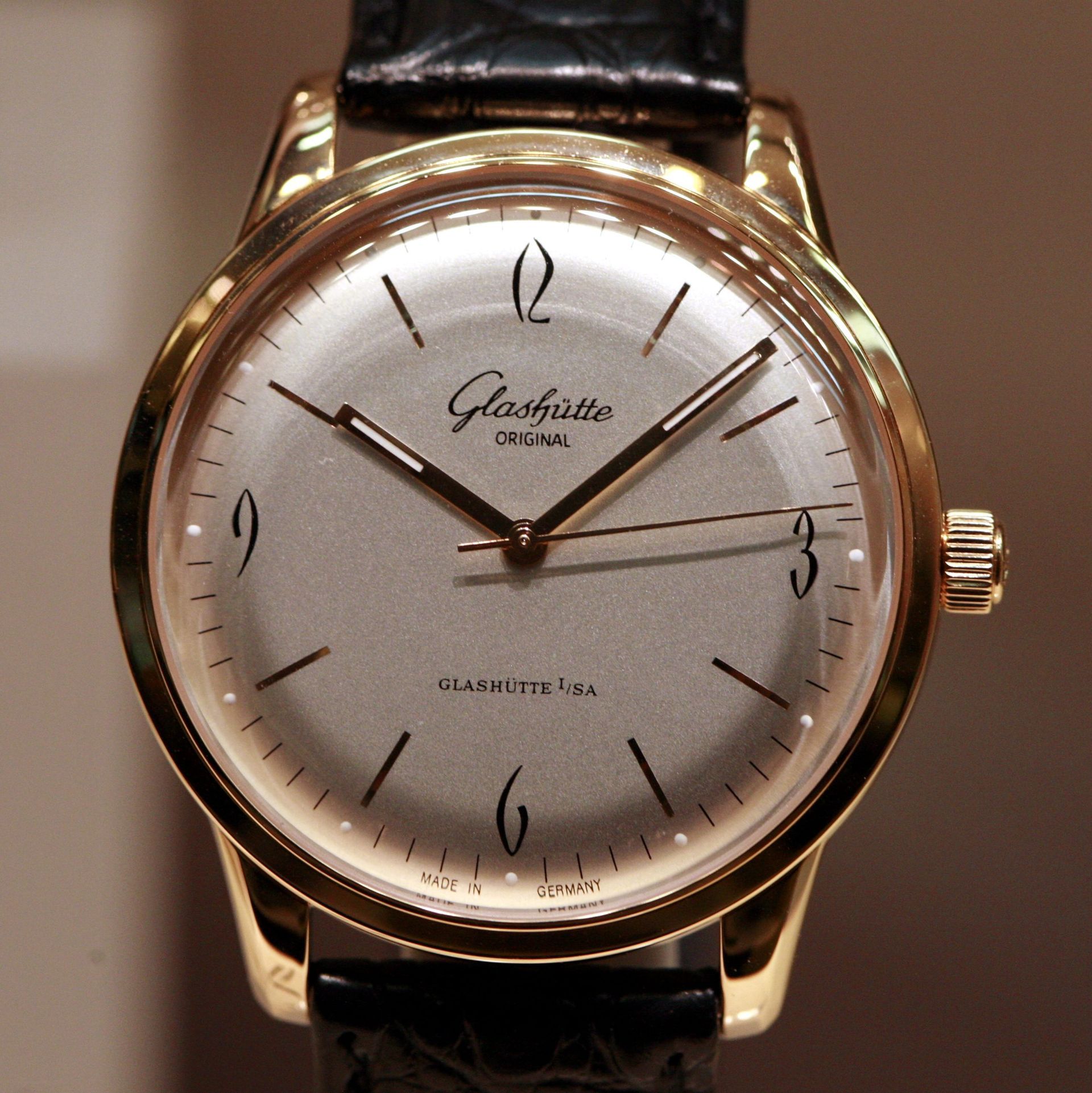
The defining characteristic of all PanoSeries watches: the main time display is positioned to the upper left of the dial , not at the centre. The remaining dial space to the right accommodates subsidiary displays — seconds, power reserve, moonphase, or date depending on the reference.
The movement architecture that enables this: Calibre 90 series movements are designed with the going train offset from the dial's centre, allowing the hands to be positioned at the upper left without requiring complex intermediate gearing. This is a genuine movement design choice, not a cosmetic overlay applied to a standard movement.
The visual effect: a panoramic (hence "Pano") view of the dial, with the main display occupying the dominant left third and the subsidiary information arranged on the right. The asymmetry is disciplined rather than arbitrary — it follows clear visual logic.
PanoMaticLunar — The Signature Reference
Photo: Rama — CC BY-SA 2.0 FR — Wikimedia Commons
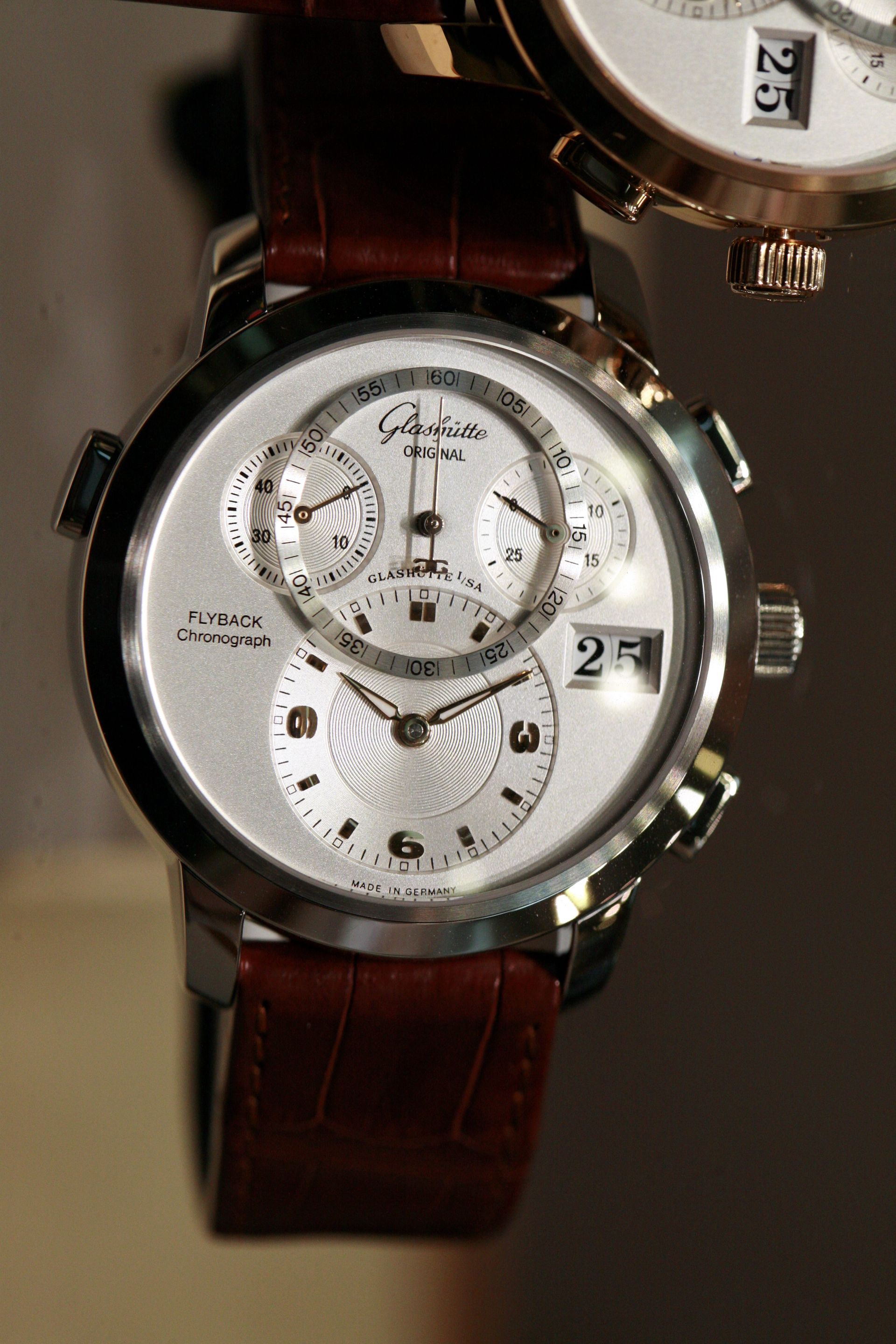
The PanoMaticLunar is the PanoSeries reference that best expresses the collection's design intent:
| Specification | Detail |
|---|---|
| Calibre | 90-02 |
| Display | Off-centre time (upper left), date (lower left), moonphase (right) |
| Power reserve | 55 hours |
| Frequency | 28,800 vph |
| Case | 40mm, rose gold or steel |
The moonphase display occupies the right portion of the dial — a large aperture showing the lunar disc against a night-sky background. The off-centre time display, combined with the date at lower left and moonphase at right, creates a dial architecture that presents three information elements in clear visual hierarchy without crowding.
The moonphase accuracy: one 29.5-day correction every 122 years — achieved through a 135-tooth lunar wheel that advances the moon disc 0.9856° per day (the precise average daily lunar motion of 360° ÷ 29.5306 days).
PanoReserve
Photo: Rama — CC BY-SA 2.0 FR — Wikimedia Commons
The PanoReserve adds a power reserve indicator to the PanoSeries architecture:
| Specification | Detail |
|---|---|
| Calibre | 65-01 |
| Display | Off-centre time, power reserve indicator (right) |
| Power reserve | 45 hours |
| Case | 40mm, steel or gold |
The power reserve indicator occupies the right arc of the dial — a sector display showing reserve from fully wound to depleted. In the PanoSeries context, this becomes an additional visual element in the asymmetric composition rather than merely a functional indicator.
PanoInverse
Photo: Rama — CC BY-SA 2.0 FR — Wikimedia Commons
The PanoInverse reverses the standard three-quarter plate movement orientation to display the plate on the dial side, visible through a partially open dial:
| Specification | Detail |
|---|---|
| Calibre | 65-01 (inverted) |
| Display | Off-centre time, movement visible through dial |
| Case | 42mm, gold |
Inverting a movement to show the finishing on the dial side — where the viewer sees it directly rather than requiring the watch to be turned over — is technically demanding: the movement must be redesigned so that the going-train side (normally the dial side) becomes the decorative side. The PanoInverse achieves a watch where the Glashütte three-quarter plate and Glashütte ribbing are visible through the dial rather than only through the caseback.
PanomaticCentral
Photo: Thomasbj — CC BY-SA 3.0 — Wikimedia Commons
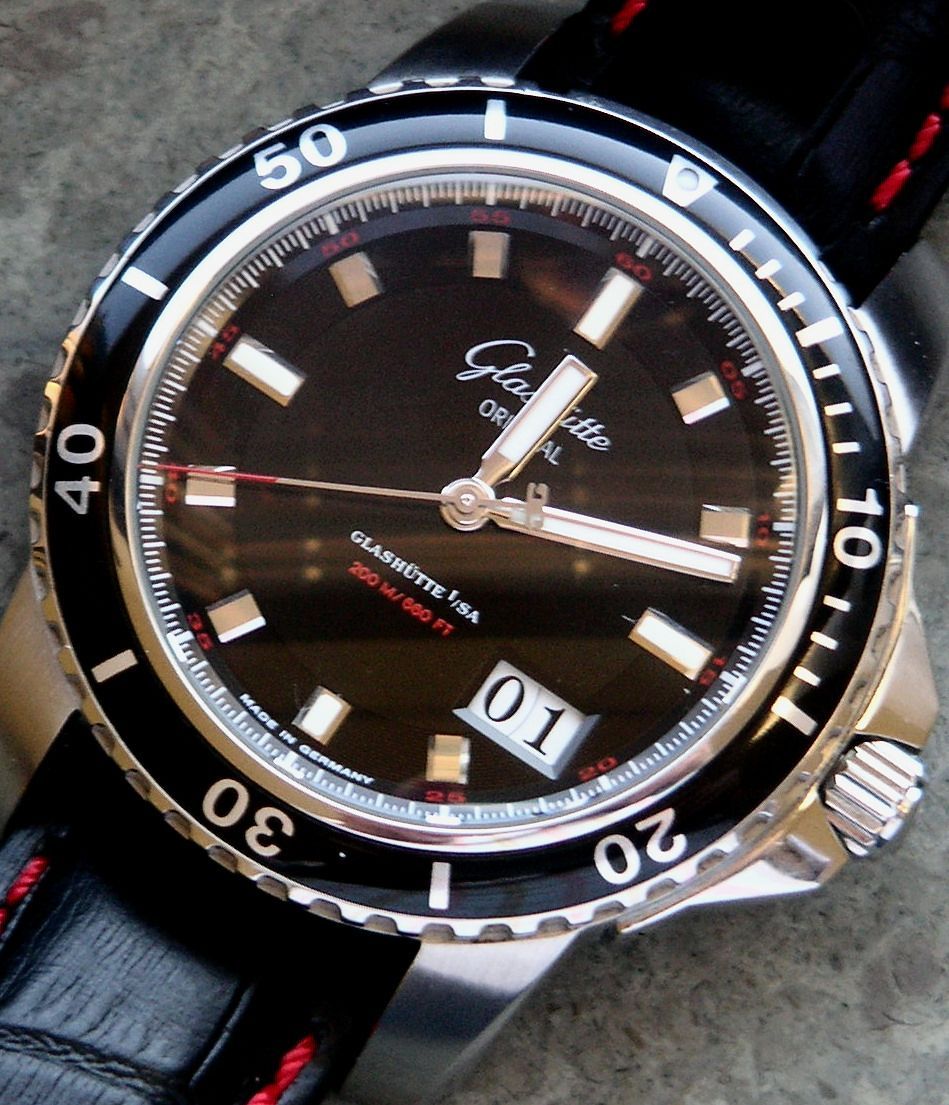
The PanomaticCentral returns the hour and minute hands to a central position while maintaining other PanoSeries design elements — the dial subdivision, the use of a large subdial for seconds, and the overall visual language. It bridges the asymmetric Pano design with more conventional readability preferences.
PanoSeries in Context
Photo: Thomasbj — CC BY-SA 3.0 — Wikimedia Commons
The PanoSeries emerged in the early 2000s as Glashütte Original's attempt to create a visual identity distinct from both Swiss competitors and from the Senator's classical German conservatism. The off-centre display had precedent in historical pocket watches and a small number of wristwatches, but Glashütte Original's systematic application to an entire collection was novel.
The result gave the brand something it needed: a collection that watch enthusiasts would photograph, discuss, and identify immediately as Glashütte Original. The PanoSeries became the brand's most discussed collection, appearing regularly in enthusiast media as an example of genuine design innovation within the luxury watch industry.
Price range: approximately €8,000–€25,000 depending on material and complication.