Glashütte Original Calibres: In-House Movements from Saxon Germany
The movement is the argument. Glashütte Original's claim to manufacture status — to being more than an assembler of bought-in calibres — rests on the range and quality of its in-house movement production. The calibre family that the Glashütte manufacture produces spans from robust sport movements to ultra-complex grand complication calibres, all sharing the finishing traditions that define the Saxon watchmaking style.
The Manufacture — Glashütte, Saxony
Photo: Thomasbj — CC BY-SA 3.0 — Wikimedia Commons
Glashütte Original's primary facility is in Glashütte itself — the Saxon town approximately 30 kilometres south of Dresden that has been the centre of German fine watchmaking since 1845.
The manufacture produces movement components (plates, bridges, wheels, jewels), assembles and regulates movements, and performs final quality control — all in Glashütte. The "Made in Glashütte" designation is protected by German watchmaking law: a watch cannot claim Glashütte origin unless at least 50% of its movement's value is produced within the town's postal code. Glashütte Original's calibres exceed this threshold comfortably.
The facility occupies a modern building on the edge of the town, constructed after the Swatch Group acquisition in 2000 to replace and expand the inherited GUB facilities. Approximately 500 employees work across the Glashütte site.
Three-Quarter Plate — The Saxon Architecture
Photo: Rama — CC BY-SA 2.0 FR — Wikimedia Commons
All Glashütte Original calibres share the three-quarter plate architecture — the defining element of the Saxon watchmaking tradition:
The three-quarter plate is a large single plate covering approximately three-quarters of the movement's back surface. In Swiss movement architecture, the equivalent area is covered by separate bridges — one for each arbor. The three-quarter plate provides greater rigidity (more material, fewer joints), a more unified visual appearance, and — critically — a larger surface area for the application of Glashütte finishing.
The trade-off: the three-quarter plate requires higher manufacturing precision. Because the plate covers multiple arbors simultaneously, its pivot hole positions must be extremely accurate — a misaligned hole cannot be corrected by adjusting an individual bridge.
Calibre 36 Series — The Foundation
Photo: Rama — CC BY-SA 2.0 FR — Wikimedia Commons
The Calibre 36 series forms the foundation of Glashütte Original's movement range:
| Specification | Cal. 36-01 | Cal. 36-03 |
|---|---|---|
| Type | Automatic | Automatic |
| Power reserve | 40 hours | 55 hours |
| Frequency | 28,800 vph | 28,800 vph |
| Jewels | 38 | 42 |
| Height | 5.9mm | ~6.5mm |
The Cal. 36-03 (55-hour reserve) powers the current Senator Excellence. The extended power reserve over the earlier Cal. 36-01 was achieved through a redesigned barrel and mainspring geometry — larger effective mainspring volume within the same case footprint.
Calibre 39 Series — Chronograph
Photo: Thomasbj — CC BY-SA 3.0 — Wikimedia Commons
The Calibre 39 series powers the Senator Chronograph references:
| Specification | Cal. 39-31 |
|---|---|
| Type | Automatic flyback chronograph |
| Chronograph mechanism | Column-wheel |
| Power reserve | 60 hours |
| Frequency | 28,800 vph |
The column-wheel chronograph mechanism — in which a rotating column wheel controls the chronograph's start, stop, and reset functions — provides more consistent, tactile pusher feel than a simpler cam mechanism. The column wheel's rotating columns physically block or release the relevant levers, creating a precise, predictable actuation sequence.
Calibre 65 Series — Calendar
Photo: Rama — CC BY-SA 2.0 FR — Wikimedia Commons
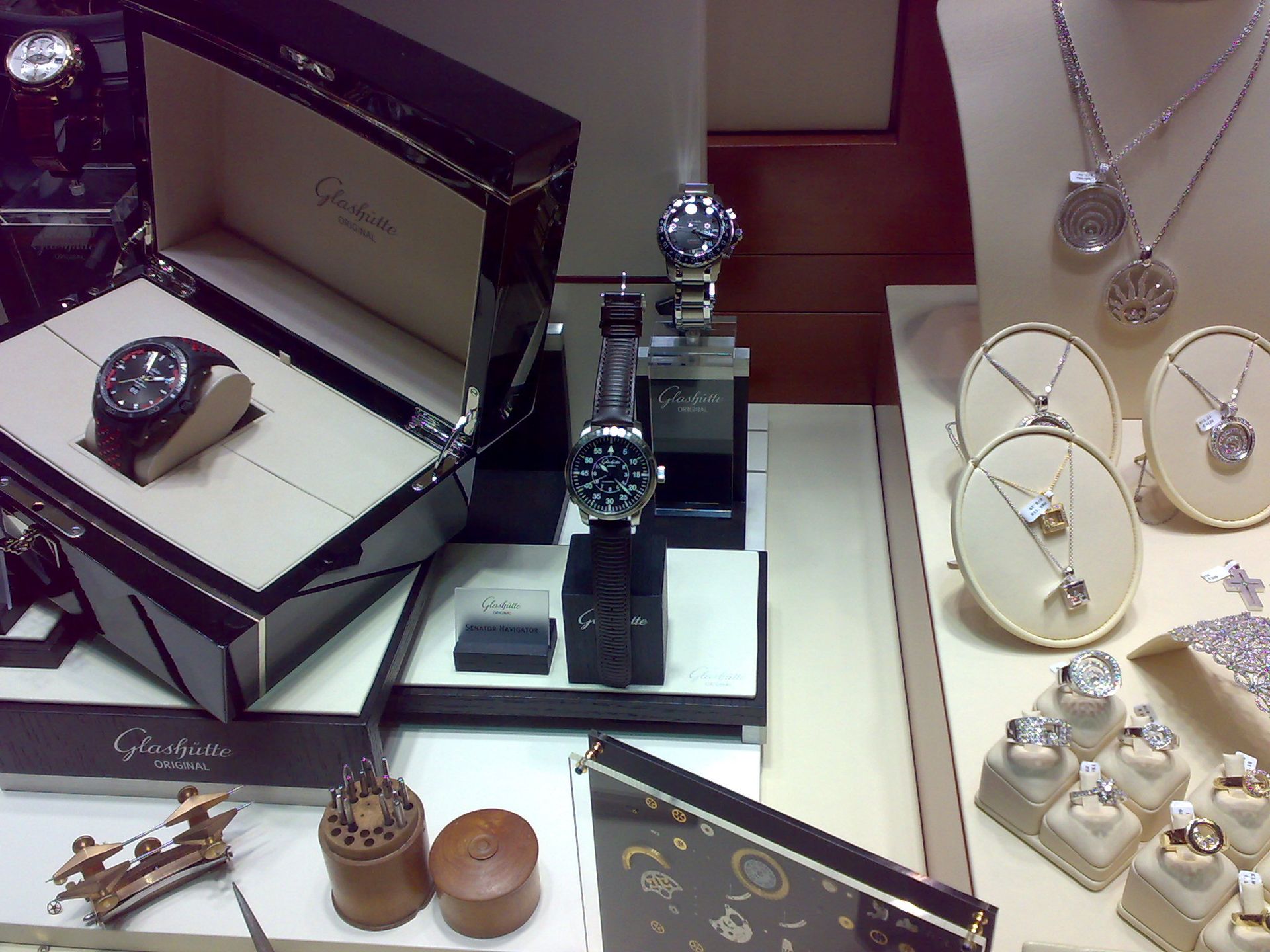
The Calibre 65 series powers the Senator Perpetual Calendar and annual calendar references:
| Specification | Cal. 65-02 |
|---|---|
| Type | Automatic perpetual calendar |
| Power reserve | 55 hours |
| Frequency | 28,800 vph |
| Complications | Perpetual calendar + moonphase |
The 65-02's perpetual calendar mechanism is integrated within the base calibre rather than applied as a stacked module — a design choice that keeps the total movement height lower and provides more reliable calendar/going-train interaction.
Calibre 89 and 90 Series — PanoSeries
The Calibre 89 and 90 series are designed specifically for the PanoSeries off-centre dial architecture:
- Cal. 89-02: World time complication (Cosmopolite)
- Cal. 90-02: PanoMaticLunar (off-centre time, moonphase, date)
- Cal. 90-05: PanoReserve (off-centre time, power reserve)
These calibres have the going train positioned off-centre from the movement's geometric centre — the movement design enables the hands to be positioned at the upper left rather than at the dial's centre. This requires a custom gear train layout that cannot be achieved by adapting a standard centred movement.
Calibre 94 Series — Tourbillon
The Calibre 94 series powers Glashütte Original's tourbillon references:
| Specification | Cal. 94-11 |
|---|---|
| Type | Manual-wind flying tourbillon |
| Power reserve | 72 hours |
| Frequency | 21,600 vph |
| Cage rotation | One revolution per minute |
The lower frequency (21,600 vph versus the standard 28,800 vph) is a traditional choice for tourbillon calibres — at lower frequencies, the tourbillon cage requires less driving force, which is advantageous when the cage's mass must be minimised for rotational efficiency.
Glashütte Finishing — The Standard Applied to All Calibres
Photo: Ferengi — CC BY-SA 3.0 — Wikimedia Commons
Across all Glashütte Original calibres, a consistent finishing standard applies:
- Three-quarter plate: The Saxon architectural signature
- Glashütte ribbing: Fine parallel striping on plate and bridge surfaces
- Bevelled anglage: Hand-polished bevels on all plate and bridge edges
- Blued screws: Heat-treated screws with oxide blue finish
- Screw-set chatons: Gold-mounted jewel bearings in selected calibres
- Côtes de Genève: On bridge surfaces in some calibres
These finishing operations are performed by hand — the anglage in particular cannot be replicated by machine to the same standard. The bevelling of an edge must be done at a consistent angle under magnification, by a hand holding a polishing stick at the correct geometry.