Ulysse Nardin El Toro and Black Toro: History of Ludwig Oechslin's Perpetual Calendar Masterpiece
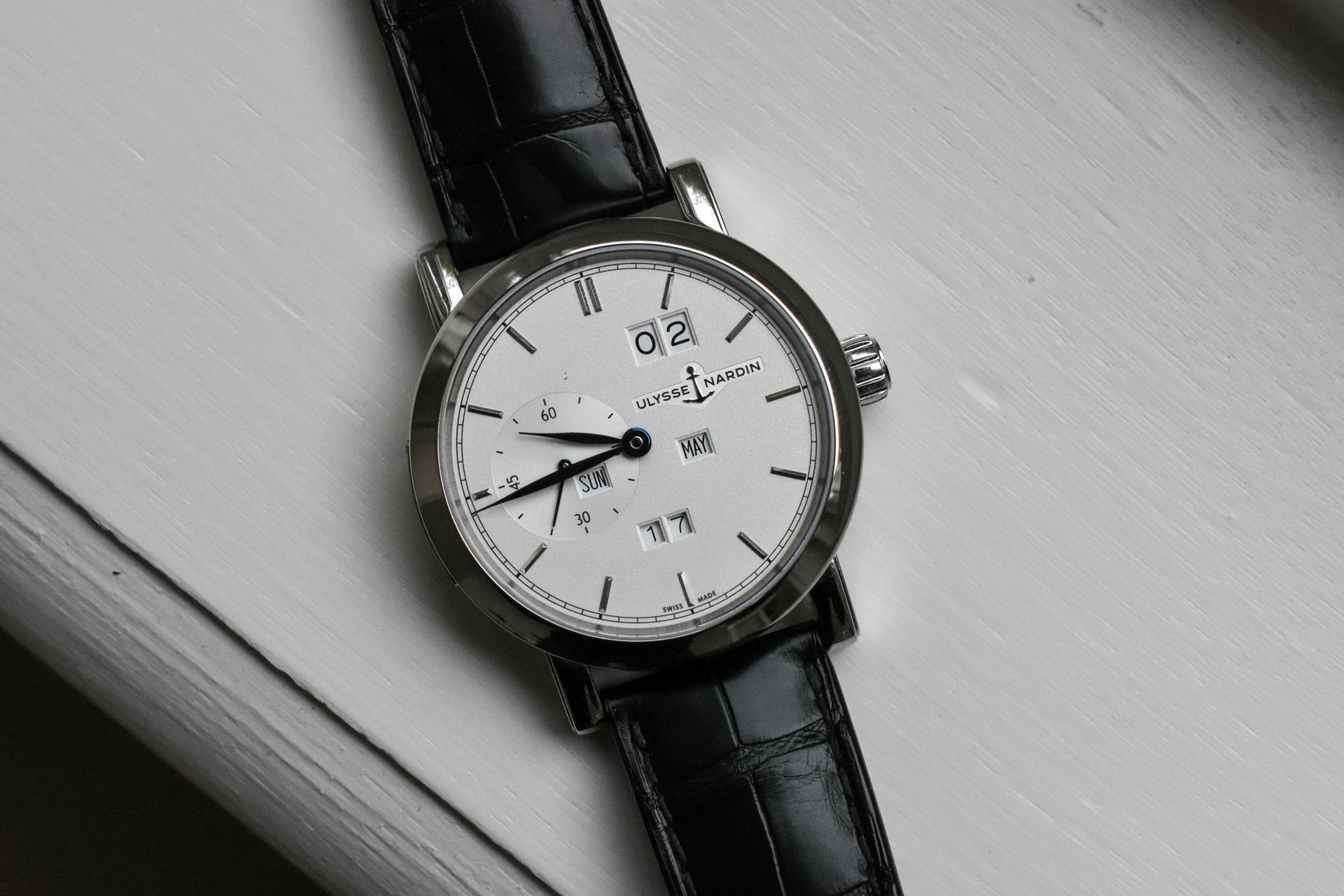
The Ulysse Nardin El Toro and Black Toro are the final horological legacy of Ludwig Oechslin 's tenure at the brand — a perpetual calendar of extraordinary mechanical elegance that solved one of watchmaking's oldest usability problems. Oechslin, who had already created the Trilogy of Time and co-developed the 2001 Freak, designed a perpetual calendar mechanism for the El Toro that operates entirely through rotating disc elements — no springs, no levers, no correctors. The date, day, month, and leap year display can be adjusted forward and backward using the single crown. The El Toro was introduced in 2010 in a limited series of 500 pieces in 18-karat gold and platinum. The Black Toro followed in 2013 in 18-karat rose gold with a dark aesthetic. Both references are now discontinued. They are available only on the secondary market, where they trade well below their original retail prices — representing a significant opportunity for perpetual calendar collectors who prioritize mechanical elegance over secondary market appreciation.
The Mechanism: How the El Toro's Perpetual Calendar Works
A traditional perpetual calendar watch accounts for the different lengths of months — 28, 29, 30, and 31 days — automatically, advancing through February 28 or 29 without manual correction. This feat requires a complex cam system that encodes four years of monthly information. The conventional mechanism, used by Patek Philippe, A. Lange & Söhne, and most grand complication houses, employs levers and springs that can only be corrected forward using push-correctors on the case flank — attempting to correct backward risks damaging the mechanism.
Ludwig Oechslin's solution for the El Toro was architecturally different. He designed a perpetual calendar in which all display elements are rotating discs , driven by gearing rather than spring-and-lever detents. Because the mechanism operates through pure gear engagement rather than snap-action springs, it can be advanced forward or backward without mechanical risk — using only the crown. Setting a perpetual calendar forward several months (if the watch stops for an extended period) requires repeatedly advancing the date through a conventional mechanism; setting it backward after an accidental over-advance requires a watchmaker. On the El Toro, the wearer adjusts in either direction freely. This is not merely a convenience — it is a fundamentally different mechanical architecture.
The movement is the Calibre UN-32 , derived from the Lémania 1340 base calibre and substantially redesigned by Oechslin. The UN-32 provides 45–48 hours of power reserve, runs at 28,800 vph (4 Hz), and incorporates the perpetual calendar module as an integrated layer above the base timekeeping architecture. The module itself was patented by Ulysse Nardin and remains one of the most referenced perpetual calendar patents in contemporary watchmaking literature.
El Toro: The 2010 Original
The El Toro — "The Bull" in Spanish, a name referencing the power of the mechanism — launched in 2010 as a limited series of 500 pieces. The 43mm case was offered in 18-karat yellow gold and platinum, placing the watch firmly in the haute horlogerie bracket. The dial presented the perpetual calendar's four displays — date, day, month, leap year — across the watch face in a layout that Oechslin designed for legibility as well as mechanical transparency. The displays operate continuously and silently; there is no snap at midnight as with spring-lever perpetual calendars. The transition is imperceptible, which is a characteristic of the disc-based mechanism that traditional perpetual calendar owners find remarkable when they first encounter it.
Original retail for the El Toro in 18-karat yellow gold was approximately USD 35,000–$45,000; platinum examples commanded more. The 500-piece limitation was met, and the reference closed production.
Black Toro: The 2013 Dark Variant
The Black Toro , introduced in 2013, applied the same UN-32 perpetual calendar movement to an 18-karat rose gold case with a dark dial treatment and black accents. The "Black" designation referred to the PVD-treated elements and the overall visual reduction of the watch's palette — a design shift away from the El Toro's traditional gold presentation toward a more contemporary aesthetic that the Kering-era brand was beginning to explore.
The Black Toro's original retail was approximately USD 50,000–$65,000 in rose gold, reflecting both the higher material cost of rose gold and the watch's status as a continuation of a proven complication at the brand's auction-validated price tier. Like the El Toro, the Black Toro has since been discontinued and is available only through secondary market sources.
Secondary Market: Current Prices and What to Look For
| Reference | Original Retail | Secondary Market (2026) |
|---|---|---|
| El Toro (yellow gold) | ~$35,000–$45,000 | ~$23,000–$32,000 |
| El Toro (platinum) | Higher than gold | Rare; price on application |
| Black Toro (rose gold) | ~$50,000–$65,000 | ~€23,000–€44,000 |
The secondary market discounts on the El Toro and Black Toro are significant — 25–40% below original retail for most examples. This reflects Ulysse Nardin's general pattern of secondary market depreciation rather than any deficiency in the watches themselves; the mechanical sophistication of the UN-32 perpetual calendar is comparable to examples from houses that command higher secondary market multiples.
Buyers on the secondary market should verify the perpetual calendar's calendar accuracy — confirm the watch is tracking the correct date, day, month, and leap year cycle — before purchase. A watch that has been stopped for an extended period and not reset correctly may show calendar information that appears correct but is cycling through the wrong year of the four-year leap year sequence. This is correctable, but it requires careful calendrical reasoning or a watchmaker's assistance.
El Toro introduced: 2010 | 500 pieces | 43mm 18K yellow gold and platinum
Black Toro introduced: 2013 | 43mm 18K rose gold | Both now discontinued
Movement: Calibre UN-32 | Based on Lémania 1340 | Redesigned by Ludwig Oechslin
Complication: Perpetual calendar — bidirectional setting via crown only, no correctors
Power reserve: 45–48 hours | 28,800 vph | Status: Discontinued (secondary market only)
Frequently Asked Questions
What makes the El Toro perpetual calendar different from other perpetual calendars?
The El Toro's Calibre UN-32 uses rotating disc elements instead of conventional springs and levers, allowing the perpetual calendar to be adjusted both forward and backward using only the crown. Traditional perpetual calendars (Patek Philippe, A. Lange & Söhne) can only be corrected forward via case-flank pushers; backward correction risks damage. The El Toro's disc-based mechanism eliminates this limitation.
Who designed the El Toro?
Ludwig Oechslin, Ulysse Nardin's chief movement designer from 1983 to approximately 2013, designed the UN-32 perpetual calendar mechanism used in the El Toro and Black Toro. Oechslin also created the Trilogy of Time (Astrolabium, Planetarium Copernicus, Tellurium) and co-developed the 2001 Freak's silicon escapement concept.
Is the Ulysse Nardin El Toro still made?
No. Both the El Toro (2010) and Black Toro (2013) have been discontinued. They are available only through the secondary market — auction houses, Chrono24, and specialist pre-owned dealers — at prices typically 25–40% below original retail.
What is the UN-32 movement?
The Calibre UN-32 is based on the Lémania 1340 base calibre, substantially redesigned by Ludwig Oechslin to incorporate the perpetual calendar module. It runs at 28,800 vph with 45–48 hours of power reserve. The perpetual calendar module uses rotating discs rather than springs and levers, enabling bidirectional calendar adjustment.
Sources: Ulysse Nardin (ulysse-nardin.com), Monochrome Watches, Hodinkee, WatchTime, Chrono24 secondary market data.