
Oris Calibre 400: The In-House Five-Day Movement

Zach Charles • April 25, 2026

Share this article

Oris Calibre 400: The In-House Five-Day Movement

Calibre 400 is Oris's most significant technical achievement in the company's 120-year history: the first entirely in-house designed and manufactured automatic movement. Launched in 2020, it represents a decade's development work and a strategic decision to reduce dependence on externally sourced ETA and Sellita movements — a prerequisite for any independent brand seeking genuine autonomy at every level of production.


The Strategic Context — Why In-House Mattered

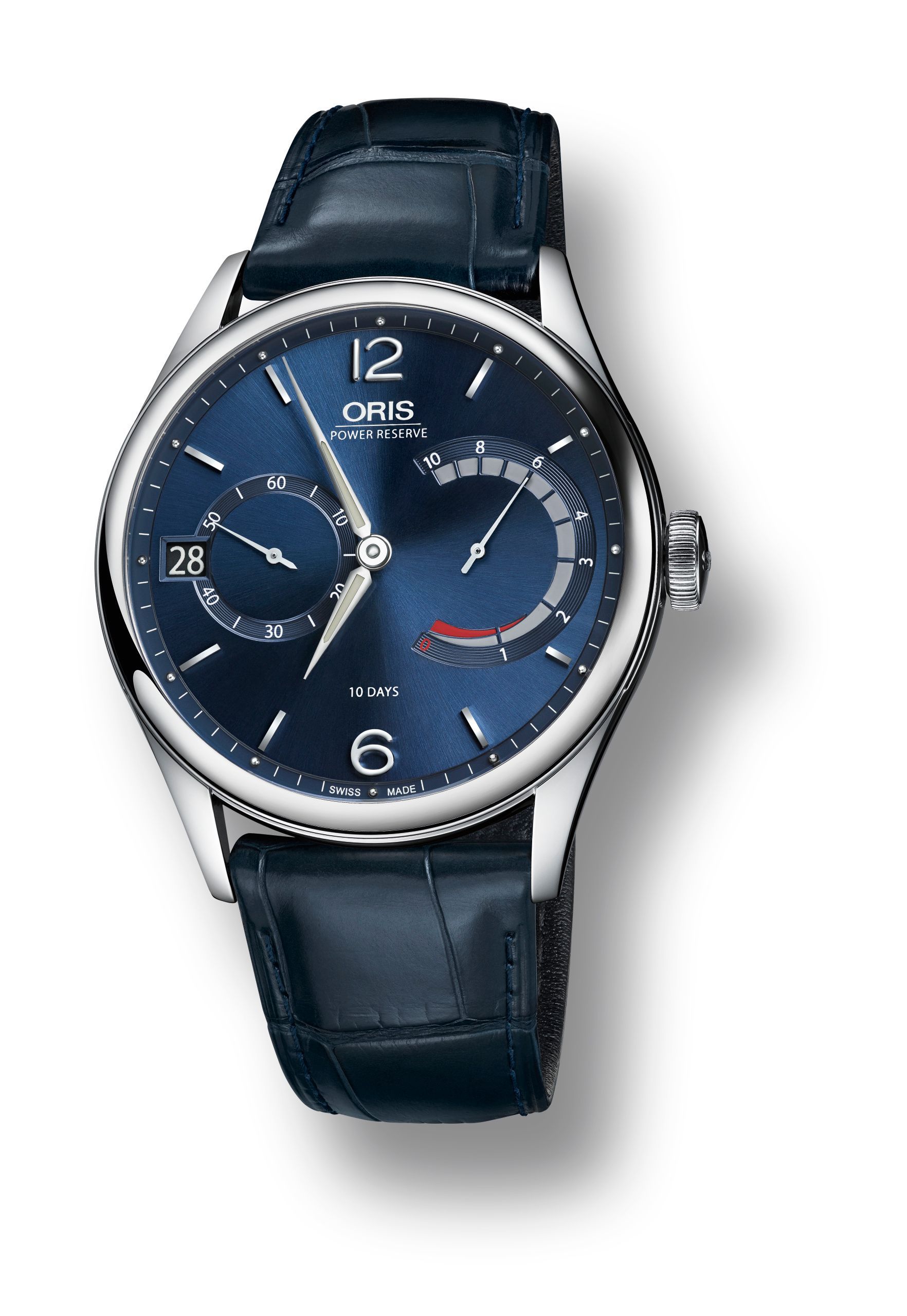
Oris Artelier Calibre 111 with 10-day power reserve
Oris Artelier Calibre 111 — featuring the proprietary Calibre 111 movement with 10-day power reserve and left-hand crown, from the Artelier dress watch collection.
Photo: Oris SA — CC BY-SA 3.0 — Wikimedia Commons
For most of its history, Oris sourced movements from external suppliers — principally ETA (Swatch Group's ébauche division) and subsequently Sellita (an independent Swiss movement manufacturer). This sourcing model is common among mid-market Swiss brands: ETA and Sellita supply well-engineered, reliable, cost-effective movements that allow brands to focus on case design, finishing, and marketing.

The strategic risk became apparent in 2011, when Swatch Group announced it would progressively limit ETA movement sales to third-party brands, forcing those brands to find alternatives. For Oris, this was not immediately critical — the brand had already transitioned substantially to Sellita — but it highlighted a structural vulnerability: dependence on any external supplier creates price risk, supply risk, and differentiation limitations.

The decision to develop a proprietary movement was also a positioning statement: a brand that makes its own movement is categorically different from one that buys movements and fits them into own-design cases. In the watch industry, movement autonomy is a prestige marker.


Development — 2010s

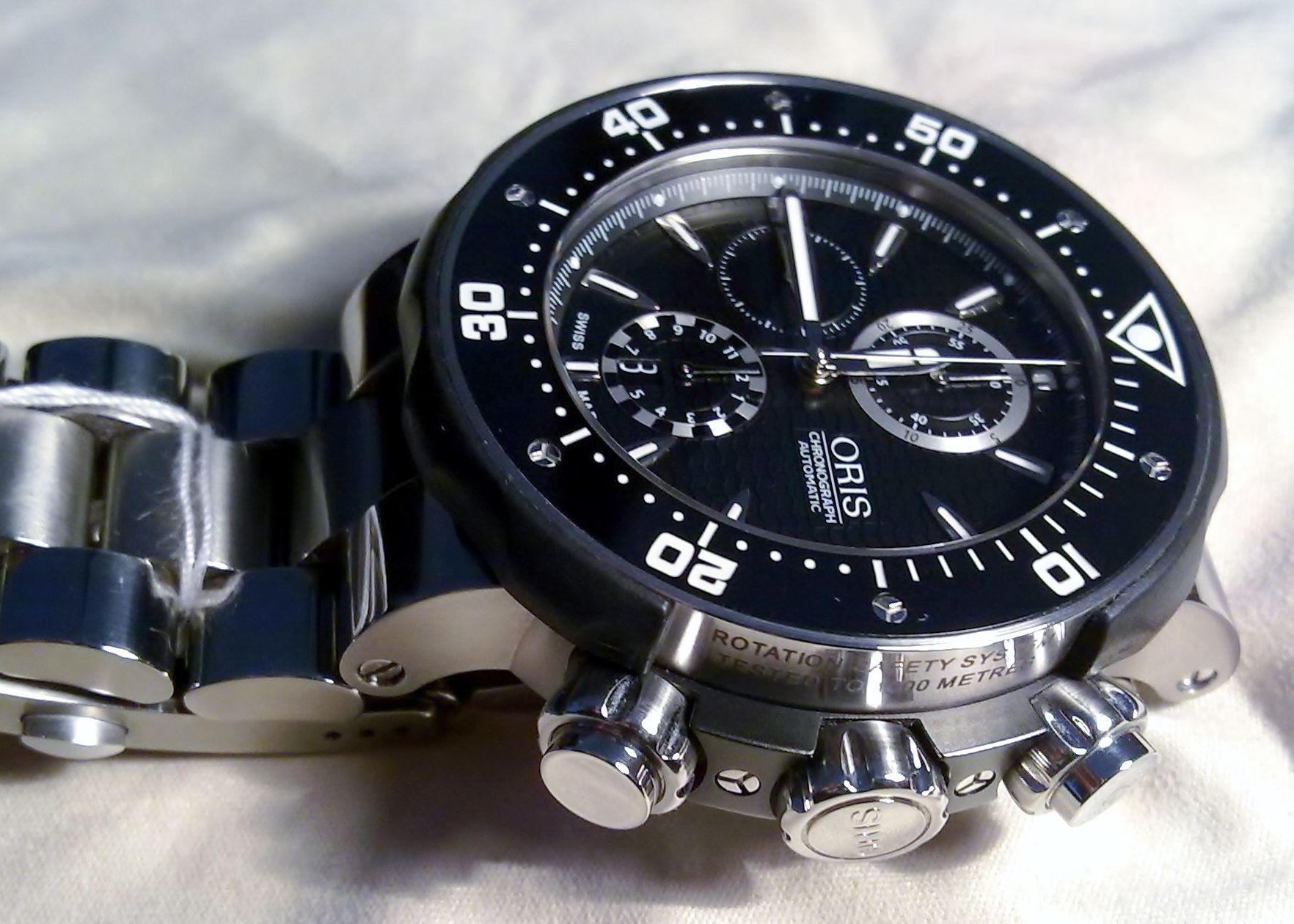
Oris ProDiver Chronograph titanium dive watch
Oris ProDiver Chronograph — a 1000-metre water-resistant automatic dive-chronograph in titanium, representing Oris’s technical dive watch capability.
Photo: Johntorcasio — CC BY-SA 3.0 — Wikimedia Commons
Oris engineers began development of what would become Calibre 400 in the early 2010s. The stated objectives were ambitious:

  1. Five-day power reserve — substantially longer than the 38–42 hour standard of ETA/Sellita automatics
  2. Anti-magnetic resistance — exceeding ISO 764 standard (>2,500 A/m)
  3. COSC-level accuracy — ±3.0 seconds per day
  4. 10-year service interval — four times longer than the typical 3-year service recommendation

The 10-year service claim required specific engineering decisions: reduced sliding friction between components (achieved through silicon parts and optimised surface geometry), sealed oil reservoirs at critical points, and selection of wear-resistant materials.

Development was conducted at Hölstein. Oris does not have the full component manufacturing capability of the Grande Maison manufactures — some components are produced by specialist Swiss suppliers under Oris specification — but the movement architecture, design, assembly, regulation, and finishing are done in-house.


Technical Specifications

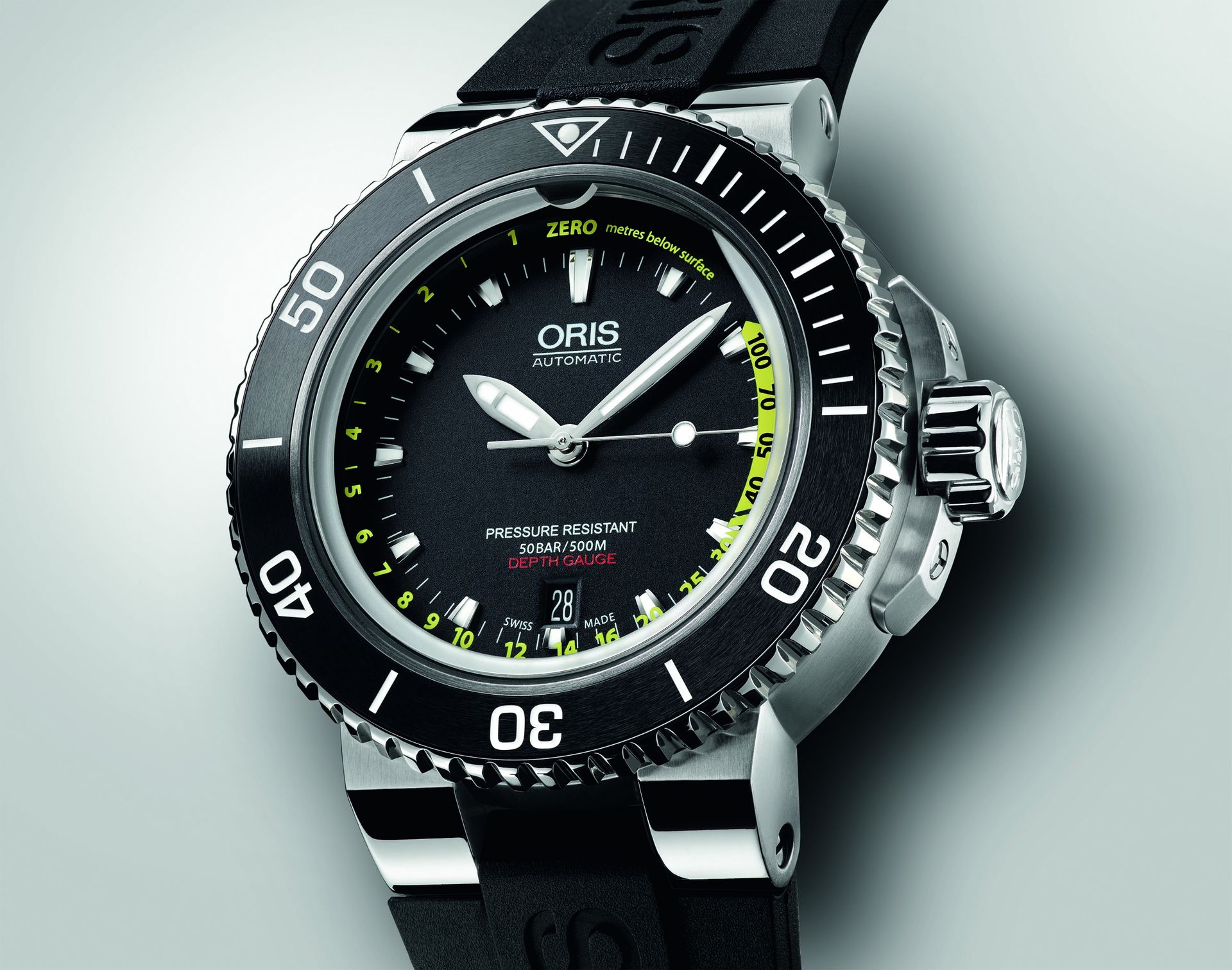
Oris Aquis Depth Gauge dive watch white dial
Oris Aquis Depth Gauge — featuring the capillary depth gauge system built into the crystal, reading depth via direct water pressure without electronics.
Photo: Olaf Köster / Oris SA — CC BY-SA 3.0 DE — Wikimedia Commons
Specification Calibre 400
Power reserve 120 hours (5 days)
Frequency 28,800 vph (4 Hz)
Jewels 27
Anti-magnetic >2,500 A/m (ISO 764)
Shock protection Incabloc
Rotor Bidirectional, unidirectional winding
Accuracy ±3.0 s/day (COSC-equivalent)
Service interval 10 years (manufacturer's recommendation)
Water resistance (Aquis) 300m

The five-day reserve comes from a pair of series-coupled mainspring barrels. Two barrels in series double the available energy storage compared to a single barrel without increasing the winding torque requirement at the crown. The barrel architecture is the primary technical enabler of the long reserve.

The silicon components include the escapement components: specifically, the impulse lever (pallet fork) and escape wheel are produced from silicon. Silicon is dimensionally stable across temperature ranges, non-magnetic, requires no lubrication at the escapement (reducing the rate at which lubricants degrade), and is harder than steel in relevant wear modes. These properties directly support the 10-year service interval claim.


Calibre Family

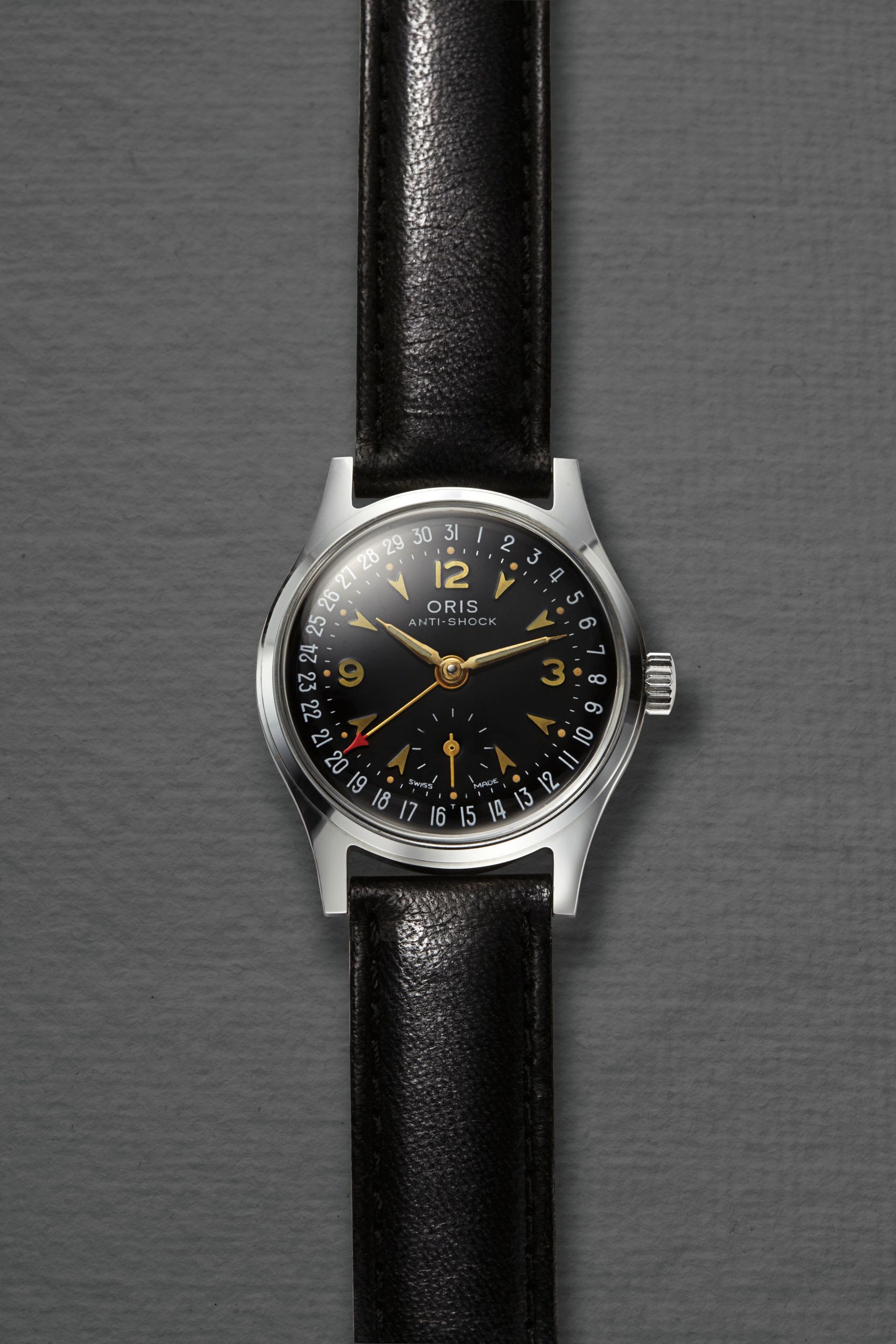
Oris Pointer Date 1938 heritage model
Oris Pointer Date 1938 — a heritage model showcasing the retrograde arc date display with colour-coded pointer hand, Oris’s signature complication since the 1940s.
Photo: Oris SA — CC BY-SA 3.0 — Wikimedia Commons
The Cal. 400 base spawned a family of movements:

Calibre 400 — Base automatic, no date. Used in Aquis Date (paradoxically, the "date" in the watch name refers to the collection name, not always the movement variant).

Calibre 401 — Cal. 400 with date display module. Used in Aquis Date Cal. 400.

Calibre 403 — Cal. 400 with GMT module adding a 24-hour second time zone hand. Used in Aquis GMT Date.

Calibre 111 — A separate Oris proprietary movement for the ProPilot, with a left-hand crown, 10-day power reserve, and Pointer Date complication. Not a direct derivative of Cal. 400 but developed contemporaneously.


Roll-Out Across the Range

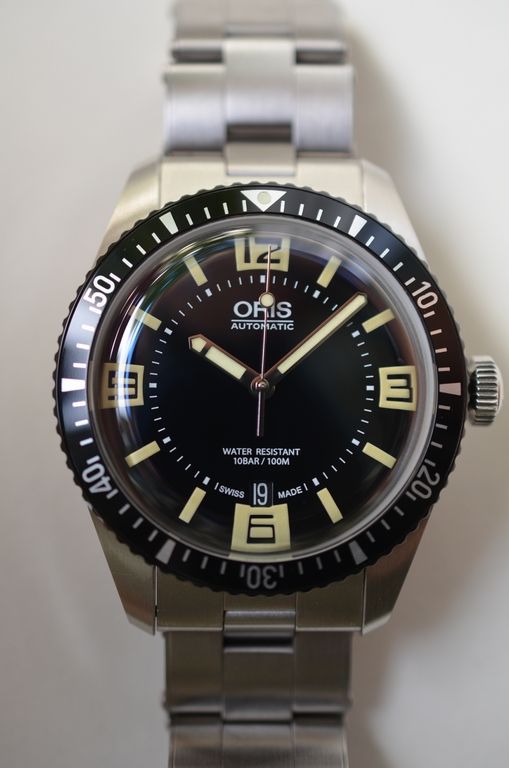
Oris Divers Sixty-Five reissue
Oris Divers Sixty-Five (Ref. 01 733 7707 4064) — the 2015 reissue of Oris’s original 1965 diver, with Calibre 733 automatic.
Photo: Wiki Peter Jan — CC BY-SA 4.0 — Wikimedia Commons
Cal. 400 was introduced first in the Aquis Date in 2020, then progressively applied across the Aquis range (Aquis Date Upcycle, Aquis GMT Date) and the Divers Sixty-Five Cal. 400 from 2022. Oris has indicated intention to extend Cal. 400 to the ProPilot Date range.

Watches with Cal. 400 are clearly differentiated at retail — they command a premium over the Sellita-based equivalents (approximately CHF 300–500 more) and are identified in the collection name with "Cal. 400." The transparent caseback, available on some Cal. 400 references, shows the movement architecture and the bidirectional rotor.


The 10-Year Service Claim

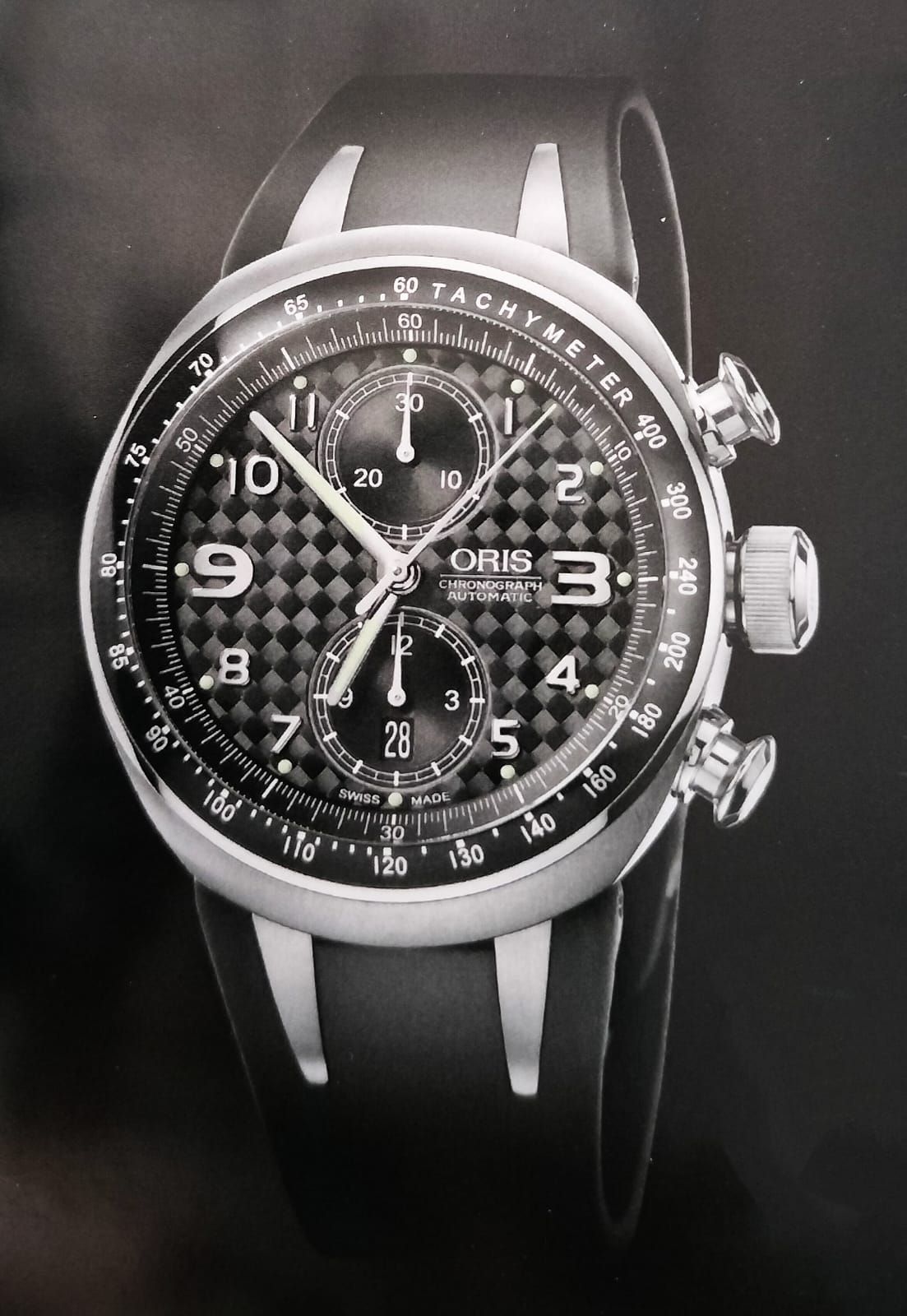
Oris Williams TT3 Formula 1 collaboration watch
Oris Williams TT3 — a Formula 1 collaboration piece with the Williams F1 team, illustrating Oris’s motorsport partnership history.
Photo: Clyde94 — CC BY-SA 4.0 — Wikimedia Commons

The 10-year service interval is the most commercially significant claim attached to Cal. 400. Standard Swiss manufacturer recommendations for mechanical movement service are 3–5 years. Oris's 10-year claim, if accurate, approximately halves the total cost of ownership over a watch's useful life.

Oris backs the claim with an extended 5-year warranty (standard Swiss is 2 years) for Cal. 400 watches. The warranty and service interval claim are supported by published engineering rationale (silicon escapement, reduced lubrication points, dual barrel). Independent testing of long-term accuracy retention under the 10-year claim is ongoing as the first Cal. 400 watches approach their claimed service interval.


Recent Posts

By Zach Charles • October 10, 2026
Hamilton's American Classic Cushion Mechanical revives its 1926 Art Deco cushion watches, seen in Oppenheimer, in 30mm and 34mm with the new hand-wound…
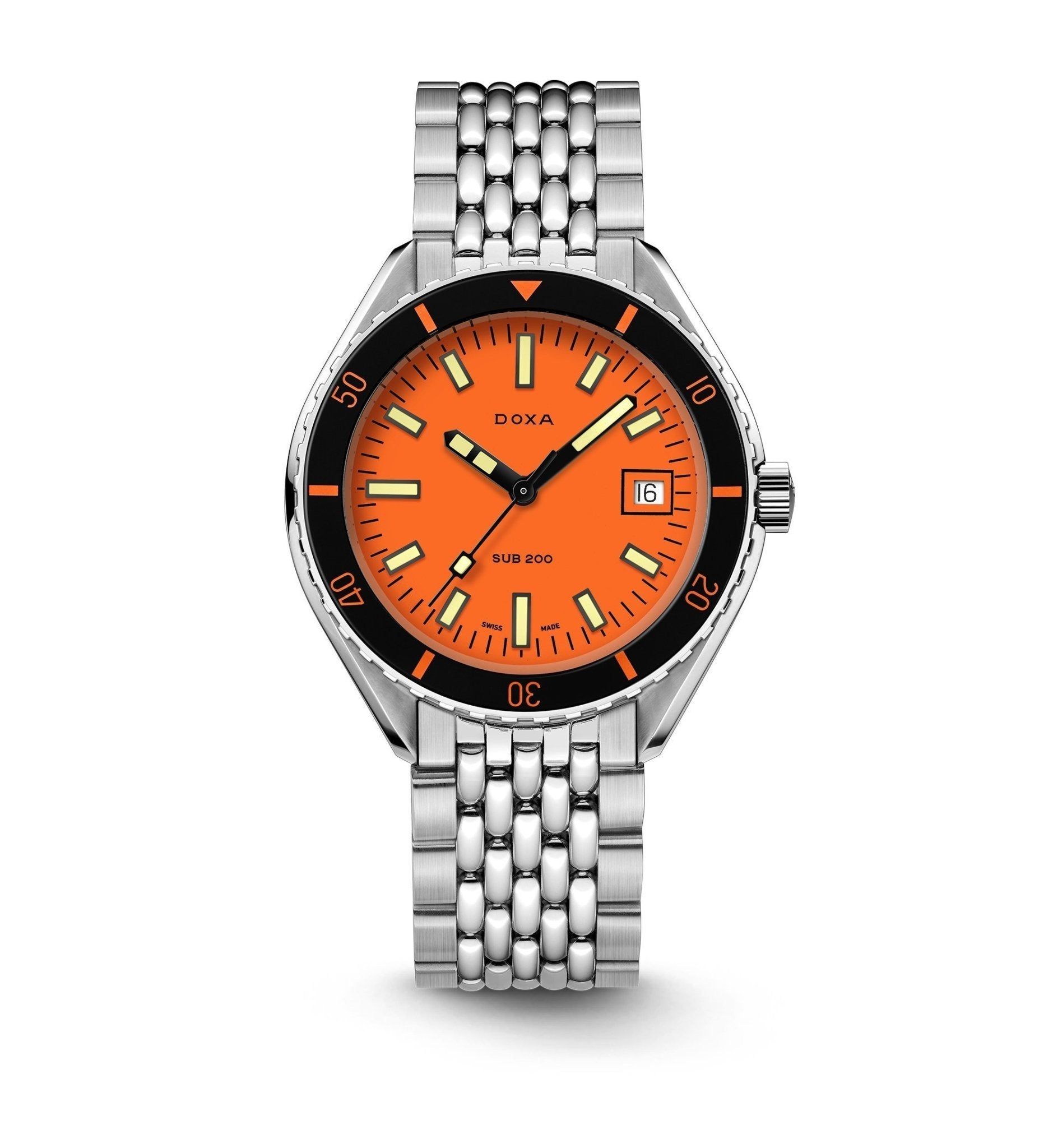
Doxa SUB 200: The Accessible Everyday Diver
By Zach Charles • October 10, 2026
Complete guide to the Doxa SUB 200 — 42mm, 200m, four colorways, Sellita SW200-1. The accessible entry to the Doxa SUB family with the full…

By Zach Charles • October 10, 2026
The Breitling Top Time B01 Aston Martin DB5 pairs a cushion-shaped 41mm case, a wooden inner ring and the in-house Caliber 01 across three limited…
By Zach Charles • October 10, 2026
TAG Heuer developed the Mikrograph (2011, 1/100th second), Mikrotimer Flying 1000 (2011, 1/1000th second), and Mikrogirder (2012, 1/2000th second).
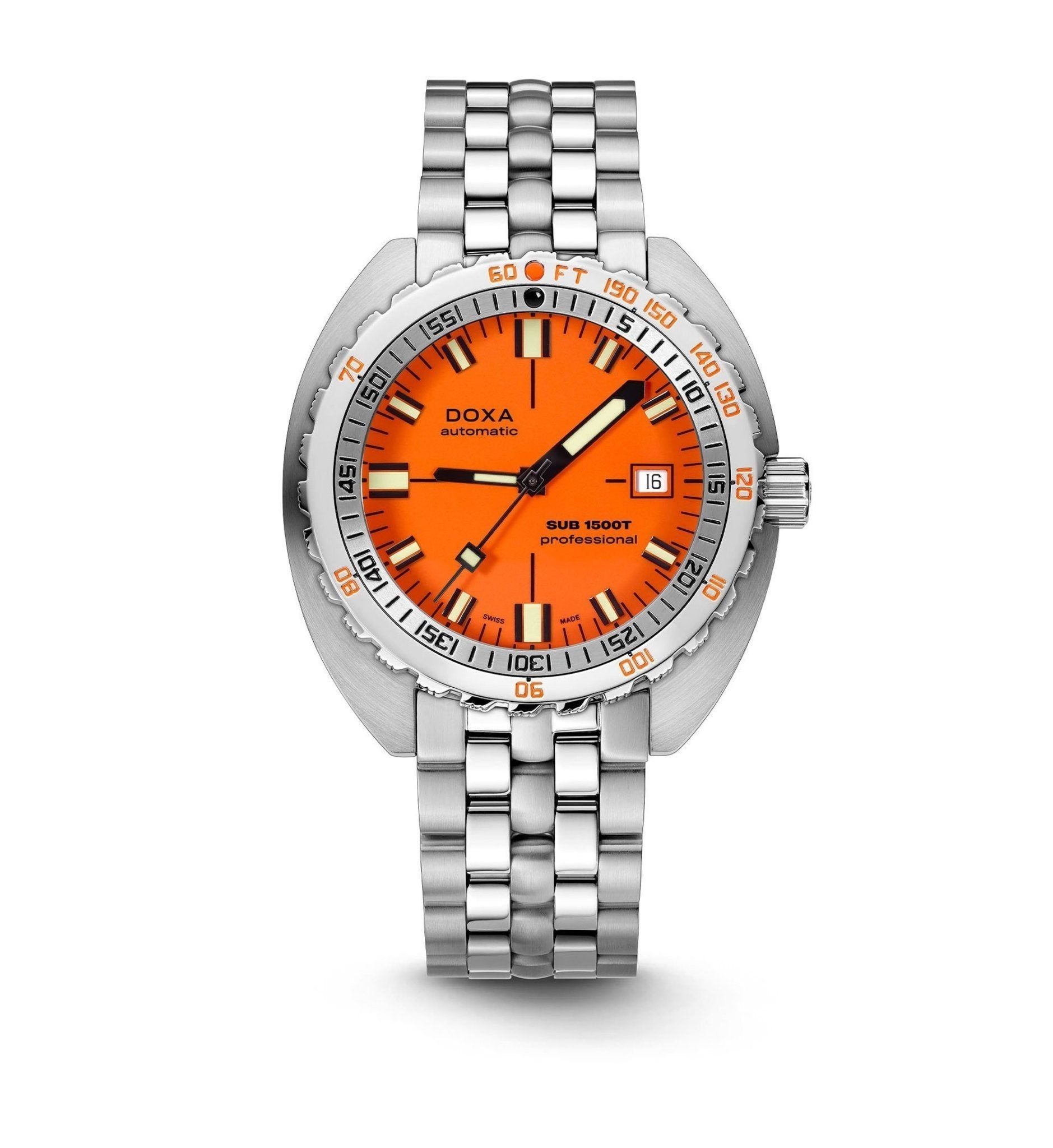
Doxa SUB 1500T: The 1,500-Metre Depth-Rating Flagship
By Zach Charles • October 10, 2026
Complete guide to the Doxa SUB 1500T — 45mm, 1,500m depth rating, helium escape valve, ETA 2892-2 movement, USD 2,690.
Audemars Piguet Royal Oak 'Jumbo' ref. 15202 with blue tapisserie dial and integrated steel bracelet
By Zach Charles • October 10, 2026
The Audemars Piguet × Swatch Royal Pop is a $400 bioceramic pocket watch in 8 colourways, powered by a new hand-wound SISTEM51 with 90+ hour power…

Time on the Move logo
By Zach Charles • October 10, 2026
Zach Charles is the editor of Time on the Move, an independent watch reference covering brand and model histories, buying guides and release news…

Omega Speedmaster Professional 'Moonwatch' chronograph, front view on steel bracelet
By Zach Charles • October 9, 2026
Find the best watches at every price point from $500 to $15,000 — new and pre-owned. Covers every budget tier with specific reference picks, brand…
By Zach Charles • October 9, 2026
The latest watch news: new releases, Watches and Wonders coverage, discontinuations, industry analysis, and market trends. Currently 1 article.

Seiko's New Panda Chronograph Is Literally a Panda: The Power Design Project HHK001 and HHK002
By Zach Charles • October 8, 2026
Seiko's Power Design Project panda chronograph (HHK001, HHK002) turns the panda dial into an actual panda face, with ear pushers, a 'Sasameter' and a 3D…
Show More