
Blancpain Perpetual Calendar: The Quantième Perpétuel Tradition

Zach Charles • May 29, 2026

Share this article

Blancpain Perpetual Calendar: The Quantième Perpétuel Tradition

The perpetual calendar — the quantième perpétuel — has been central to Blancpain's complication identity since the 1983 revival. Of the six traditional grand complications (tourbillon, perpetual calendar, minute repeater, chronograph, split-seconds chronograph, and grande sonnerie), the perpetual calendar is the one most associated with Blancpain's production heritage. The brand has produced more perpetual calendar references than any other single complication.


The Perpetual Calendar Mechanism

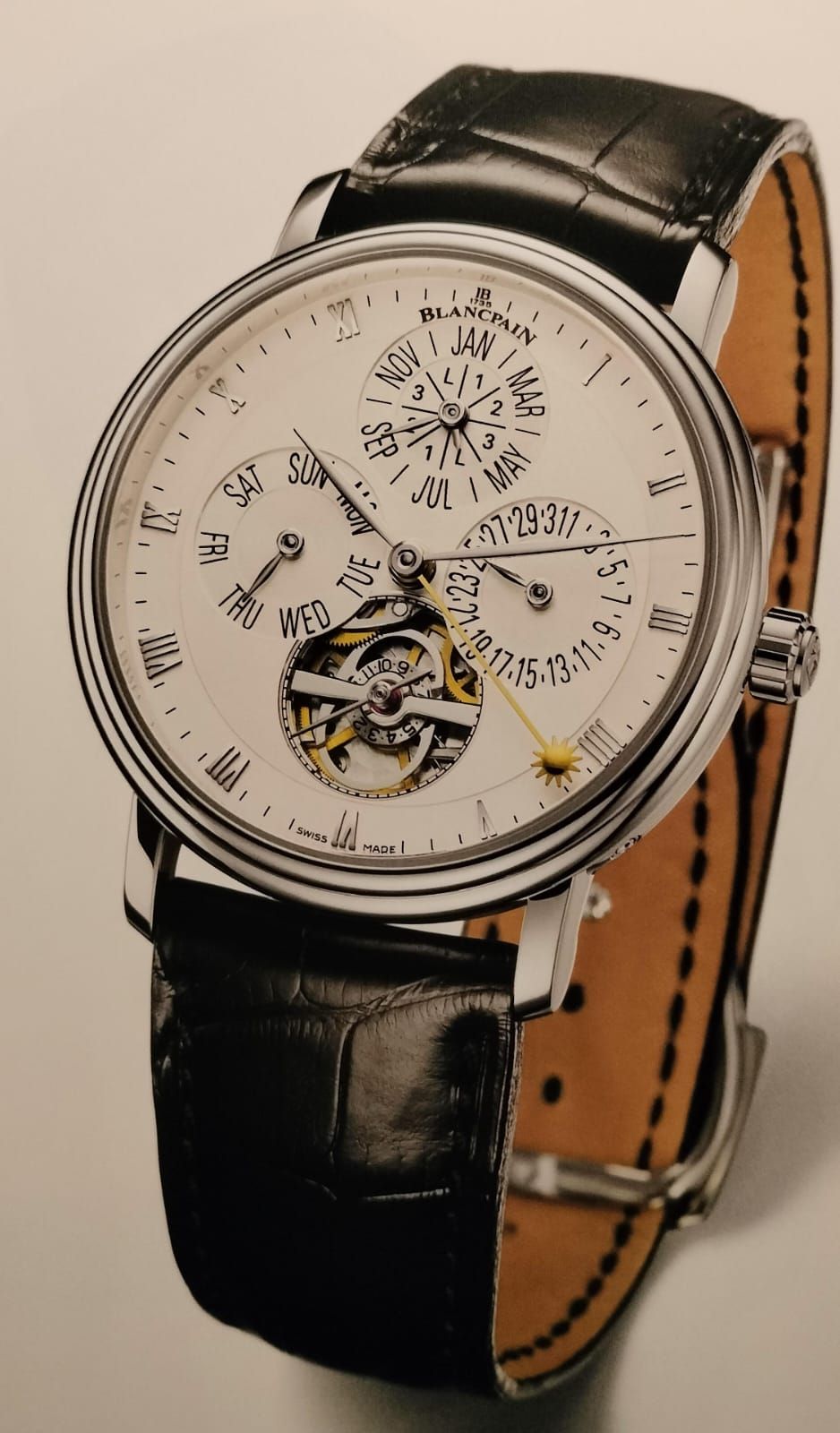
Blancpain Villeret perpetual calendar with equation of time
Blancpain Villeret Ref. 6038-3442-55B — perpetual calendar with running equation of time display, one of the most complex Villeret calendar references.
Photo: EMore98 — CC BY-SA 4.0 — Wikimedia Commons

A perpetual calendar watch automatically displays the correct date for every month of the Gregorian calendar, including February, without requiring manual correction. It achieves this through a programming cam and lever system that encodes the irregular month lengths:

  • 28-day months: February in non-leap years
  • 29-day months: February in leap years
  • 30-day months: April, June, September, November
  • 31-day months: January, March, May, July, August, October, December

The mechanism uses a four-year cam (one revolution per leap year cycle) with a shaped outer profile that drives the date display through the month-end transitions. At each month end, the cam profile determines how many days to advance the date: 1 day (from 30 to 1 for a 30-day month), 2 days (from 29 to 1 for February non-leap), or 3 days (from 28 to 1 for February leap year).

The one exception: 2100 is a century-end year that, by Gregorian rule, is not a leap year (despite being divisible by 4). The four-year cam assumes 2100 will be a leap year. A manual correction of one day will be required in February 2100.


Blancpain's Perpetual Calendar Heritage — 1980s

When Jean-Claude Biver revived Blancpain in 1983, the perpetual calendar was among the first complications produced. The Calibre 5450 (a Frédéric Piguet-based perpetual calendar automatic) powered the first Blancpain perpetual calendar wristwatches.

The 1980s and 1990s Blancpain perpetual calendars were among the most important Swiss luxury watch releases of the era — alongside the Patek Philippe 3940 and the JLC Master Perpetual — in establishing the perpetual calendar as the defining complication of the Swiss mechanical revival. The market demand for perpetual calendars that developed through the 1990s was substantially seeded by these early post-revival releases.


Villeret Perpetual Calendar — Ref. 6658 and 6657

Blancpain tourbillon with eight-day power reserve, late 1980s
Blancpain tourbillon with eight-day power reserve, late 1980s — one of the early post-revival tourbillon references that established Blancpain’s complication credentials.
Photo: EMore98 — CC BY-SA 4.0 — Wikimedia Commons

The current Villeret Quantième Perpétuel (Ref. 6658, rose gold; Ref. 6657, white gold) uses the Calibre 5954P — an in-house developed perpetual calendar movement.

Specifications:
| Detail | Specification |
|---|---|
| Calibre | 5954P |
| Power reserve | 72 hours (3 days) |
| Frequency | 28,800 vph |
| Complication | Perpetual calendar + moonphase |
| Display | Retrograde date, day, month apertures |
| Case | 40mm, platinum or gold |
| Case height | 10.6mm |

The retrograde date display is a Villeret perpetual calendar signature: rather than a rotating disc showing dates in a window, the date hand sweeps across a fan-shaped arc scale and snaps back instantly at month end — a more dramatic and legible display than a date window.


Le Brassus Perpetual Calendar Chronograph

Blancpain Léman with dual time zone, alarm, and power reserve
Blancpain Léman Ref. 2041-1230-64B — with dual time zone, alarm, power reserve indicator, and GMT function: the Léman collection’s multi-complication travel watch.
Photo: EMore98 — CC BY-SA 4.0 — Wikimedia Commons
The Le Brassus Perpetual Calendar Chronograph (Calibre 2585) combines:
- Perpetual calendar with retrograde date
- Split-seconds (rattrapante) chronograph
- Moonphase

The split-seconds function — in which two superimposed chronograph hands can be stopped independently to record two intervals simultaneously — is mechanically demanding alone. The perpetual calendar alone is mechanically demanding alone. Together, they require an architecture that prevents the chronograph's energy demands from disturbing the calendar programming.

The Calibre 2585 achieves this through:
- Column-wheel chronograph mechanism (consistent actuation force)
- Vertical clutch (smooth chronograph start, reducing energy spike)
- Perpetual calendar module designed with sufficient pre-loading to resist momentary perturbation

The result is a movement of approximately 650 components, 13.1mm in height, in a 42.5mm case.


Quantième Perpétuel with Equation of Time

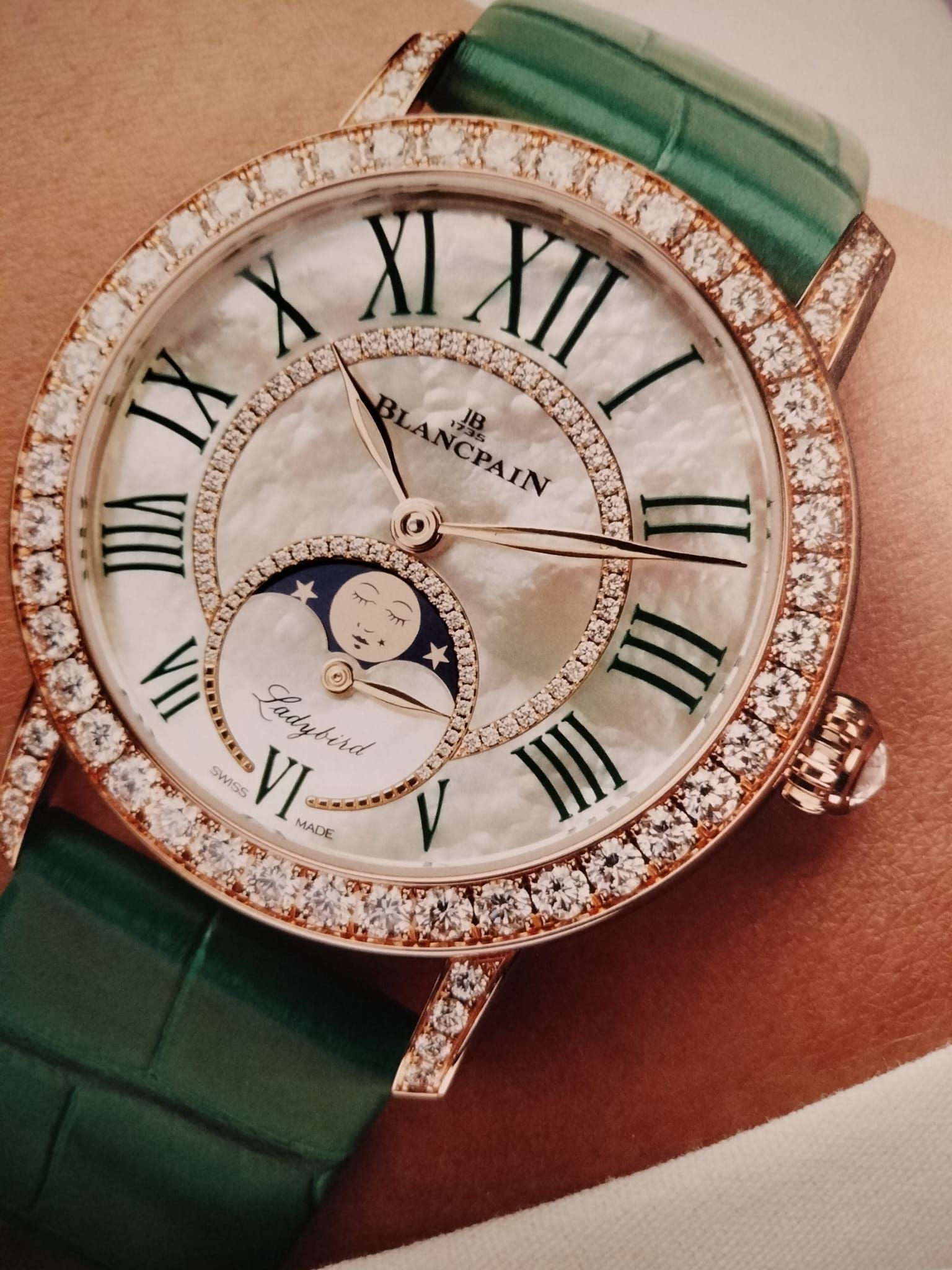
Blancpain Ladybird Colors moonphase
Blancpain Ladybird Colors Phase de Lune Ref. 3662A-2954-55B — the miniaturised automatic moonphase in Blancpain’s 21.7mm ladies’ watch case.
Photo: EMore98 — CC BY-SA 4.0 — Wikimedia Commons
The most sophisticated Villeret calendar complication is the Quantième Perpétuel avec Équation du Temps — perpetual calendar with equation of time display.

The equation of time: the difference between solar noon (when the sun is directly overhead) and mean noon (12:00:00 on a standard clock) varies throughout the year. The variation arises from two effects — the elliptical shape of Earth's orbit (more or less than 24 hours between solar noons depending on orbital speed) and the tilt of Earth's axis (which affects the projection of the sun's apparent motion). The combined effect produces a variation of up to ±16 minutes: on February 11th, the sun is approximately 14 minutes ahead of the clock; on November 4th, it is approximately 16 minutes behind.

Displaying the equation of time requires a cam profiled to the exact annual variation — a different shape each year, and annual variations are not precisely the same. The cam in Blancpain's equation of time movement is profiled for the average annual variation and is accurate to within approximately one minute across the calendar year.


Setting a Perpetual Calendar

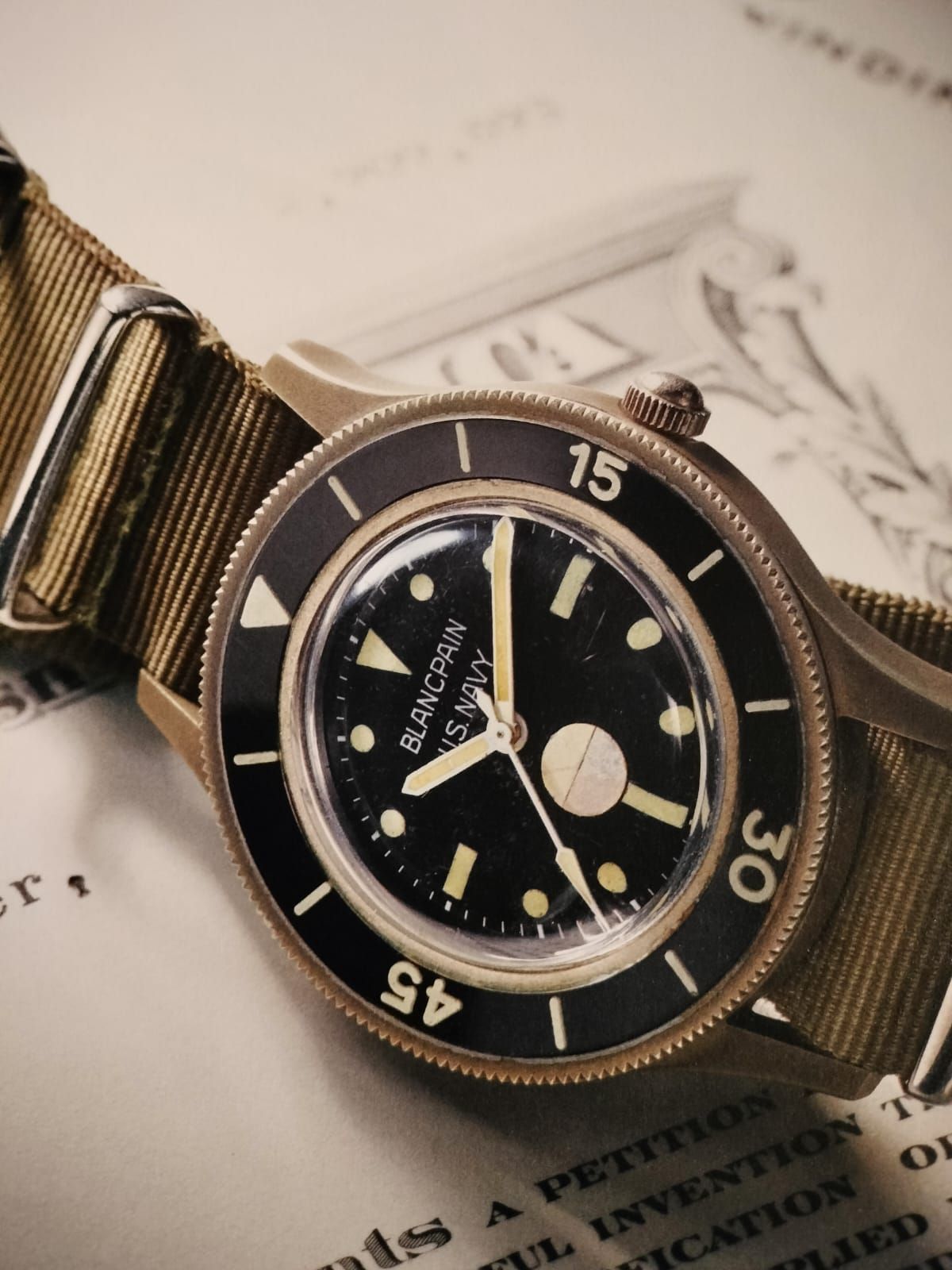
Blancpain Mil-Spec made for US Navy SEALs
A Blancpain Mil-Spec dive watch produced for the U.S. Navy SEALs — the military and professional diving heritage central to the Fifty Fathoms legacy.
Photo: EMore98 — CC BY-SA 4.0 — Wikimedia Commons
A practical consideration for perpetual calendar owners: setting the calendar requires care. Unlike a simple date, which advances forward and can be corrected in either direction, the perpetual calendar's programming mechanism can be damaged if forced forward rapidly through multiple months or backward at all (on most implementations).

Blancpain's perpetual calendars include setting pushers for date, day, and month — each advancing the respective indicator one unit per push. Setting from, say, February 1st to October 15th (after a long period in storage) requires pressing the date pusher 14 times, the month pusher 8 times, and so on. The process takes a few minutes but must be done carefully and only when the hands are not in the danger zone (roughly 9 PM to 2 AM, when the calendar advances and forced correction can break the mechanism).


Recent Posts

By Zach Charles • October 10, 2026
Hamilton's American Classic Cushion Mechanical revives its 1926 Art Deco cushion watches, seen in Oppenheimer, in 30mm and 34mm with the new hand-wound…
Doxa SUB 200: The Accessible Everyday Diver
By Zach Charles • October 10, 2026
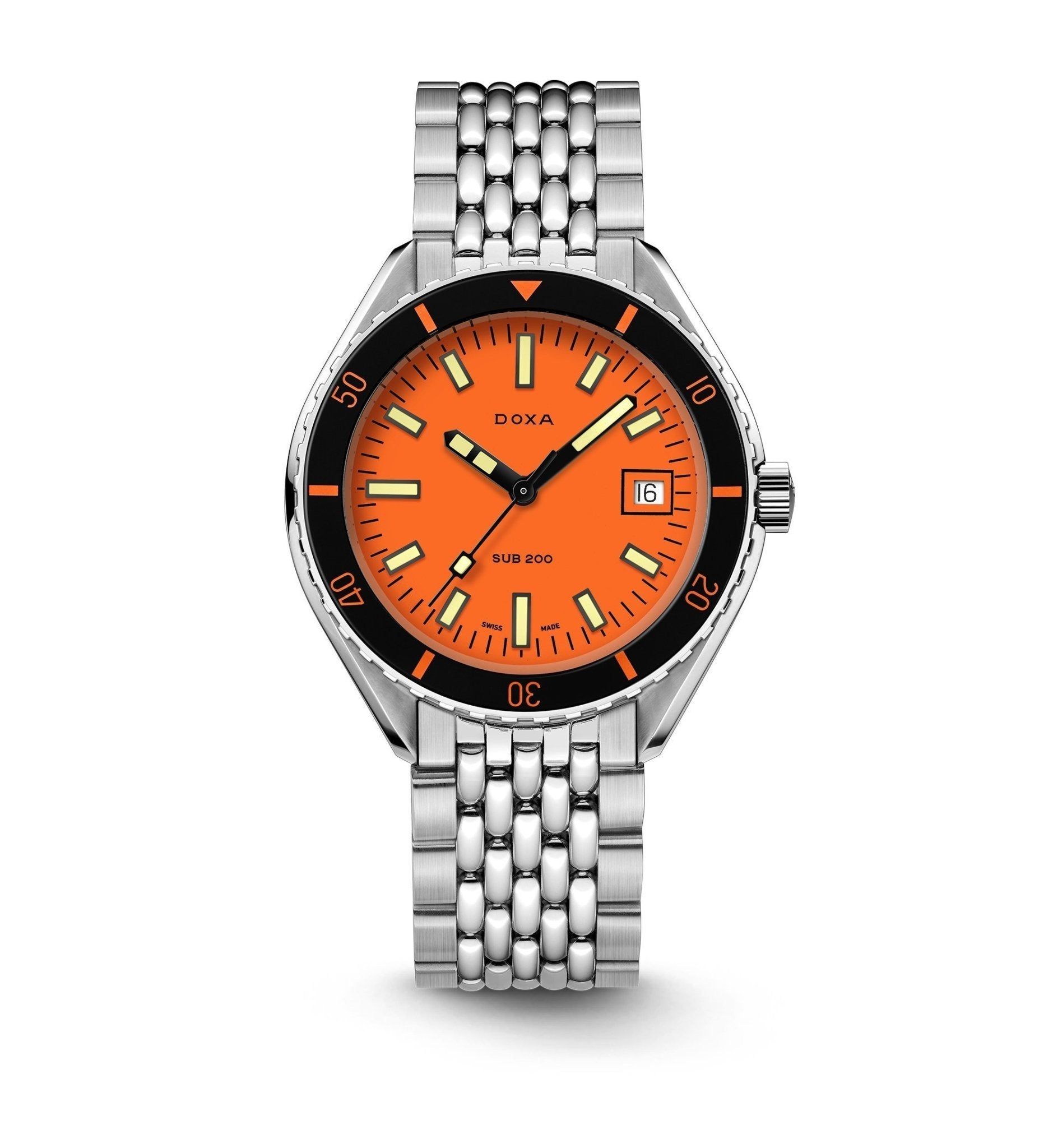
Complete guide to the Doxa SUB 200 — 42mm, 200m, four colorways, Sellita SW200-1. The accessible entry to the Doxa SUB family with the full…
By Zach Charles • October 10, 2026
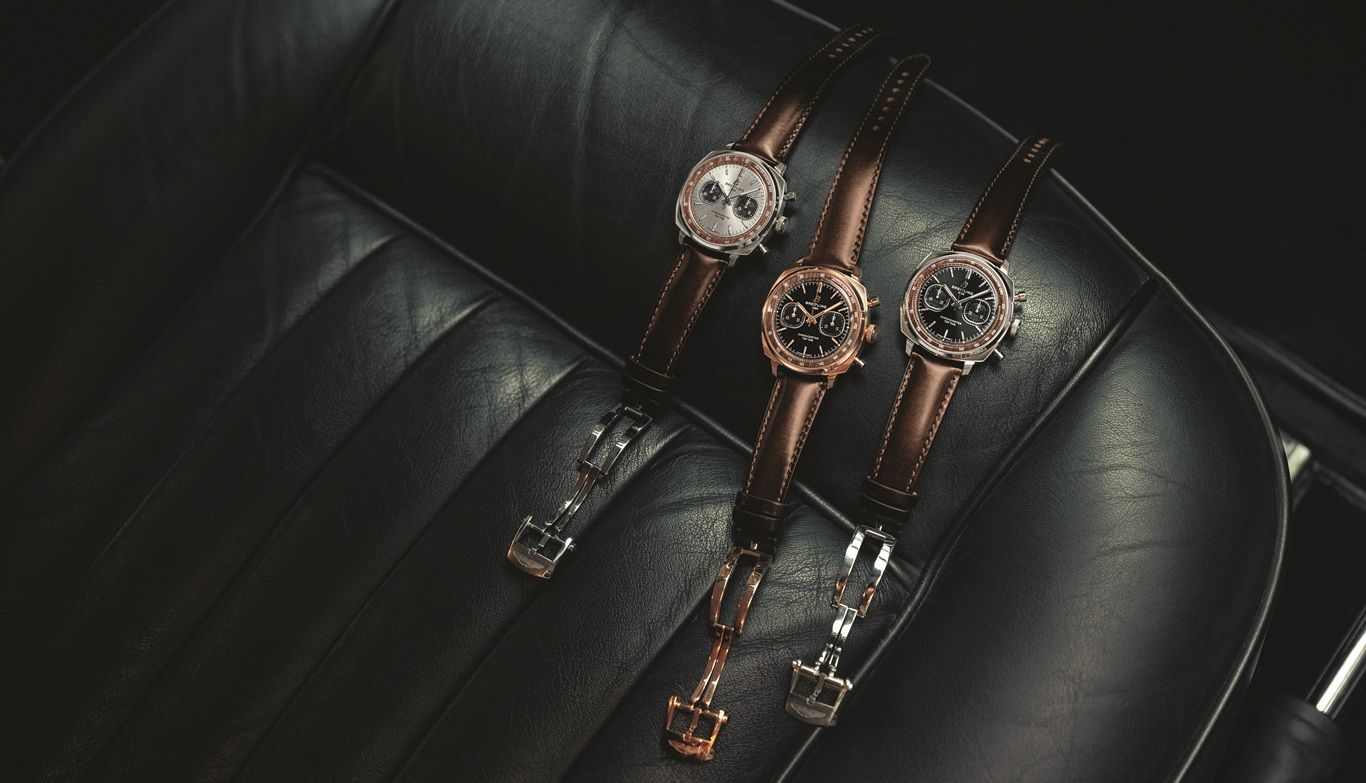
The Breitling Top Time B01 Aston Martin DB5 pairs a cushion-shaped 41mm case, a wooden inner ring and the in-house Caliber 01 across three limited…
By Zach Charles • October 10, 2026
TAG Heuer developed the Mikrograph (2011, 1/100th second), Mikrotimer Flying 1000 (2011, 1/1000th second), and Mikrogirder (2012, 1/2000th second).
Doxa SUB 1500T: The 1,500-Metre Depth-Rating Flagship
By Zach Charles • October 10, 2026
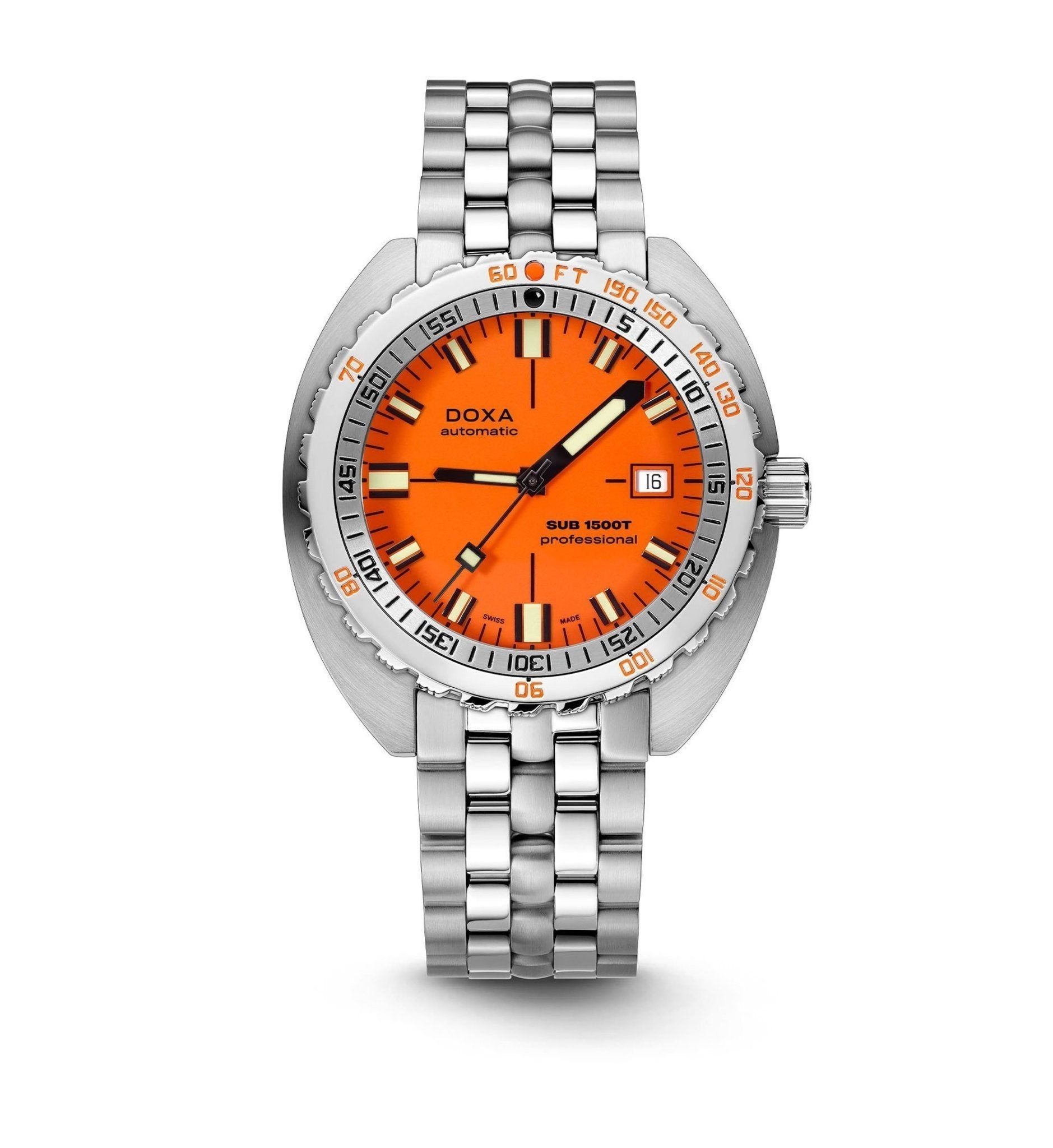
Complete guide to the Doxa SUB 1500T — 45mm, 1,500m depth rating, helium escape valve, ETA 2892-2 movement, USD 2,690.
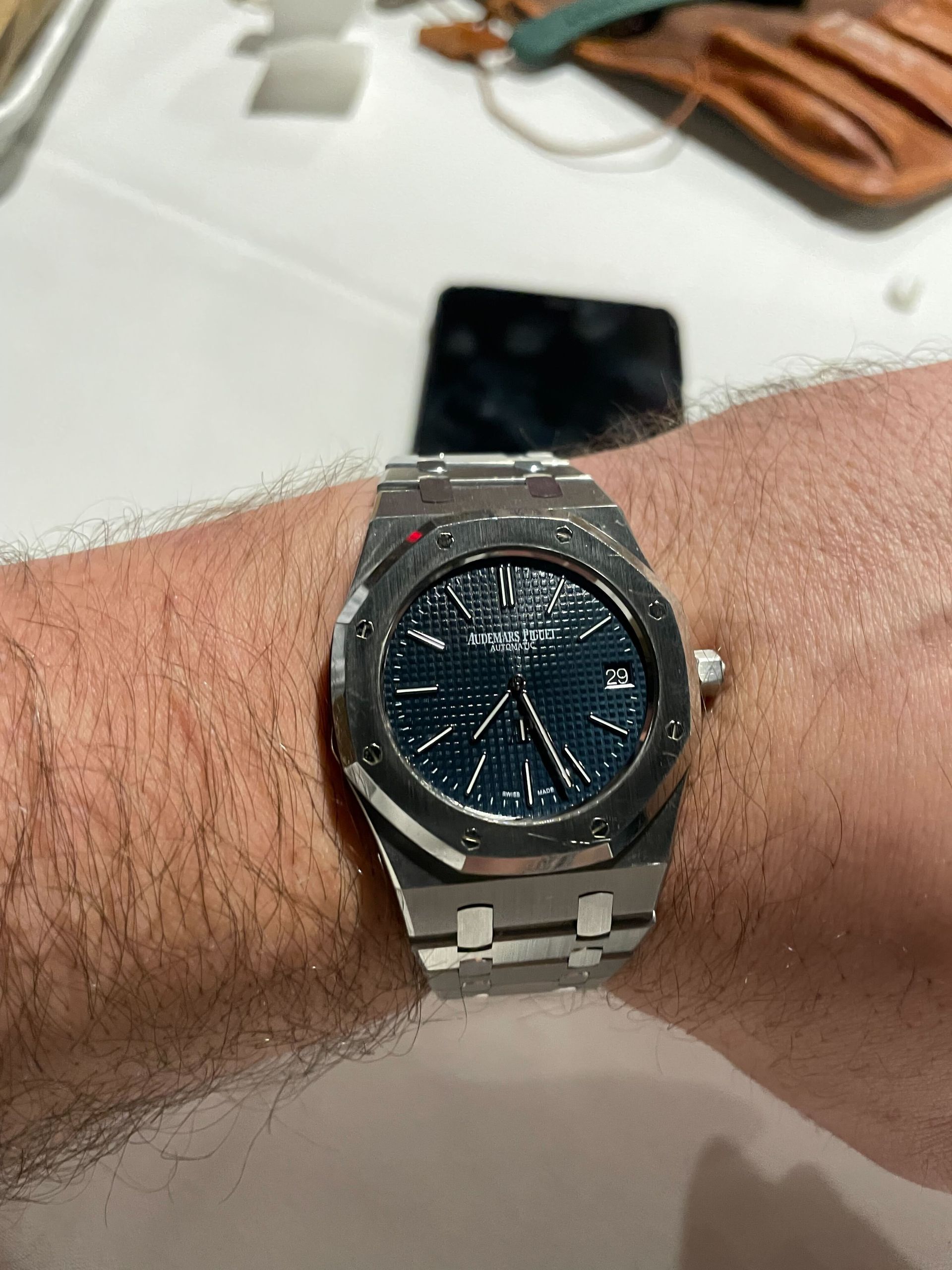
Audemars Piguet Royal Oak 'Jumbo' ref. 15202 with blue tapisserie dial and integrated steel bracelet
By Zach Charles • October 10, 2026
The Audemars Piguet × Swatch Royal Pop is a $400 bioceramic pocket watch in 8 colourways, powered by a new hand-wound SISTEM51 with 90+ hour power…

Time on the Move logo
By Zach Charles • October 10, 2026
Zach Charles is the editor of Time on the Move, an independent watch reference covering brand and model histories, buying guides and release news…
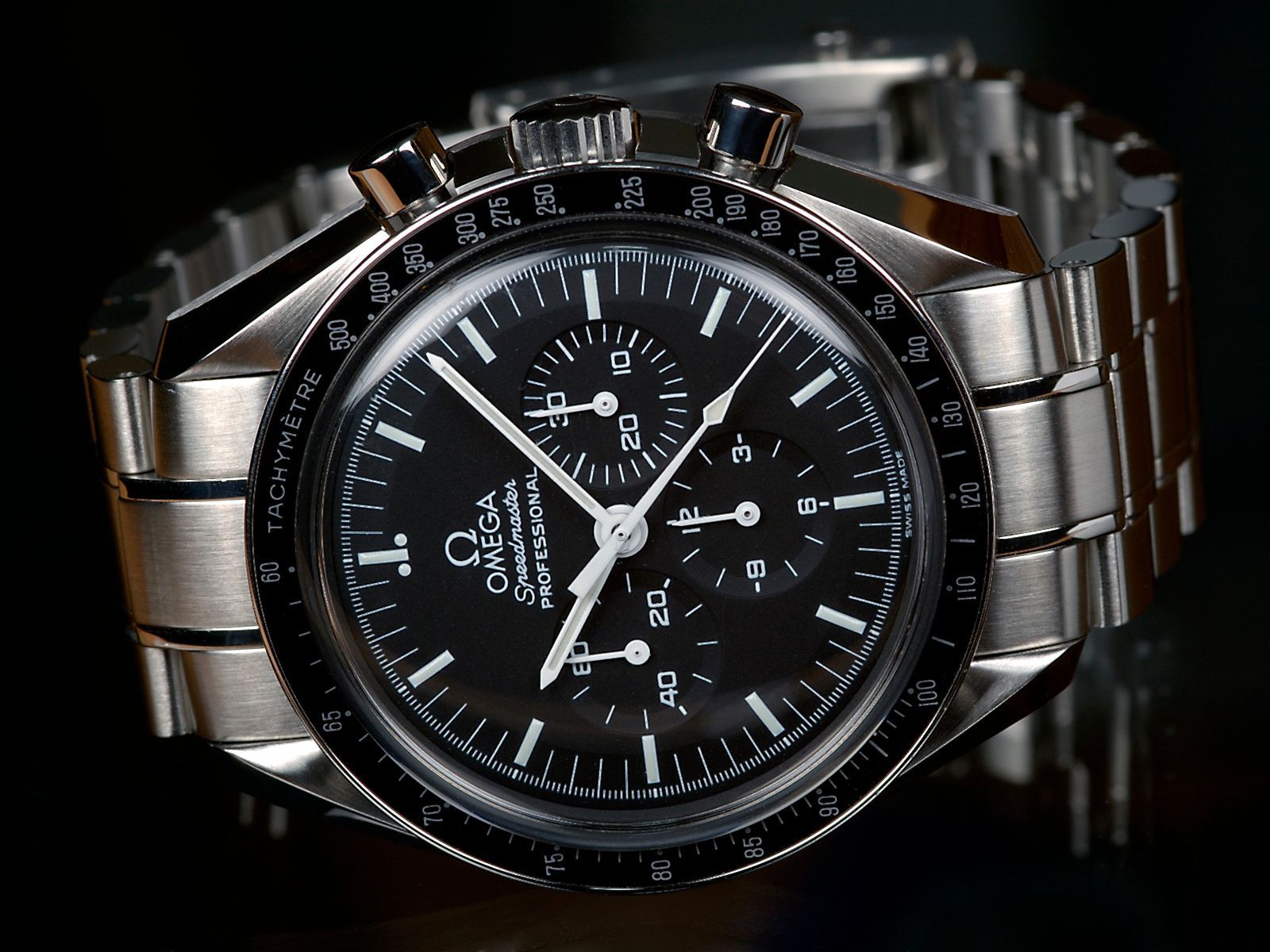
Omega Speedmaster Professional 'Moonwatch' chronograph, front view on steel bracelet
By Zach Charles • October 9, 2026
Find the best watches at every price point from $500 to $15,000 — new and pre-owned. Covers every budget tier with specific reference picks, brand…
By Zach Charles • October 9, 2026
The latest watch news: new releases, Watches and Wonders coverage, discontinuations, industry analysis, and market trends. Currently 1 article.
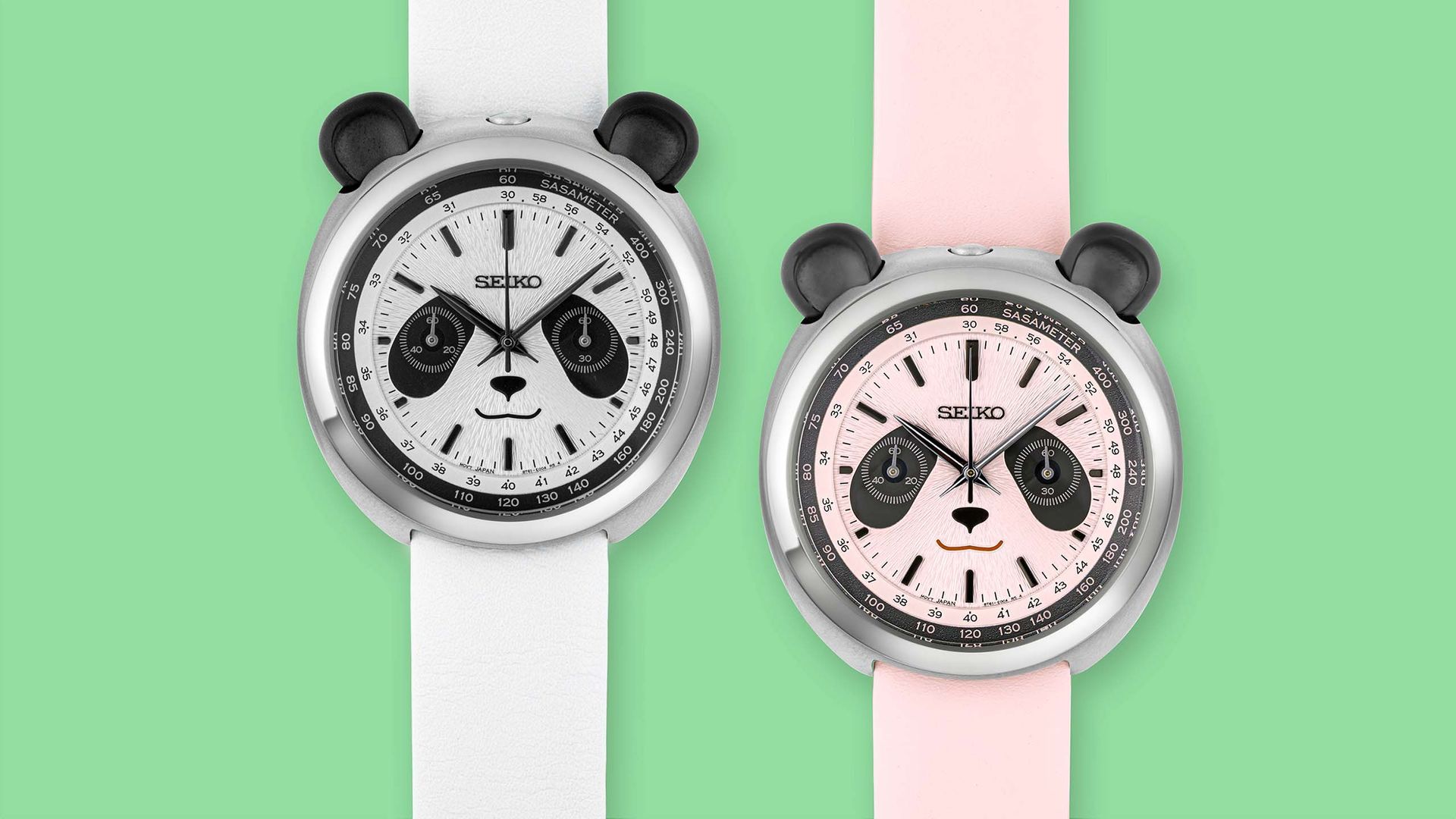
Seiko's New Panda Chronograph Is Literally a Panda: The Power Design Project HHK001 and HHK002
By Zach Charles • October 8, 2026
Seiko's Power Design Project panda chronograph (HHK001, HHK002) turns the panda dial into an actual panda face, with ear pushers, a 'Sasameter' and a 3D…
Show More