The Complete History of the Rolex Air-King
The Complete History of the Rolex Air-King
The Rolex Air-King is one of the oldest names in the Rolex catalogue and one of the most misunderstood. It has been discontinued twice, redesigned radically on its return, and at various points has been positioned as a pilot's watch, an entry-level Rolex, and a professional anti-magnetic instrument. The current Air-King — reference 126900, introduced at Watches & Wonders 2023 — shares almost nothing with the Air-King of 1990 beyond the name. That discontinuity, a model identity that has been reset twice across eight decades, makes the Air-King's history more complex, and considerably more interesting, than its modest reputation in collector circles suggests.
No other Rolex reference in current production has undergone such a fundamental repositioning. The Submariner has always been a diver's watch. The Daytona has always been a chronograph. The Air-King has been a tribute watch, an accessible daily wearer, a deleted reference, a controversial comeback, and now a professional anti-magnetic tool watch — all within the same model name. Understanding what the Air-King is today requires understanding everything it has been.
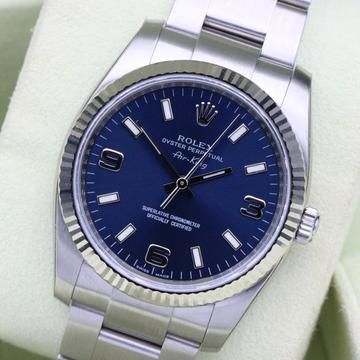
Photo: EMore98 — CC BY-SA 4.0 — Wikimedia Commons
Origins — WWII and the RAF
The Air-King name dates to the 1940s, and its origin is more specific than the generic "pilot's watch" framing often applied to it. During World War II, Rolex founder Hans Wilsdorf — operating from Geneva while Britain prosecuted the air war over Europe — maintained a close relationship with British military procurement. Under the British government's Air Ministry contract programme, Rolex supplied watches to Royal Air Force pilots who required accurate, durable timekeeping for navigation and bombing runs over occupied Europe.
Wilsdorf's gesture went further than simply filling supply contracts. He created a series of watches bearing "Air" names — the Air-King, the Air-Lion, the Air-Tiger, the Air-Giant — as explicit tributes to the courage of RAF pilots during the Battle of Britain in 1940 and the subsequent air campaigns that followed. The names evoked the hierarchy and power of aerial combat. Of the four names Wilsdorf coined, only the Air-King survived into sustained postwar commercial production. The Air-Lion, Air-Tiger, and Air-Giant were discontinued in the late 1940s, their names never appearing on a production Rolex dial again.
The decision to retain the Air-King name specifically — and to abandon the others — reflects how the "king" designation resonated as an enduring mark of distinction rather than a wartime novelty. The name carried weight. Wilsdorf understood branding as well as he understood watchmaking, and the Air-King's name was one of his more considered postwar choices.
The earliest Air-King references from the mid-1940s were 34mm, manually wound, and built on the same case architecture as other Rolex Precision watches of the era — a range of modestly priced, competently made Rolex pieces positioned below the Oyster Perpetual in terms of complication and, accordingly, in price. The Air-King dials of this period bear the model name directly — "Air-King" printed clearly below the Rolex crown — with clean, legible layouts in keeping with the utilitarian wartime and immediate postwar aesthetic. These watches are genuinely rare today, and examples in original condition represent some of the more historically significant pieces in the Rolex vintage market precisely because of their documented wartime connection.
The Reference 5500 Era (1957–1989)
The reference 5500 is the Air-King that most collectors encounter when they explore the vintage Rolex market. Introduced in 1957 and produced continuously until 1989 — a 32-year run — the 5500 is among the longest-produced single Rolex references in the brand's history. Only the Explorer reference 1016, which ran from 1959 to 1989, matches that longevity. For context: the Submariner reference 5512 ran from 1959 to 1979. The Daytona reference 6263 ran from 1969 to 1988. The 5500's production span is genuinely remarkable.
The specification is austere. The 5500 measures 34mm in Oystersteel, with no date complication and no Cyclops lens on the crystal. Early production pieces used the calibre 1520, an automatic movement with a 17-jewel lever escapement and a Glucydur balance wheel; later production transitioned to the calibre 1530. The crystal was acrylic — standard for the era. The Oyster case provides 100 metres of water resistance, and the bracelet options during the 5500's three-decade run evolved with Rolex's broader bracelet portfolio, from the riveted Oyster to the solid-link Oyster configuration of the later production years.
What distinguishes the 5500 as a collector object is its extraordinary dial variety. Over 32 years of production, Rolex produced the 5500 in black, silver, white, blue, salmon, and cream dial configurations, with variations in the treatment of the hour markers — baton indices, Arabic numerals, or combinations thereof — and in the printing style of the model name and subsidiary text. The variety reflects both the Air-King's long production life and Rolex's willingness during this period to offer genuine dial choice within a single reference. Tropical dials — cases where the original black lacquer has oxidised over decades to a rich brown, caramel, or chocolate tone — command particular premiums when they surface at auction.
The 5500's market position today is defined by this dial diversity. Common configurations — straightforward black or silver dials with baton indices — trade at approximately $1,500–$3,000 on Chrono24 (April 2026 data), making the 5500 one of the most accessible vintage Rolex references with an automatic movement and Oyster case. Unusual configurations — tropical dials, salmon dials, particular print styles, or early production examples with distinctive text layouts — can reach $5,000–$8,000 or higher at specialist auction houses including Phillips, Christie's, or Antiquorum.
The 5500 is frequently described as the "forgotten" vintage Rolex — undershadowed by the narrative weight of the Submariner's diving heritage, the Daytona's motorsport connection, and the Explorer's Everest mythology. The Air-King has no equivalent story. It was made because it sold, because it was affordable, and because the name had survived. That absence of mythology is, paradoxically, what makes the 5500 interesting to a specific kind of collector: the buyer who wants a mechanically solid Rolex, in a 34mm case that wears correctly on a range of wrist sizes, at a price that does not demand either a trust fund or an extended wait at an authorised dealer.
The Modern Era — References 14000 and 14010 (1989–2007)
In 1989, Rolex retired the 5500 and introduced its successor — the reference 14000. The transition marked a genuine modernisation. The 14000 retained the 34mm case diameter and the no-date configuration, but replaced the acrylic crystal with sapphire, upgraded the movement to calibre 3000, and refined the case finishing in keeping with Rolex's evolving manufacturing standards of the late 1980s. A companion reference, the 14010, offered a white dial with date complication — a configuration that sits awkwardly in retrospect, since the Air-King's identity had never been date-centric, but which reflected Rolex's practice of offering minor variants within a reference family.
The 14000 occupies a specific, somewhat uncomfortable place in the Rolex catalogue: it was, for most of its production life, the least expensive Oyster Perpetual reference available. This made it the default entry point for buyers who wanted an authentic Rolex automatic with the full Oyster case and the recognisable dial layout, but could not reach the price of the Submariner, Datejust, or Explorer. The collector vocabulary that developed around this era is telling — the 14000 was called the "starter Rolex" or the "gateway Rolex" with consistent regularity in enthusiast forums of the 1990s and early 2000s. This framing was not entirely unfair but it was reductive: the 14000 is a well-made, properly specified Rolex with a sapphire crystal and a competent automatic movement, and its entry-level status said more about Rolex's pricing structure than about the watch's quality.
In approximately 2000, Rolex updated the reference to the 14000M, replacing calibre 3000 with calibre 3130. The 3130 is a meaningfully improved movement — it incorporates a Parachrom hairspring, giving it enhanced resistance to temperature variation and magnetic fields, and its construction represents a refinement of the 3000's architecture rather than a complete redesign. The "M" suffix designation follows Rolex's standard practice of indicating a material or movement upgrade within a continuing reference.
Dial options across the 14000 and 14000M period included black, white, and silver configurations, with variations in text and index treatment. The dials of this era are cleaner and less varied than the 5500's remarkable range — Rolex had rationalised its dial production by the late 1980s — but the execution is precise and the legibility is excellent.
The Air-King reference 14000M was discontinued in 2014. Rolex's official explanation pointed to a simplification of the Oyster Perpetual line; in practical terms, the Air-King had become redundant in a catalogue that increasingly emphasised specialised professional tools rather than entry-level variations on the standard Oyster. The 34mm no-date Air-King was replaced, for buyers who wanted an uncomplicated automatic Rolex, by the standard Oyster Perpetual references. The Air-King name disappeared from the catalogue entirely — for the second time in its history. It would return two years later as an entirely different watch.
Pre-owned examples of the 14000 and 14000M trade in April 2026 at approximately $3,000–$5,000 depending on condition and configuration — above the 5500's floor but below the 116900's pre-owned pricing. These references represent practical, wearable vintage Rolexes with modern sapphire crystals and movements serviced or serviceable at any authorised Rolex centre.
The 2016 Return — Reference 116900
Rolex reintroduced the Air-King at Baselworld 2016 with the reference 116900. It was, by any honest assessment, a complete reinvention. The new Air-King shared the name, the Oyster case architecture, and the general Rolex DNA of its predecessors. Beyond those continuities, it was a different watch entirely — different in diameter, different in dial language, different in movement specification, and different in intended positioning.
The case grew from 34mm to 40mm. This was not a subtle adjustment. The 34mm Air-King had been among the smallest Rolex Oyster references in production. The 40mm 116900 is a full-size contemporary sports watch, identical in case diameter to the contemporary Submariner and Explorer. The 5mm increase in diameter brought the Air-King into the mainstream wearing dimension of modern watch collecting, but it also severed any direct physical continuity with the original Air-Kings that had defined the name for 50 years.
The dial design of the 116900 is unlike any other current production Rolex. The black dial carries large Arabic numerals at 3, 6, and 9 o'clock — not in silver or white, but in a specific yellow-green hue that Rolex developed for this watch. The minute track, which runs as a continuous bold ring around the dial's perimeter, uses the same yellow-green. The hour and minute hands are the standard Mercedes configuration with luminous fill, which creates a deliberate contrast against the yellow-green of the dial elements — the hands read in cool blue-white in darkness, while the Arabic numerals and track read in a warm yellow-green in daylight.
This colour choice is not arbitrary. The yellow-green of the 116900's dial text is a direct reference to aviation instrumentation. Professional cockpit instruments — altimeters, airspeed indicators, turn-and-slip indicators, attitude indicators — historically used high-contrast colour coding optimised for peripheral readability. A pilot's primary instrument scan covers the artificial horizon; secondary instruments are read in peripheral vision. Colour contrast and large, simple graphics are engineered features, not decorative choices. The 116900's dial applies that logic to a wristwatch, producing something that reads immediately from across a room or in a glance at the wrist.
The movement powering the 116900 is calibre 3131. This is a technically significant choice. The 3131 incorporates a Parachrom hairspring — standard in modern Rolex calibres — but it adds a Faraday cage construction around the movement's key components. The cage uses paramagnetic alloys, including aluminium, beryllium, and copper-aluminium combinations, to shield the movement's escapement and balance assembly from external magnetic fields. The specification is 1,000 gauss resistance — the same magnetic protection offered by the Rolex Milgauss reference 116400GV, which at the time of the 116900's introduction remained in production at a significantly higher retail price.
Water resistance on the 116900 is 100 metres, sealed by the Triplock winding crown. The Oyster bracelet uses the standard Oysterclasp with Easylink comfort extension, allowing approximately 5mm of incremental length adjustment without tools — a practical feature that Rolex had been incorporating across its sports references since the early 2000s.
The 116900 was produced from 2016 until 2023. Pre-owned examples in April 2026 trade at approximately $6,000–$8,000 on Chrono24, below the original retail price for most configurations — a rational secondary market entry point for the modern Air-King aesthetic without the full retail commitment to the current generation.
The Current Air-King — Reference 126900 (2023–Present)
Rolex introduced the reference 126900 at Watches & Wonders 2023, the Geneva-based trade event that had replaced Baselworld as the primary showcase for Rolex's annual releases. The 126900 is a direct evolution of the 116900 — the same 40mm case, the same dial language, the same overall character — but with a movement upgrade that materially improves the watch's specification.
The new calibre is the 3230. It replaces the 3131 used in the 116900 and incorporates two significant improvements. First, the Chronergy escapement — Rolex's proprietary lever and escape wheel design, introduced in 2015 and progressively rolled out across the Oyster Perpetual line through the subsequent decade — improves energy efficiency by approximately 15% compared to the conventional Swiss lever escapement geometry. Second, and most relevant for daily use, the power reserve increases from 48 hours on the calibre 3131 to 70 hours on the calibre 3230. A watch left on a nightstand for a long weekend maintains its charge and keeps running — a practical improvement that distinguishes the 126900 from its predecessor for anyone who rotates between multiple watches.
The anti-magnetic protection is maintained at 1,000 gauss. The Faraday cage architecture of the 3131 carries forward into the 3230's design, ensuring the 126900 delivers the same professional environmental protection as the watch it replaces.
The dial of the 126900 continues the visual language established by the 116900: black ground, large yellow-green Arabic numerals at 3, 6, and 9, bold yellow-green minute track. The execution is refined — the finishing quality of current Rolex dials reflects three years of incremental manufacturing improvement between the 116900's final production and the 126900's introduction — and the overall legibility of the layout is if anything more immediate than the first-generation watch. The Mercedes hands, applied Rolex crown at 12, and lume-filled hour markers complete a dial that remains the most distinctive in the current Rolex sports catalogue.
Current retail price for the reference 126900 in April 2026 is approximately $7,050 — positioning it as one of the more accessible current-production Rolex sports watches, below the Submariner No Date (reference 124060, approximately $9,100) and the Explorer 36mm (reference 124270, approximately $6,550). Secondary market pricing for the 126900 sits at or slightly below retail for most configurations, with a modest premium for box-and-papers examples in unworn or near-mint condition. There is no significant waiting list premium at most authorised dealers — the Air-King is among the more available current Rolex models, which reflects both its production volume and the continued divisiveness of its dial design.
The Dial — Aviation Instrument Aesthetic
The dial of the reference 116900 and 126900 demands specific attention because it is the defining element of the modern Air-King's character — and because understanding its design logic is essential to understanding why this watch polarises opinion in a way that few other current production Rolex references do.
The black ground is standard for a professional tool watch. Rolex uses matte black on the Air-King rather than the more polished black seen on some Datejust variants — this is a functional choice, reducing reflective glare in bright conditions. The large Arabic numerals at 3, 6, and 9 o'clock are applied at a size substantially larger than the hour markers found on any other current Rolex, including the Explorer, Submariner, and Milgauss. The yellow-green hue is precisely calibrated — not the pure, saturated yellow of a generic racing watch, and not the cool green of the green-dial Submariner or the green sapphire Milgauss. It sits at a spectral point that maximises contrast against the black background while reading as warm rather than acidic under interior lighting.
The minute track — which forms a continuous bold yellow-green ring with individual marks for each minute increment — is the element that most divides collectors. On conventional Rolex sports dials, the minute track sits at a size consistent with the overall dial architecture and does not dominate the visual composition. On the Air-King, the minute track is large enough to be a primary visual element in its own right. This is a deliberate choice, drawing from the instrument panel logic already discussed: in professional aviation contexts, time readability is a functional requirement, not an aesthetic preference. Every design decision on the Air-King dial is about immediate, unambiguous legibility.
The visual effect is unusual in the context of Rolex's current catalogue. Beside a Submariner 126610LN or an Explorer 124270, the Air-King reads as deliberately, almost aggressively graphic — its dial makes its intentions plain in a way that conventional Rolex sports dials do not. Those who find this unacceptable have no shortage of alternatives within the Rolex sports range. Those who respond to its directness tend to find the Air-King uniquely satisfying among current Rolex offerings — a watch that doesn't politely recede into the background.
The closest functional parallel in the broader world of precision instruments is a cockpit altimeter or an airspeed indicator from a light aircraft — instruments designed with the same large-numeral, high-contrast, large-track philosophy, where reading the instrument must be possible in a fraction of a second under workload. The Air-King is the only current Rolex whose dial design you could plausibly argue was inspired more by instrument engineering than by watch design history.
Anti-Magnetic Protection — Why It Matters
The Air-King's 1,000-gauss anti-magnetic protection is not a marketing claim. It is a functional specification with real-world relevance that distinguishes the 126900 from the majority of the Rolex sports catalogue — and from most Swiss mechanical watches at any price point.
Modern daily life exposes mechanical watches to magnetic fields from sources that did not exist in the era when most watchmaking standards were developed. Smartphones generate fields of approximately 20–40 gauss in normal use. Laptop computers, particularly near their charging ports or hard drive housings, generate similar levels. Airport security wands — the handheld metal detectors used for secondary screening — generate approximately 100–150 gauss. Inductive charging pads used for wireless device charging can generate local fields of 300 gauss or higher. Medical imaging environments present the extreme case: MRI machines operate at 15,000–60,000 gauss, levels that are destructive to any conventional mechanical movement and beyond the specification of any current production wristwatch, including the Air-King.
The practical damage that magnetic exposure causes in a conventional mechanical movement is hairspring magnetisation. The hairspring — a flat coil of metal that governs the oscillation rate of the balance wheel and thereby controls the watch's timekeeping — is typically made of a metal alloy with carefully calibrated elastic properties. When exposed to a sustained magnetic field, the hairspring's coils can magnetise, causing adjacent coils to attract or repel each other. The result is a change in the effective length of the hairspring, which alters the oscillation rate of the balance — typically causing the watch to gain significant time, often several minutes per day.
The Air-King's protection mechanism is a Faraday cage integrated around the movement's escapement and balance assembly. The cage is constructed from paramagnetic alloys — materials that do not hold a magnetic charge and therefore do not concentrate or transmit external magnetic fields onto the components they surround. Aluminium, beryllium, and copper-aluminium alloys serve this function. The cage does not affect the watch's external appearance, winding, or regulation. It is invisible from outside the case and transparent to the watch's normal operation. What it does is reduce the magnetic field reaching the hairspring and balance to levels where magnetisation cannot occur.
At 1,000 gauss, the Air-King's protection covers every magnetic field source a working professional is likely to encounter outside of a medical imaging suite or an industrial magnetic separator. For the vast majority of wearers — including those who work in technology environments, travel regularly through airport security, or carry multiple electronic devices — the Air-King's anti-magnetic specification means the watch runs accurately without the periodic demagnetisation service that a conventional mechanical watch may require.
This is the Air-King's professional credential. It is not an entry-level Rolex with an interesting dial. It is a watch with a specific, documented capability that the Datejust, Submariner, GMT-Master II, and Explorer do not offer at their respective price points. The Milgauss offered the same specification — but the Milgauss is no longer in production.
Air-King vs. Milgauss — The Anti-Magnetic Comparison
The discontinuation of the Rolex Milgauss reference 116400GV in 2023 — announced in the same year the Air-King 126900 was introduced — is the defining context for understanding the current Air-King's role in the Rolex catalogue.
| Criterion | Rolex Air-King (126900) | Rolex Milgauss (116400GV) |
|---|---|---|
| Case diameter | 40mm | 40mm |
| Anti-magnetic protection | 1,000 gauss (Faraday cage) | 1,000 gauss (Faraday cage) |
| Date | No | No |
| Crystal | Sapphire | Green sapphire (GV) or clear |
| Movement | Calibre 3230 | Calibre 3131 |
| Power reserve | 70 hours | 48 hours |
| Dial style | Black, yellow-green numerals | Black, white, or "Z-Blue" |
| Current production | Yes | No (discontinued 2023) |
| Current retail | ~$7,050 | N/A |
| Secondary market | At or near retail | $8,000–$15,000 pre-owned |
The Milgauss was introduced in 1956 and revised over several generations — references 6541, 1019, and finally the modern 116400 and 116400GV — as a specialist watch for scientists and engineers working in environments with elevated magnetic field exposure, originally at the CERN particle physics laboratory near Geneva. Its lightning-bolt seconds hand, green-tinted sapphire crystal (on the GV variant), and distinctive orange-accented dials gave it a visual identity that the Air-King does not replicate. Collectors who valued the Milgauss for its aesthetic — particularly the green sapphire and Z-Blue dial combination — will not find a direct substitute in the 126900.
What they will find is every specification that mattered technically. The 1,000-gauss Faraday cage protection is identical. The 40mm Oystersteel case is the same diameter. The lack of date complication is the same. The Oyster bracelet with Easylink is the same. The 126900's calibre 3230 improves on the Milgauss's calibre 3131 with the Chronergy escapement and the 22-hour power reserve increase. In every measurable functional dimension, the Air-King 126900 equals or exceeds the discontinued Milgauss.
The Milgauss's pre-owned prices — $8,000–$15,000 in April 2026, with premium for the green-sapphire GV variants and the Z-Blue dial configurations — now sit significantly above the Air-King's $7,050 retail. For a buyer who wanted the Milgauss for its anti-magnetic specification rather than its visual identity, the Air-King 126900 is the rational current answer: lower price, better movement, currently in production with full warranty and authorised service access.
Vintage Air-King Collecting
The vintage Air-King market is genuinely accessible by vintage Rolex standards — a statement that deserves unpacking given how distorted the broader vintage Rolex market has become over the past decade.
The reference 5500 is the benchmark vintage Air-King. Its 32-year production run created a substantial number of surviving examples, which exerts downward pressure on prices relative to shorter-run references. Its mechanical specification — calibre 1520 or 1530 automatic, Oyster case, no complications — is straightforward to service and free of the exotic parts that make some vintage Rolex references expensive to maintain. And the absence of a compelling secondary narrative (no Everest, no Le Mans, no CERN) means the 5500 has not attracted the speculative premium that has driven Submariner and Daytona prices into five and six figures.
The result is a reference that trades on merit and condition rather than mythology. Common configurations — black dial with baton indices, silver dial with Arabic numerals — in good unpolished condition with an original bracelet trade at $1,500–$3,000 on Chrono24 and at specialist vintage dealers (April 2026). This is genuinely reasonable money for a 34mm automatic Rolex with an Oyster case, a sapphire-equivalent level of durability in its original acrylic form, and the mechanical robustness that Rolex's movements of that era are rightly known for.
Unusual 5500 configurations command meaningful premiums. Tropical dials — where the original lacquer has oxidised over decades to brown or chocolate tones, a process driven by UV exposure and humidity over the watch's lifetime — are rare and visually arresting; examples with strong, even tropical colouration and unpolished cases can reach $5,000–$8,000 at specialist auction. Salmon dials, while not as dramatically transformed as tropical pieces, carry their own collector premium. Early production examples with unusual text configurations — variations in the printing of "Air-King" and the associated subsidiary text — attract interest from reference specialists who track dial printing history across the 5500's three-decade run.
The condition hierarchy for the 5500 follows standard vintage Rolex convention, with particular weight placed on case preservation. A polished 5500 — one where the original sharp case edges have been rounded by successive polishing during service — trades at a significant discount to an unpolished example with intact edge geometry. This is consistent across all vintage Rolex collecting but is especially pronounced with the 5500, where the slim profit margins of more common configurations make polishing status a decisive pricing factor rather than a minor adjustment.
The 14000 and 14000M era watches are a different collecting proposition — practical, wearable, genuinely modern Rolexes with sapphire crystals and movements that can be serviced at any Rolex authorised service centre. At $3,000–$5,000 pre-owned, they offer the full Rolex ownership experience at a price substantially below new, and their modern specification means they lack the maintenance risk associated with acrylic-crystal vintage pieces. They are not particularly interesting as collector objects — their production volume was substantial and their dial variety limited — but as everyday watches they are among the most sensible purchases in the pre-owned Rolex market.
The reference 116900 — the first-generation modern Air-King from 2016–2023 — is the most contested segment. At $6,000–$8,000 pre-owned, it sits just below the retail price of the current 126900 for most configurations, which creates a rational choice between the two: the 116900 is available now without any dealer relationship or waiting, carries no warranty, and runs on calibre 3131 with its 48-hour power reserve; the 126900 at retail provides the full warranty, calibre 3230's 70-hour reserve, and current production support. For a buyer who intends to wear the watch rather than store it, the $1,000–$2,000 gap toward the current reference is easily justified. For a buyer primarily interested in the 116900's design — which is effectively identical to the 126900's — the pre-owned route remains logical.
The Air-King's Place in the Modern Rolex Catalogue
The current Rolex sports catalogue — Submariner, Sea-Dweller, GMT-Master II, Explorer, Daytona, Yacht-Master, Milgauss — has a clear internal logic. Each reference serves a professional function defined by its complication set and case specification: the Submariner for diving, the Sea-Dweller for saturation diving, the GMT-Master II for transmeridian travel, the Daytona for motorsport timing. The Air-King, with no external bezel, no complication, and no depth rating beyond 100 metres, appears at first glance to lack this professional anchor.
The 1,000-gauss anti-magnetic specification is that anchor. It is the Air-King's version of the Submariner's 300-metre depth rating — a professional environmental protection that the watch is built around and that distinguishes it from the general-purpose Oyster Perpetual references. The difference is that magnetic field protection is invisible, intangible, and requires explanation, whereas depth rating is immediately communicable: 300 metres means something to a non-watch-person. 1,000 gauss requires a sentence of context.
That communication challenge has always limited the Air-King's appeal relative to its technical peers. The Submariner's depth-rated bezel is visible from twenty feet away. The Air-King's Faraday cage is invisible from zero feet. Wearing it does not signal its capability. This is either a disadvantage or, depending on your perspective, a feature: the Air-King is a professional instrument that requires knowing what it does to appreciate what it is. It rewards the informed owner.
In the context of the current catalogue — with the Milgauss discontinued, the standard Oyster Perpetual references covering the no-complication segment at lower prices, and the established professional references commanding substantially higher retail prices — the Air-King occupies a logical position as the entry point to the professional sports range. At $7,050, it is less expensive than every other current sports Rolex except the Explorer 36mm, and it offers a functional professional specification — anti-magnetic protection — that the Explorer does not. The dial design, divisive as it is, ensures that the watch has a character appropriate to its specification.
Closing
The Air-King's history is a study in identity evolution. It began as a WWII tribute name — one of four, and the only one that survived. It became an entry-level daily wear, the Rolex you bought when you couldn't yet afford the Submariner. It was discontinued in 2014, its reference family absorbed into the rationalised Oyster Perpetual line. It returned in 2016 as something completely different — larger, bolder, more purposeful, with a specification that directly addressed a gap left by the Milgauss's eventual disappearance. And in 2023, it was upgraded again to carry the Chronergy escapement and 70-hour power reserve of Rolex's current movement generation.
Each iteration answered a different question. The original Air-Kings answered: what do you make for the pilots who won the Battle of Britain? The reference 5500 answered: what's the entry point into automatic Rolex ownership? The reference 116900 answered: who replaces the Milgauss buyer when anti-magnetic protection matters at an accessible price? The reference 126900 answers the question the 116900 posed, with a better movement and the same distinctive character.
The current Air-King is not for everyone — no watch with that dial could be — but it is a watch that knows exactly what it is: visually distinctive, mechanically capable, carrying a professional credential that most watches at its price do not offer, and available at a retail price that does not require either a waitlist or a compromise on specification. In a catalogue full of watches that justify their prices through mythology, the Air-King justifies its price through engineering.
Related Articles
Anti-Magnetic Pair
Professional Collection
The Foundation
Recent Posts