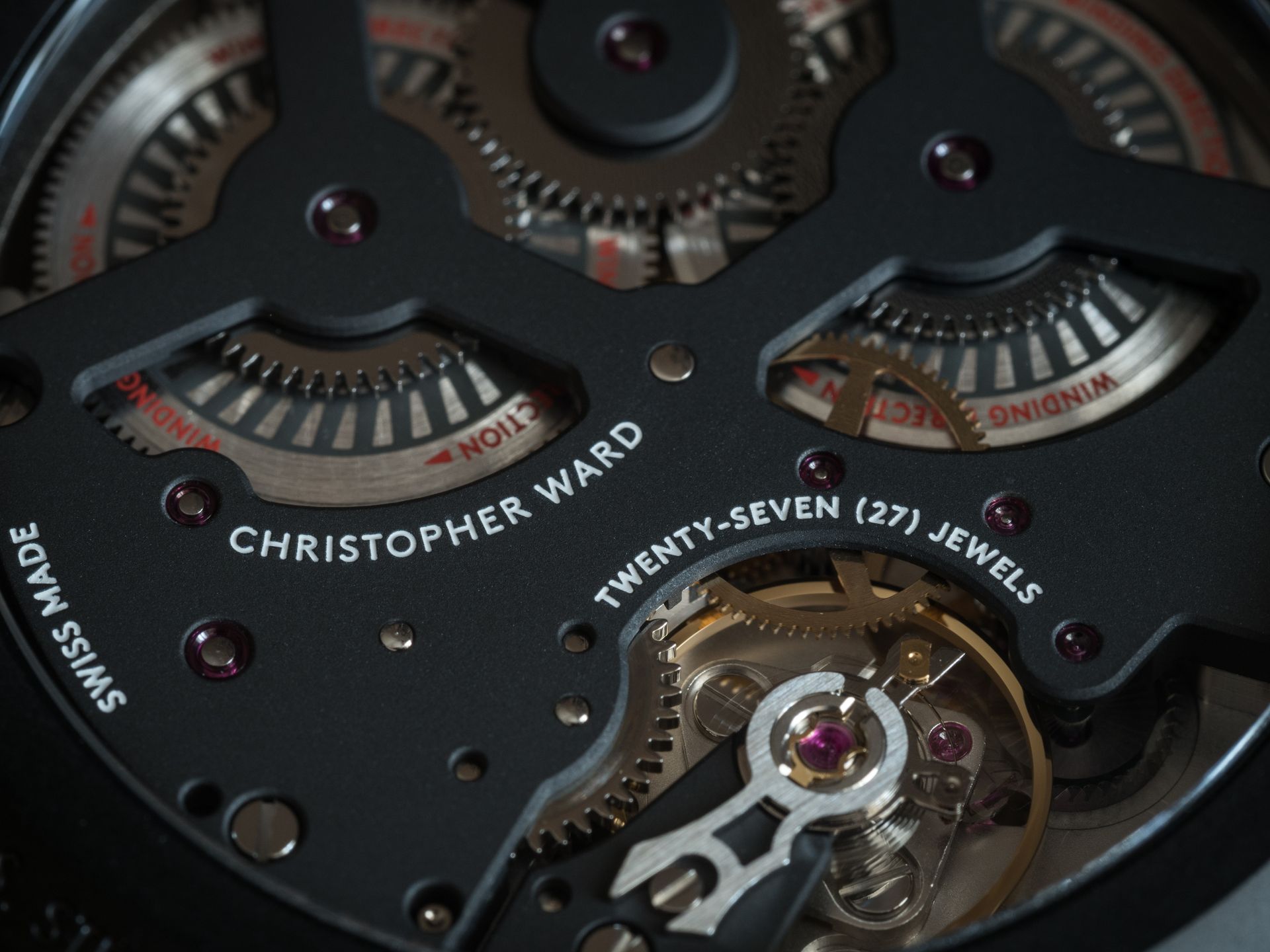
Christopher Ward Calibre SH21: The In-House Bidirectional Jumping Hours Movement
The Calibre SH21 is Christopher Ward's most significant technical achievement — an in-house co-developed automatic movement that demonstrates the brand's capabilities extend beyond case design and value positioning into genuine watchmaking. Its bidirectional jumping hours display, five-day power reserve, and silicon balance spring place it in technical territory that Swiss manufacture movements costing four to five times more typically occupy.
Development — Synergies Horlogères Partnership
The SH21 was developed in collaboration with Synergies Horlogères — the Swiss watchmaking manufacture in Fleurier founded by independent watchmaker Peter Speake-Marin . Speake-Marin's reputation in the independent watchmaking community (he had founded Speake-Marin before establishing Synergies Horlogères as a contract manufacture for brands) gave the collaboration horological credibility.
The SH designation references Synergies Horlogères ; the 21 references the movement's specification goals during development. The collaboration was Christopher Ward's first genuine co-development project rather than a standard movement supply arrangement.
Development timeline: approximately four years from initial brief to commercial introduction, with iterative prototype testing and specification refinement throughout. The movement was introduced in 2017 in the C60 Trident Pro Concept — the brand's flagship dive watch case.
Bidirectional Jumping Hours — The Mechanism
Photo: Daniel Zimmermann — CC BY 2.0 — Wikimedia Commons
The SH21's most distinctive feature is its bidirectional jumping hours display — an hours hand or disc that does not rotate continuously but advances instantaneously (jumps) at each hour mark.
In a conventional watch, the hours hand rotates continuously: at 12:59, the hour hand is almost at the 1 position; at 1:00, it is exactly at 1. In a jumping hours watch, the hour hand or digit stays precisely at 12 until the instant of 1:00, then instantly jumps to 1 — providing clearer hour legibility and a more dramatic mechanical event.
Bidirectional jumping hours adds the ability to set the hours both forward and backward without damaging the jumping mechanism — a practical feature for time zone changes that unidirectional jumping hours mechanisms cannot offer without risk of damage.
The mechanism requires a stored-energy system: as the minutes approach 60, a spring is loaded with increasing tension. At the hour mark, the accumulated energy is released suddenly, driving the hours display to its new position in a fraction of a second. The spring must be precisely calibrated: too weak and the jump is sluggish; too strong and the mechanism is subject to excessive stress over its lifetime.
SH21 Specifications
| Specification | Detail |
|---|---|
| Display | Bidirectional jumping hours + minutes hand |
| Power reserve | 5 days (120 hours) |
| Frequency | 28,800 vph |
| Balance spring | Silicon |
| Jewels | 29 |
| Winding | Automatic (micro-rotor) |
| Height | Approximately 5mm |
Five-day power reserve: Achieved through an extended mainspring in a single barrel, taking advantage of the micro-rotor's thin profile to allow a taller barrel within the same case depth. Five days of reserve eliminates the need to wind the watch on weekends for most users — a practical benefit proportional to the extended reserve duration.
Silicon balance spring: The Nivarox alloy used in conventional balance springs is slightly affected by magnetic fields — not enough to cause failure, but enough to affect precision in strong magnetic environments. Silicon is non-magnetic, dimensionally stable across temperature ranges, and self-lubricating at the hairspring-stud interface. Silicon balance springs are used in several premium Swiss manufacture movements (Breguet, Rolex, Omega) at much higher price points.
Micro-rotor: A winding rotor embedded within the movement's plane rather than rotating above it — keeping the total movement height lower. The micro-rotor must be made from a dense material (tungsten or platinum in the SH21) to provide adequate winding mass within its smaller diameter.
Watches Using the SH21
The SH21 appears across Christopher Ward's range, applied to different contexts:
C60 Trident Pro Concept: The debut application — jumping hours in a 300m dive watch case. The combination of the SH21's modern complication with a serious dive watch specification is unusual and deliberate: Christopher Ward was demonstrating that in-house movement development and sport watch functionality could coexist.
C65 Trident Concept: The vintage-styled case with the SH21's jumping hours — the same movement in a visually quite different context.
C1 Bel Canto: The SH21 as a platform for the minute repeater development (the most complex application of the Synergies Horlogères relationship).
SH21 Versus the Market
Photo: Daniel Zimmermann — CC BY 2.0 — Wikimedia Commons
The SH21 with jumping hours, five-day reserve, and silicon balance spring, in a Swiss-made watch, retails in Christopher Ward watches at £1,800–2,500 . Comparable combinations of these three specifications in Swiss manufacture movements typically appear in watches priced at £8,000–20,000.
This price differential is the SH21's commercial argument: Christopher Ward's direct-to-consumer model and manufacturing partnership eliminate the retail margin and brand premium that inflate prices for equivalent Swiss manufacture competitors. The SH21 is the most direct expression of the founding premise — that a genuine value gap existed in the market, and that closing it required investment in genuine technical capability.